Amazon Late Delivery Refund Eligibility and How to Claim It
Most late deliveries qualify for refunds only if you claim them within 90 days.

Amazon's late delivery guarantee is a real, enforceable refund policy, and most shoppers who qualify for it walk away with nothing. The eligibility rules aren't buried in some fine-print maze; the real issue is that nobody tells you the guarantee runs on entirely different terms than the delivery estimate you've trained yourself to ignore.
Here's the distinction that actually matters: an estimated delivery window is a guess, while a guaranteed delivery date is a promise. Only the promise creates refund eligibility. You'll see it on the product detail page, again at checkout, then confirmed in your order confirmation email. Save that email, since it's your proof when you file a claim later, and without it you're arguing from memory against a company that logs everything.
At checkout, there's also an "Order Within" countdown. That countdown locks in your guaranteed date, and missing it kills the guarantee entirely, even if the product page still shows a delivery estimate sitting right next to the buy button. This coverage also excludes third-party marketplace sellers, since they set their own refund terms and Amazon's guarantee stops at the edge of its own fulfillment network. That boundary doesn't bend, and pretending otherwise is how people waste an hour arguing with the wrong party.
The specific conditions that make a late order eligible for compensation
"Late" on its own means nothing to Amazon's system. The package has to arrive more than 24 hours past the guaranteed date, and twenty hours late doesn't count, no matter how annoying the wait felt or how many times you refreshed the tracking page.
A few things void eligibility even when the date gets missed, and most people never check for them before filing. Severe weather, natural disasters, and labor strikes count as uncontrollable circumstances, and Amazon won't pay out when tracking flags one of these as the cause. The shipping method you picked at checkout also has to match what the product page advertised; a mismatch breaks the guarantee outright. And some rural or remote addresses fall outside guaranteed-date coverage altogether, no matter what shipping speed you paid for.
Most people assume Prime status decides whether they're eligible in the first place, but Prime membership changes what you can get after that point, not whether you qualify to begin with. Both Prime and non-Prime customers qualify for shipping fee refunds; Prime members just get a wider menu of compensation past that floor.
Four things disqualify a claim outright:
- The order was placed after the countdown timer expired
- A third-party seller fulfilled it, not Amazon
- The delivery missed the deadline by less than 24 hours
- Tracking shows a weather or force-majeure notation
What Amazon actually pays out when a guaranteed date is missed
There's no fixed payout table, and that's by design, not an oversight. Amazon calculates compensation based on how bad the delay was, what the order was worth, and your account history. Two people with nearly identical delays can walk away with different outcomes, and that's just how the system works.
The menu includes a shipping fee refund (the baseline, open to Prime and non-Prime alike), promotional credits that vary case by case, partial refunds on the order, and occasionally a full refund where you keep the item outright.
The old advice that a late delivery automatically nets you a free month of Prime is outdated, and clinging to it just sets you up to be disappointed. Any Prime membership extension is discretionary, not owed. Treat it as a possible bonus, never the baseline.
Filing takes about ten minutes, and skipping that step is the actual mistake most people make. According to ParcelPath, 65% of customers received some form of compensation ranging from small credits to free Prime membership extensions, which also means a substantial share walked away with nothing. That gap is exactly why the escalation process below exists, and stopping at the first no is how you end up in that empty-handed third.
How to file the claim: the exact sequence from Your Orders to confirmed refund
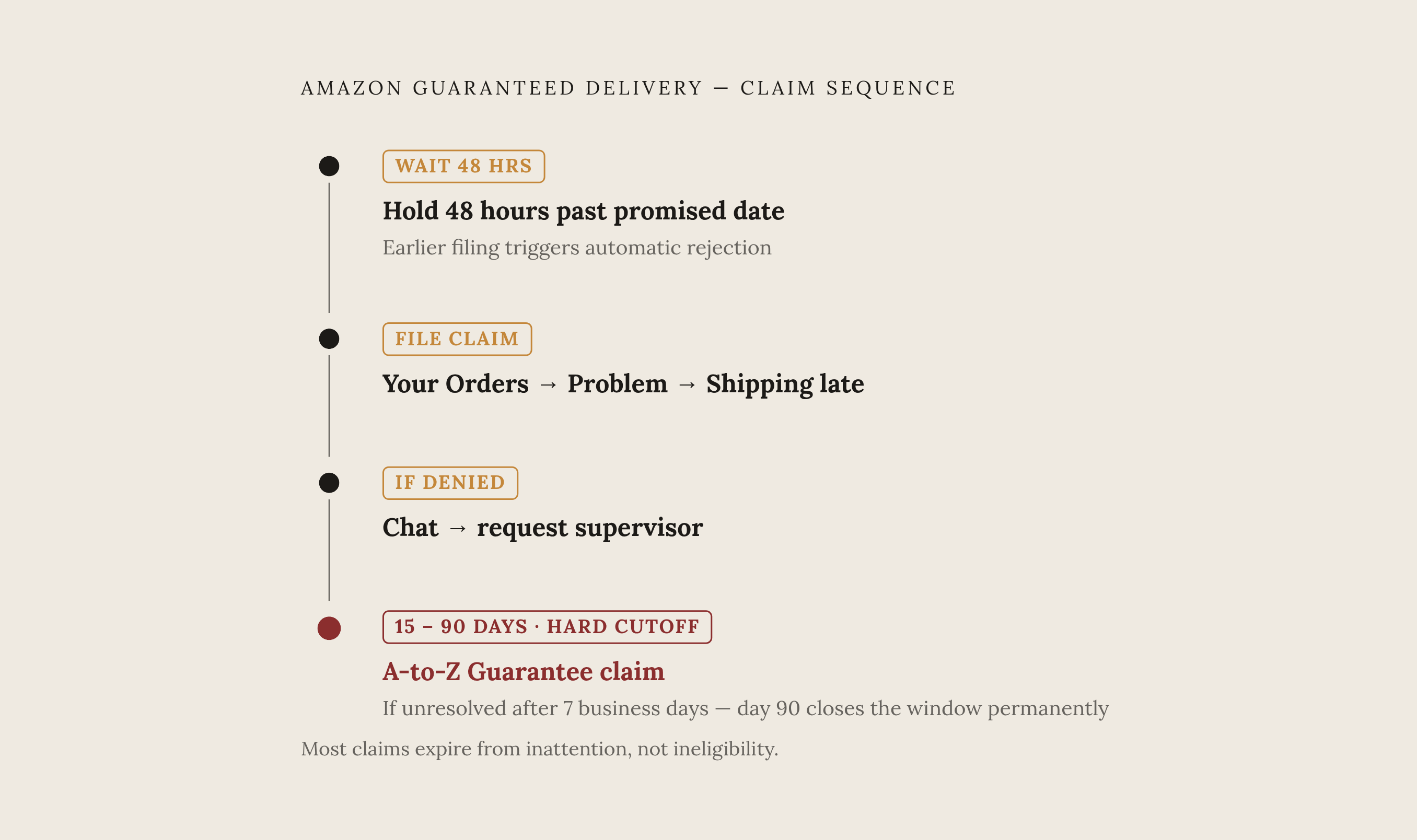
Wait 48 hours past the promised delivery date before filing anything, since Amazon's systems need that window to log the package as officially undelivered. File too early and you'll get an automatic rejection, because the order still shows as in transit.
Once that window passes, the path is short:
- Go to Your Orders and select the late order
- Choose "Problem with an order"
- Select "Shipping or delivery issues"
- Select "Shipment is late"
Amazon doesn't proactively refund most late deliveries, so the claim has to start with you. The one exception is Prime Express and Same-Day delivery failures, which trigger an automated refund because the contractual window there is tightest. Some Prime members with guaranteed delivery failures also get proactive outreach from Amazon's retention team, but treat that as a bonus, not something to plan around.
Roughly 40% of standard claims get approved instantly through this flow, and when that happens, the refund or credit lands within one to two business days. A denial, or an attempt to redirect you to the third-party seller instead, isn't the end of the road; it just means you escalate.
What to do when the standard claim is denied
Don't take a denial from the automated flow at face value, since the bots that handle the first pass aren't the last word here. Open Amazon's Customer Service chat and ask directly to escalate to a supervisor.
State your case plainly: the guaranteed delivery date shown at checkout, the actual date the package showed up, and the policy that covers it. Skip the frustration and the emotional appeal; the facts alone carry the claim, and padding it with how annoyed you are just slows the person reading it down.
If Customer Service hasn't resolved things within seven business days, move to an A-to-Z Guarantee claim. A-to-Z runs on a completely separate team from Customer Service, so you're getting a fresh set of eyes instead of the same decision rubber-stamped twice.
Timing here is strict, with no flexibility on either end. You can file an A-to-Z claim between 15 and 90 days after the order date. The 15-day floor gives the seller a chance to resolve things first, while the 90-day ceiling is a hard cutoff, and missing it closes the window for good. Cases with a clearly missed and documented guaranteed date see high approval rates, though nothing here comes with a guarantee attached.
If A-to-Z still comes back denied, there's one more lever: a chargeback through your credit card issuer. Most issuers give you 60 to 120 days from the original charge, though that range shifts by issuer, so check your card's specific terms before assuming you're covered. File under "goods or services not received," a category most issuers side with the cardholder on. This is a legitimate last step, and it belongs after you've run the Amazon process, not instead of it.
Why most eligible shoppers never collect what they're owed
Amazon doesn't put this guarantee front and center, and that's the real reason most people miss it. It lives inside the Help system where you have to already know to look, and almost nobody does. A policy nobody reads is a policy that costs less to honor.
Timing kills the rest. The 90-day A-to-Z window and the card issuer's chargeback deadline are both hard constraints, and inattention, not ineligibility, is the single biggest reason claims expire unclaimed. Most shoppers see a late package, shrug it off as a minor inconvenience, and move on with their day. What they're missing is that a guaranteed date is an obligation Amazon put on itself, and failing to meet it creates a real claim worth pursuing, beyond just a reason to grumble.
Go back to that figure: the share who received nothing is significant, and that's not a sign they were ineligible. It's far more likely they hit the first denial and stopped, which is precisely the failure point the escalation path exists to fix.
This pattern isn't unique to Amazon. Price-drop refund windows, billing errors, delivery guarantees: these rights sit on paper for nearly everyone who qualifies, and most people never touch them. What separates the shoppers who collect from the ones who don't comes down to whether someone tracked the deadline, and that's a job most people don't have the patience to do reliably on their own.