Instacart and DoorDash Late Delivery Credit Policies Compared
Instacart's automatic refund process beats DoorDash's case-by-case judgment calls.
Instacart and DoorDash both say they'll make a late delivery right, but the paths that promise takes on each platform are built differently, and that difference decides whether a customer actually sees money back. Instacart runs a self-serve system: the customer opens the app, reports the problem, and picks the fix, with no support agent standing between the complaint and the credit. DoorDash runs on discretion: there's no published formula tying a late order to a set refund, so a support agent weighs the case and decides what happens. An Instacart customer who knows the steps can file a claim every time an order is late, while a DoorDash customer is at the mercy of whoever reads the ticket and how that person reads the customer's own refund history.
How Instacart's self-serve claim system works, step by step
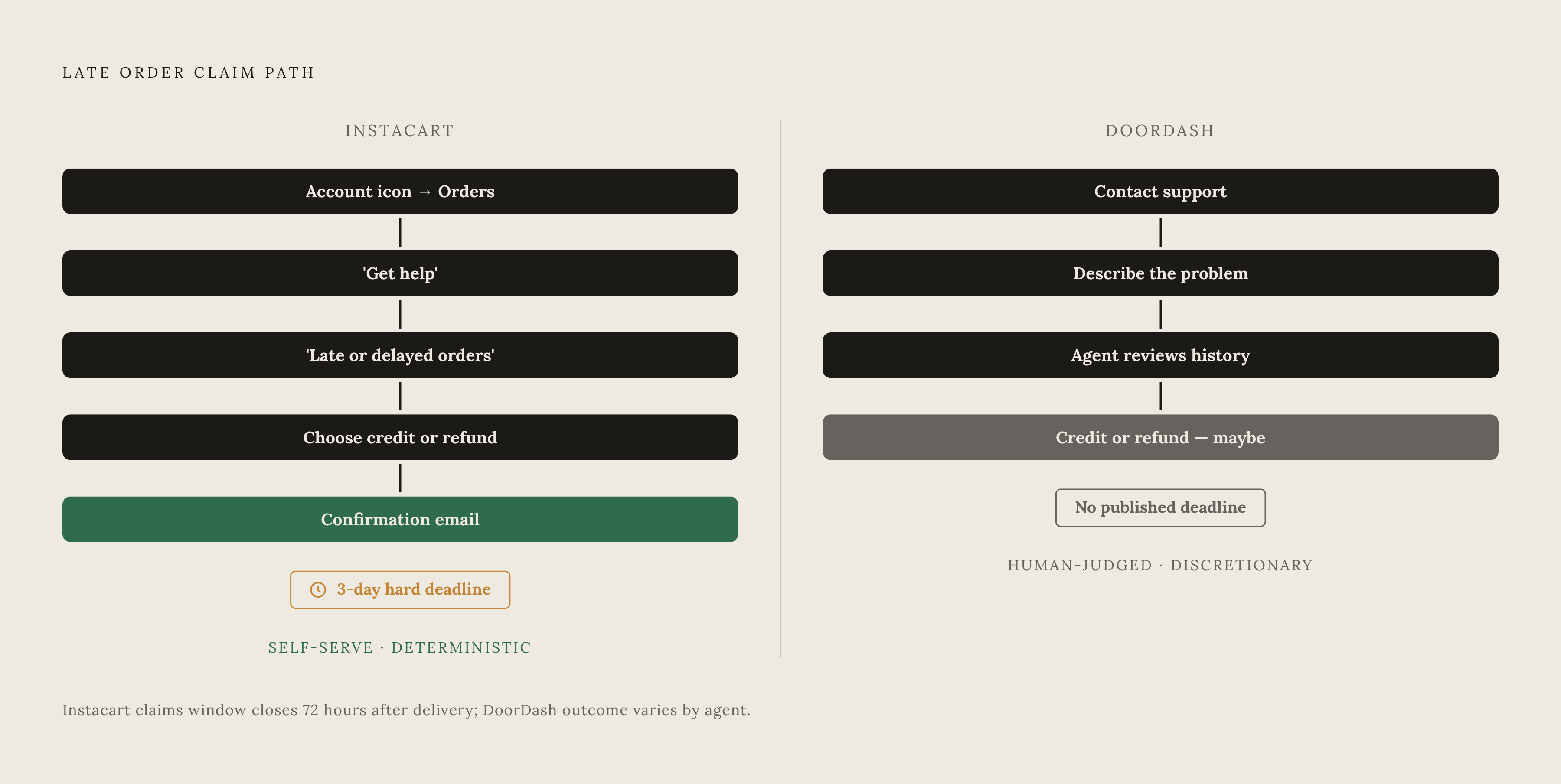
Instacart built its late-delivery claim as a process a customer can finish start to finish, without ever talking to a human, as long as it's done within three days of pickup or delivery. That three-day window covers every kind of order issue, not just lateness, and Instacart's help center states it directly: customers get up to three days after pickup or delivery to report a problem themselves. Once those three days pass, the self-serve door closes, though Instacart does offer an order issue appeal form for customers who miss the window and still want to make a case.
The in-app version of this process runs through a short, fixed sequence. Open the app, tap the account icon, go to Orders, and choose "Get help" on the order in question. From there, select the issue (in this case, late or delayed delivery), choose the specific items affected if the issue is item-related, and pick the resolution to request. A "Help center" option sits inside that same flow for anyone who wants a person instead of a form. The web version mirrors this almost step for step: go to instacart.com, click the three horizontal lines in the upper left corner, open "Your orders," and select "Report a problem" on the relevant order. From there, pick the issue, pick the affected items if needed, and choose a resolution. Both the app and the website versions are laid out this way in Instacart's own help documentation, so a customer on either platform follows the same logic.
Once the claim goes in, Instacart sends an email confirming any credit or refund that gets applied. Instacart states that refunds get processed right away on its end, though how fast the money actually appears in the customer's account still depends on the customer's bank. A handful of restrictions shape what a customer can actually recover. Credits can't be used to cover alcohol, prescriptions, restaurant orders, Instacart+ membership fees, service fees, taxes, or tips, so a credit doesn't always make a customer whole on everything they paid. EBT SNAP orders don't qualify for credit. Only a refund is available, and that refund has to be requested by contacting Instacart's Customer Experience team directly, since the retailer has no ability to process it. Orders paid through PayPal or Klarna get refunded straight to those accounts. Any issue with that refund has to be taken up with PayPal or Klarna, not Instacart. For certain high-value or certified-delivery items, Instacart also allows an in-store return at eligible retailers, using the digital receipt from the app, instead of a credit or refund through the platform.
DoorDash's discretionary claims process
DoorDash has no published rule that turns a late delivery into an automatic credit. Whatever a customer gets back depends on a support agent's judgment call, and on whether DoorDash's internal systems have already flagged that account as a frequent refund requester. That single fact shapes everything else about filing a claim on DoorDash: there's no fixed sequence of screens to tap through, no three-day countdown printed anywhere, and no guaranteed outcome tied to how late the order actually was.
What a customer can count on is a choice between two forms of resolution once a claim is approved: account credit or a refund back to the original payment method. Credit tends to post faster, while a cash refund to a bank or card takes longer to clear. DoorDash credits also come with a shelf life. They generally expire six months after they're issued, can't be redeemed for cash, and can disappear early if the account tied to them gets deactivated. For a customer weighing which option to pick, that expiration date is worth factoring in before accepting a credit over a refund.
The discretionary structure cuts both ways depending on the customer's history. DoorDash reserves the right to turn down a refund request outright, and it tends to exercise that right when an account has filed a high number of prior claims. Once an account gets flagged, future requests go through manual review, and a pattern that looks suspicious to DoorDash's systems can get a legitimate claim denied with no published way to appeal that decision. DashPass subscribers sometimes get a more favorable hearing, but even that isn't guaranteed and shifts from case to case. None of this makes DoorDash's process unreasonable. It simply means a customer can't predict the outcome the way an Instacart customer can, because the rules aren't written down anywhere a customer can check in advance.
The fee layers both platforms charge
What's actually at stake in a late-delivery claim is bigger than the delivery fee alone, because both platforms stack several charges on top of the order that most customers never add up in their heads. Instacart layers a delivery fee that shifts based on the retailer, the order size, and how fast the delivery window is, a separate service fee charged as a percentage of the order, and a tip, and none of those three numbers get shown together as one total until the final checkout screen. Faster delivery windows, the ones most likely to run late in the first place, tend to carry higher fees than a scheduled slot, so the orders at greatest risk of being late are often the ones that cost the most to begin with. Some retailers also mark up item prices beyond what's shown on the shelf, adding a cost that has nothing to do with any platform fee and is easy to miss.
DoorDash stacks its own set of charges: a delivery fee, a service fee, a small-order fee, a long-distance fee, and in some markets a regulatory response fee on top of all of it. Which of these apply, and how much each one costs, isn't consistent order to order, and the full breakdown often doesn't become clear until checkout. DashPass, DoorDash's subscription tier, renews automatically and charges whatever card is on file unless it's canceled at least a day before the renewal date; canceling mid-cycle doesn't get a partial refund for the unused time.
Regulators have started paying attention to exactly this kind of fee stacking. The Federal Trade Commission opened a preliminary rulemaking process in April 2026 to examine whether new federal rules should govern fee practices across food and grocery delivery platforms, with particular attention to "drip pricing," the practice of advertising an attractive price upfront and letting additional charges accumulate as the customer moves through checkout. The comment period closed on May 18, drawing hundreds of responses from stakeholders. A customer who can't track what they were actually charged has no way to know what they're owed back if an order arrives late, and the fee structure itself becomes a barrier to filing a claim correctly. Tools built to track these fees automatically matter here: proactive monitoring like Compass, which flags specific money-saving opportunities including delivery credits without the customer having to hunt for them, is built to surface these claims before a deadline passes rather than leaving the discovery burden entirely on the customer.
The three-day window and other timing traps that quietly close the claim for both platforms
The most common reason a valid late-delivery credit never gets claimed is that the window to act closed before the customer got around to filing, and neither platform sends a reminder before that happens. Instacart's rule is specific and written down: three days after pickup or delivery, self-reported through the app or the website, Instacart's own help center states. Once those three days pass, the self-serve option disappears, and the published policy doesn't describe any support escalation that reopens a late claim after that point. Each issue on an order also has to be reported on its own, so a delivery that arrived late and was also missing an item requires two separate reports, not one combined complaint.
DoorDash doesn't publish a hard deadline the same way. That looks like flexibility, but it works against the customer: the longer someone waits to report a problem, the weaker the case looks to a support agent who has less context and less reason to bend on a complaint that's gone stale. Instacart's three-day rule is strict, but at least a customer can plan around it. DoorDash's lack of a stated deadline benefits the platform, because a customer who waits a week has no written rule to point to and no clock they can say DoorDash violated.
Both platforms start counting from the moment of delivery or pickup, not from the moment the customer actually notices something went wrong, so a customer who doesn't check the order right away can lose days off the window without realizing it. A late order that lands at an inconvenient time, say, during a workday or a trip, might not get checked over until a day or two later. Picture a delivery that shows up late on a Thursday. The customer deals with the inconvenience in the moment and doesn't think to file anything until the following Monday. By then, the Instacart window has already shut. A DoorDash customer in the same spot might still be able to file, but with no deadline working in their favor, there's a real chance the agent simply won't escalate a complaint that's a few days old. The deadline, not the fine print, is what actually decides whether the claim goes through, and the only reliable way around it is to act immediately or have something else tracking the clock. Instacart's three-day cutoff is firm and leaves no room to negotiate, so a background monitor that flags a late delivery before that window closes can mean getting the credit instead of losing it.
A step-by-step claims guide for both platforms, with the variables that change the outcome
Knowing that a policy exists isn't the same as knowing how to use it. The exact sequence of steps, which resolution gets chosen, and what the account's history looks like all shape whether a claim actually succeeds, so each of those pieces needs to be handled on its own terms.
On Instacart, the claim has to be opened within three days of delivery or pickup, a cutoff that doesn't bend. Inside the app, that means tapping the account icon, going to Orders, selecting "Get help," choosing "Late or delayed orders" as the issue, and picking a resolution. On the website, the same claim runs through instacart.com, the three horizontal lines in the corner, "Your orders," and "Report a problem," followed by selecting the issue and the resolution. The resolution itself comes down to a choice between credit, which lands in the Credits, promos & gift cards section of the account and applies automatically at the next checkout, or a refund, which Instacart processes right away on its end even though the bank's own processing time varies. That choice isn't always simple. Since credits can't be used to cover fees, taxes, or tips, a customer trying to recover the full cost of a late order, fees included, is often better off requesting a refund instead of a credit. EBT SNAP orders don't have that choice at all: credit isn't an option, and getting a refund means contacting Instacart's Customer Experience team directly rather than filing through the standard flow. Anyone who paid through PayPal or Klarna needs to watch those accounts for the refund and follow up with PayPal or Klarna directly if it doesn't show up. Every issue on an order has to be reported separately, so a single submission covering multiple problems won't work, and the confirmation email that arrives after filing is worth keeping as a record that the claim went through.
DoorDash's process asks more of the customer in how the complaint gets framed. A vague complaint tends to get a vague response, so describing how late the order was and what concrete problem it caused, food that was unusable, a time-sensitive need that went unmet, gives a support agent something specific to act on. The resolution choice again comes down to account credit versus a refund to the original payment method, and the right pick depends on how urgently the money is needed, since a cash refund takes longer to process than a credit. Credit comes with its own fine print: it expires six months after it's issued, can't be turned into cash, and can vanish earlier than that if the account gets deactivated or deleted. Account history carries real weight in this process. A customer flagged for a high rate of past refund requests will likely see the claim pushed into manual review, with a real chance of denial and no published appeal path if that happens. DashPass subscribers sometimes get a marginally better response, though that's not guaranteed and shifts case by case. Filing quickly helps on DoorDash more than on Instacart, since a support agent is more likely to act on a complaint that's fresh and clearly explained than one that arrives days after the fact.
The variable that ties both platforms together is timing. Instacart rewards a customer who acts inside a known, fixed window. DoorDash rewards a customer who acts fast and states the problem clearly, even without a written deadline forcing the issue. Either way, the claim favors whoever moves first, not whoever waits to see if the platform makes it right on its own.