Hidden Subscription Charges on Credit Card Statements
Confusing merchant names and small charges make subscriptions nearly invisible until they pile up.
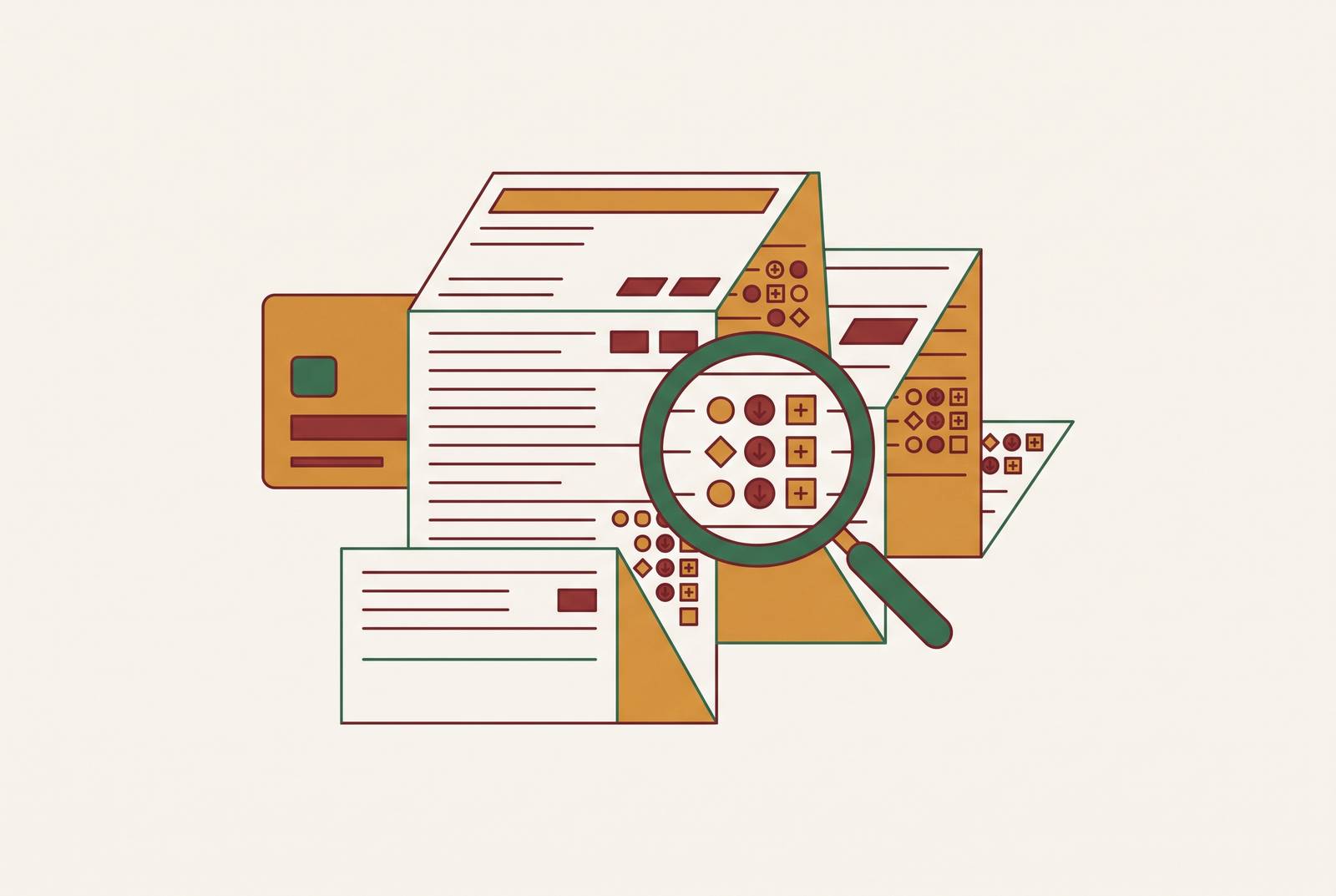
The name on your statement is often unrelated to the name of what you signed up for, and that gap is the whole problem. Payment processors and billing intermediaries stamp their own name onto the transaction instead of the brand you'd recognize, so a streaming app bills under its parent media company, and a software tool shows up as "STRIPE" or "PADDLE" instead of its own product name.
App-store billing and PayPal make this worse. "APPLE.COM/BILL" tells you nothing about which of your seventeen app subscriptions just renewed, and "PAYPAL *4471829" is even less helpful, so most people guess wrong, or don't guess at all, and just scroll past it.
There's a mechanical failure underneath the psychological one, and it's the one people miss. Card networks cap how many characters a merchant descriptor can use, so a charge from "GLOBALFITNESSPRO MONTHLY" gets truncated to "GLOBALFITNESSPR," recognizable only if you already know what you're hunting for, and geographic codes and random numeric strings tacked onto the end make pattern recognition even harder.
Most of this traces back to how payment rails got built decades ago, long before subscriptions became the dominant billing model, rather than any deliberate concealment, though intent doesn't matter much to the person staring at their statement. PayPal history and app-store billing history also run on entirely separate systems from your credit card statement, each with its own labeling conventions. Check them separately and treat each as its own review, or you'll miss half of what's actually there, since checking them together as one pass, which is what most people do, tends to leave the biggest gaps unnoticed.
Micro-billing and the psychology of amounts too small to question
Small numbers don't get scrutinized the way big ones do. A $4.99 charge doesn't trigger the same alarm as a $400 charge, even though twelve of those $4.99 charges add up to nearly $60 a year, and the math is simple, but almost nobody runs it while skimming a statement, and pricing teams know it.
Plenty of services price deliberately at sub-$5 or sub-$10 levels for exactly this reason. It's no accident that so many apps land at $2.99 or $6.99 instead of rounding to a number that would actually catch your eye.
The clearest example here is debt protection add-ons sold by some credit card issuers. These charge a percentage of your balance each month instead of a flat fee, so the dollar amount moves from statement to statement. A fixed subscription is easy to spot once you know the number; a moving number rarely reads as a subscription at all, which is exactly what makes it so hard to flag. Enrollment in these products often happens without a clear moment of informed consent, and plenty of people pay into them for months without ever using the benefit.
Size, not legitimacy, is the real culprit behind most of this concealment. Most micro-charges aren't fraud, since the amount discourages the basic act of checking, but no single line item is alarming, even though the pile is.
Timing patterns that keep subscription charges out of active awareness
Annual billing is close to a perfect blind spot, and it's the single biggest reason people underestimate what they spend. Sign up for something in February, get billed once, and by next January you've forgotten the service exists, so when the charge reappears, it reads as a mystery instead of a renewal. Reviewing only the current month's statement, which is what most people do when they bother at all, misses every annual charge on the account entirely. You need a full twelve months of transactions pulled at once, not just the most recent cycle, or you're not actually looking.
Billing dates add another layer of noise. Plenty of services bill on the day you signed up rather than the first of the month, so recurring charges scatter across the calendar instead of clustering in a way your brain could group together.
Free trials play their own game. They convert to paid after a set window, timed specifically to land before most users think to circle back and cancel. Making it worse, the converted charge often looks nothing like the original trial signup, with a different dollar amount and sometimes a completely different merchant name, so the mental thread connecting the two snaps clean.
Then there's the quiet price increase, and this is the one I'd flag as the most underrated failure mode of all of them, more dangerous than trial conversions or scattered billing dates combined. A service that raises its price mid-subscription usually keeps the merchant name identical, so the charge still looks familiar even though it costs more now. A single month's statement will never reveal that kind of creep, so comparing the same charge across several months is the only way to catch it, a habit almost nobody has unprompted.
Stack a dozen subscriptions on top of each other, each with its own billing date and its own cycle, and the statement reads as a scattershot of unrelated transactions. That's exactly how it was designed to read.
How legitimate services use dark patterns to preserve charges consumers would cancel
Regulators have a formal name for this now: dark patterns, deceptive design choices that make signing up effortless while making canceling a genuine chore. The FTC has brought enforcement actions against companies that build cancellation to be hard on purpose, creating real legal exposure for services that use these designs.
The playbook shows up in a few recognizable forms, and once you've seen them you can't unsee them. "Cancel anytime" language that's technically accurate but practically misleading cost Instacart a $60 million FTC settlement. Cancellation flows get buried three or four menus deep inside account settings, often with no confirmation email sent afterward, so the user has no way of knowing whether the cancellation actually went through. Plenty of people also don't realize that where a subscription was purchased determines where it must be canceled, and the app itself may not make that clear.
The FTC's "Click to Cancel" rule took effect January 14, 2025, with full compliance required by May 14, 2025, and it exists specifically to fix this: canceling has to be as easy as signing up was. Some states have gone further with their own renewal disclosure requirements, so state and federal protections can stack on top of each other.
Here's the practical fallout for anyone reading their statement. Even someone who spots a charge and actively tries to cancel it might believe the job is done when it isn't, and then the charge shows up again next month, turning one surprise into two.
The scale of charges that go unrecognized long enough to become disputes
The numbers at the system level are large. Cardholders disputed $9.8 billion in credit card charges in 2024, resulting in $5.9 billion in actual chargebacks, according to the CFPB's 2025 Consumer Credit Card Market Report. Every one of those disputes is a charge that went unrecognized long enough that dispute became the only remaining option, an upstream recognition failure showing up downstream as a formal complaint that's already too late to fix cheaply by the time it gets that far.
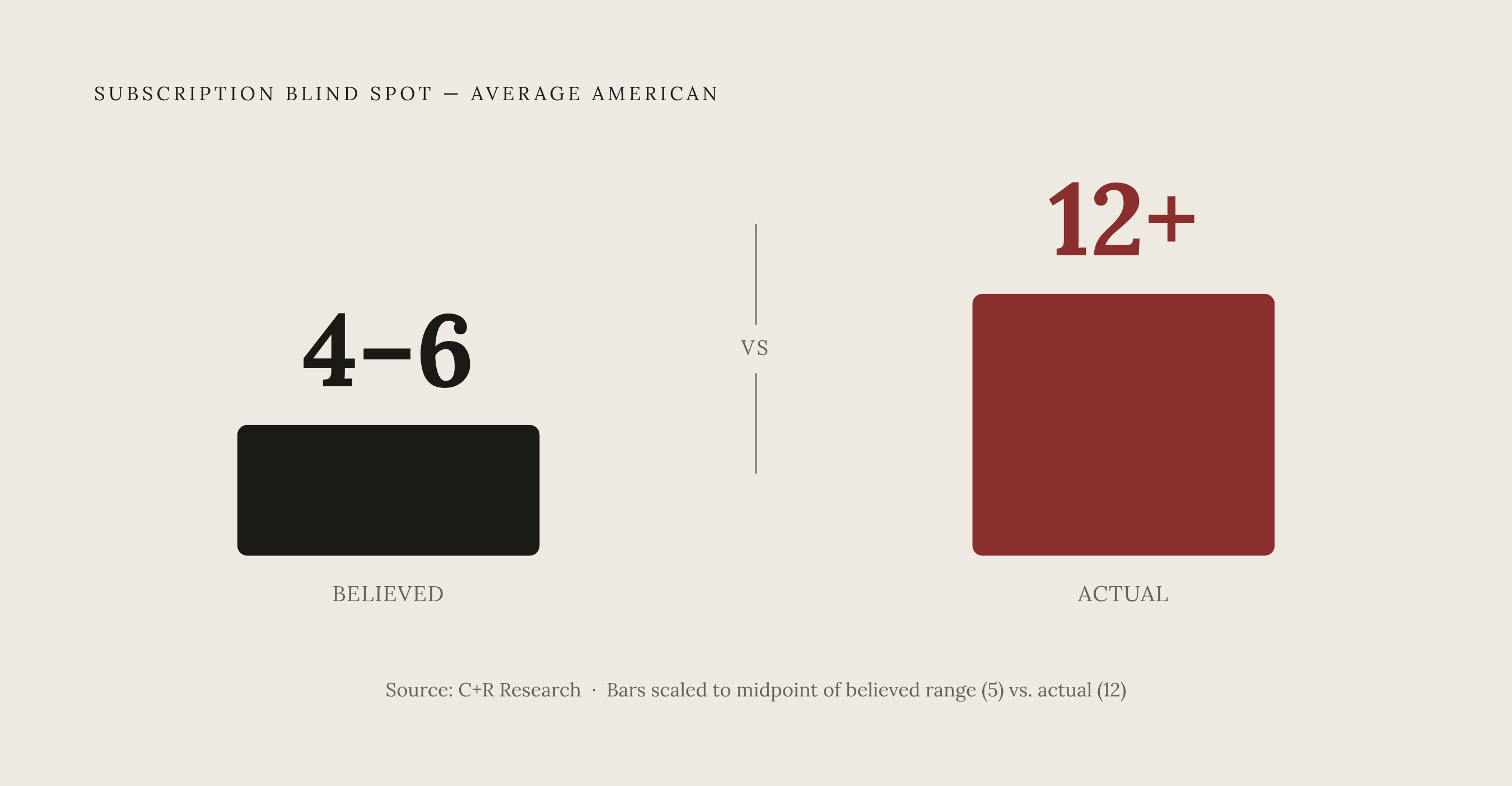
C+R Research found the average American carries 12 or more active subscriptions while believing they have somewhere between four and six. That gap, between believed count and actual count, is the structural reason disputes happen at the scale they do, and it's the thing I'd push back on hardest when people blame carelessness. The count itself is unknowable from a glance, and that's a much bigger driver than any lack of attention to money, which is the explanation people reach for first and the one the numbers don't actually support.
Disputes are a lagging indicator, and a slow one at that. By the time a charge reaches dispute stage, it may have cleared for months or years without anyone noticing, and everything covered above, the naming, the timing, the pricing psychology, the cancellation friction, is what lets that accumulation happen in the first place. Most of these charges are legitimate services the consumer genuinely signed up for at some point and simply lost track of. That's exactly why this deserves attention on its own, separate from anything to do with catching thieves.
What a systematic statement review actually looks like in practice
Two windows matter here, not one, and skipping either one defeats the exercise. Three months of statements catches most monthly recurring charges, while twelve months is the minimum needed to surface anything billed annually, and skipping that longer pass means missing every yearly renewal on the account, full stop.
Coverage matters as much as the time window. Checking accounts means checking every credit card, PayPal transaction history, and app-store billing history separately, because each one uses its own naming convention and none of them talk to each other.
What you're actually hunting for:
- The same merchant name showing up at regular intervals: monthly, quarterly, or annually
- The same dollar amount repeating even under an unfamiliar name; amount consistency is often a more reliable signal than name recognition
- Any charge from "APPLE.COM/BILL," "PAYPAL *," or a known payment processor that doesn't name the actual service, which needs a second lookup before you can judge it
- Small fluctuations in an otherwise steady amount, which can point to percentage-based billing or a price increase nobody flagged
For anything unrecognized, search the exact merchant name plus the word "subscription" before filing a dispute. Most unrecognized charges turn out to be a forgotten legitimate service rather than fraud, and disputing a valid charge just creates its own headache with the card issuer. For annual charges, check whether the same date shows up across all twelve months and cross-reference it against old signup confirmation emails from around that time last year.
Here's the honest limit of this approach: most people run through it exactly once, usually after something prompts them, and never again, so any subscription that starts after the audit, or any price that creeps up slowly afterward, slides right back into invisibility until the next time someone forces the issue.
Why ongoing monitoring catches what one-time audits miss
A one-time audit is a snapshot, and the problem it's aimed at keeps moving after the snapshot gets taken. New subscriptions start the week after you finish reviewing, free trials convert on their own schedule, and prices tick upward quietly in the background, none of which pauses because you did a thorough job in March.
That's the real argument against treating this as a once-a-year chore. The mechanism that hides charges doesn't take a year off, so a yearly check can only ever catch up to where things stood on the day you looked, not where they stand now.
A dashboard that reports what already happened serves a different purpose than a system built to notice what's happening in real time, and treating them as interchangeable is the mistake that makes most budgeting tools feel limited for this specific job. A budgeting app that shows a charge after it's cleared is useful, sure, but by then the window to cancel before renewal, or to dispute within whatever timeframe the card issuer allows, may already be closing.
Compass+ is built around that distinction. It connects to bank accounts, credit cards, email, and subscription services specifically to watch for the patterns laid out in this piece: obscure merchant names, amounts that shift slightly month to month, free trials approaching their conversion date. It runs in read-only mode, so linking accounts doesn't add any new risk; it only adds visibility that wasn't there before. Each finding comes with a specific dollar figure and a concrete next step, addressing what manual review and most budgeting apps leave unsolved. Because it covers multiple account types at once, it closes the exact gap that trips up a manual check: charges scattered across different surfaces, each with its own naming rules, none of which line up neatly on a single page.
The mechanisms behind hidden subscription charges don't need any cooperation from you to keep working. They run on their own, quietly, every billing cycle, and countering something that never stops calls for monitoring that never stops either.