One App That Hunts Your Subscriptions and Cancels Them so You Never Have to Call
App-assisted cancellation works best when paired with continuous monitoring of your accounts.
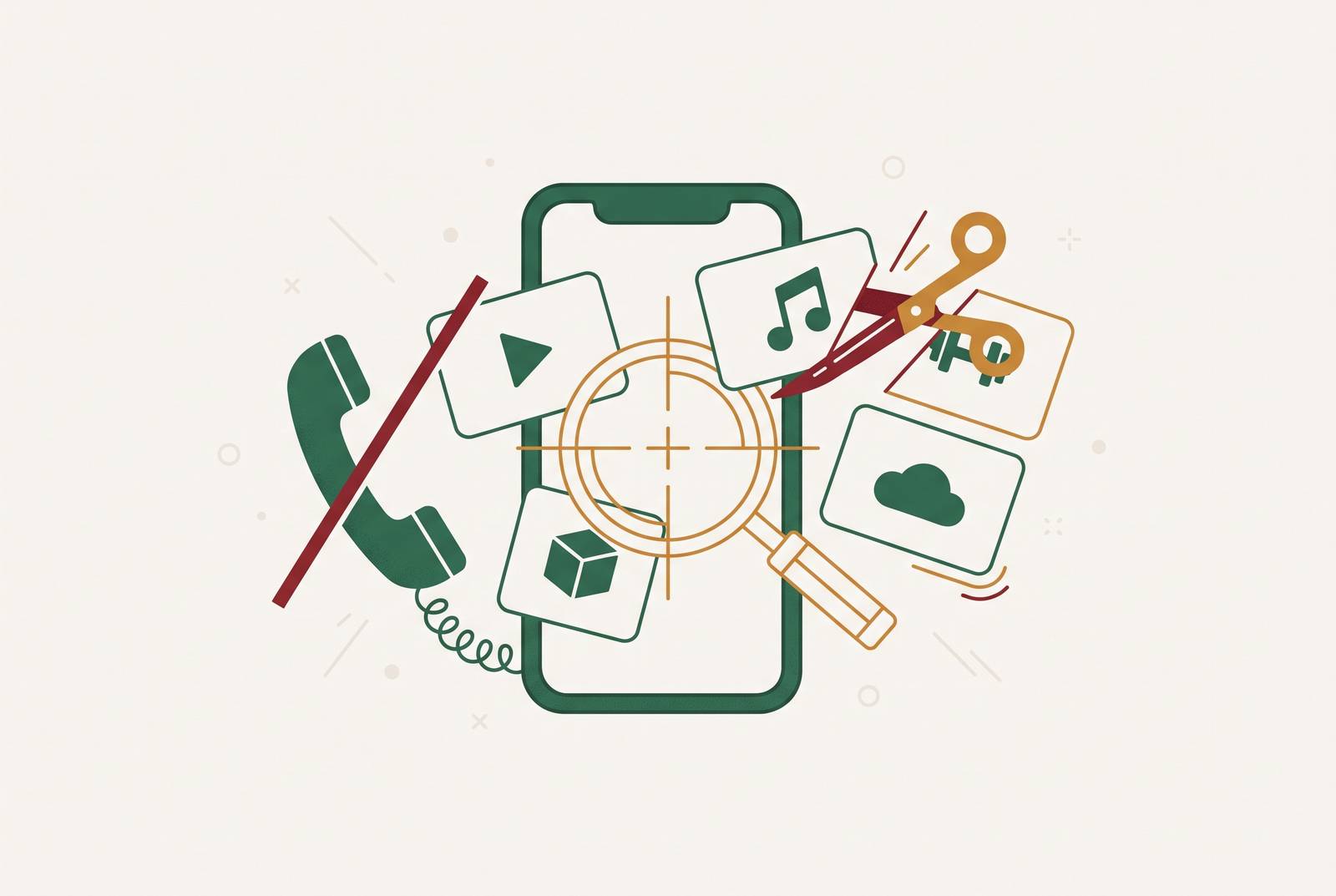
A bank-linked app can find subscriptions you forgot about, but cancellation depends on the tool and how each service bills you. Kudos Premium offers agents that find, track, and cancel subscriptions, while Experian BillFixer handles more than 200 eligible subscriptions. No third-party app can cancel everything, especially subscriptions billed through Apple or Google. The answer to subscription sprawl is ongoing detection paired with action.
How subscription billing is engineered to outlast your attention
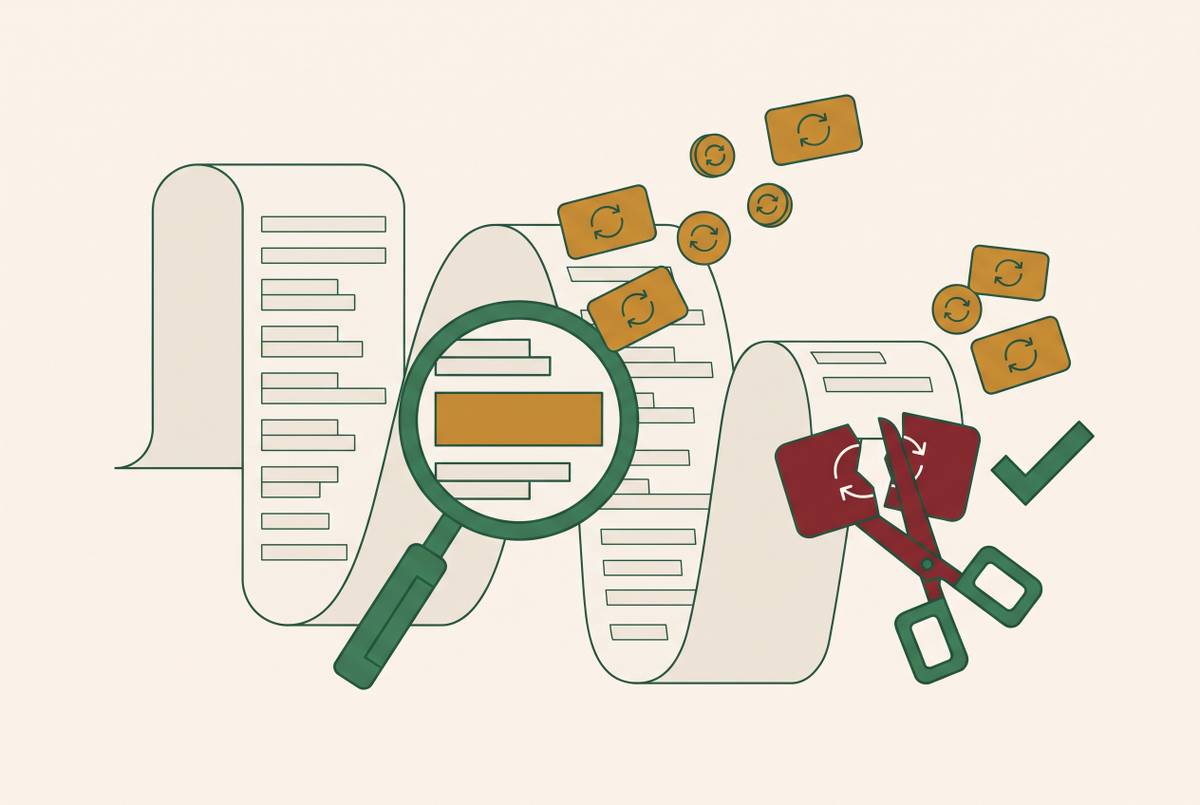
That vague dread before opening a bank statement is a predictable result of recurring billing. Small charges are easy to overlook on their own, even when they add up to a lot. Auto-pay removes the monthly decision altogether. You do not choose to keep each service every month. You simply never choose to leave.
The timing works against memory as well. Free trials are calibrated to convert before habits form, while annual plans disappear from view for most of the year. A service can remain active long after the reason for buying it has gone. The billing system keeps its schedule whether you remember that schedule or not.
What the perception gap actually measures
The gap between estimated spending and an itemized total shows what memory leaves out. Subscriptions now reach well beyond streaming into cloud storage, productivity software, meal kits, food-delivery memberships, and AI tools. Each belongs to a different part of daily life, which makes the total harder to hold in mind. Price increases widen that gap further. You may remember which services you bought but forget what they now cost.
Self Financial's 2026 survey found that 59.9% of those who took part paid for a subscription they did not use each month. The same research found that more than a third of respondents said an unexpected free-trial expense meant cutting back on other outgoings. These are not merely untidy account records. Forgotten payments take money from something else. Because the gap comes from a system that keeps billing and changing, a one-time audit closes it only briefly.
Why a one-time audit is the wrong unit of solution
New subscriptions accumulate, trials convert, and prices rise after the review is finished. Cancelling a few services can feel like getting things sorted out, even as that process goes on. The clean list starts ageing immediately. Even a gap of a few weeks leaves room for a trial to become another paid commitment.
Some charges also resist an account-by-account review. Spotting duplicate charges and zombie subscriptions, where a service cancelled on one card keeps billing another, takes a view across accounts. A quiet price increase can pass between audits without prompting another look. The problem therefore needs continuous monitoring. A background tool can sustain that watch in a way human attention cannot.
What "automatically cancel your subscriptions" actually means in practice
Detection and cancellation are separate capabilities, even when marketing bundles them together. A bank connection can discover recurring charges automatically, while a manual tracker knows only what you enter. Neither method tells you what happens after discovery. That is a separate test of the product.
Concierge cancellation means a human or automated agent contacts the company on your behalf. It applies to subscriptions billed directly by the company. One-tap navigation instead takes you to the official cancellation screen, where you finish the job. Tracking and reminders do less again. They maintain a list and warn about renewals, but leave cancellation entirely to you.
No third-party app can cancel an App Store or Google Play subscription. Those cancellations must happen through their own native screens. A tool may find charges in the background but wait for you to ask it to act. The promise needs to specify both parts.
The two camps and what each one trades away
Bank-linked tools use an aggregator to connect checking accounts and cards so they can find recurring charges automatically. Their strongest use, finding payments you cannot name, comes with a real privacy cost. A third party gets read access to financial data, and free tiers usually make money through premium upgrades, credit products, or commissions on the bills they negotiate. The connection is part of the bargain.
Manual-and-private tools give up that access. You enter subscriptions, then get warnings before they renew and help with how to cancel, without linking financial accounts. They suit people who already know roughly what they pay for or will not share banking access. Forgotten subscriptions remain outside the list, however.
What app helps you find and cancel subscriptions with a bank connection?
Kudos Premium is built to act on its own as well as show subscriptions on a dashboard. Kudos says its AI agents find, track, and cancel forgotten subscriptions as the user's authorized representative. The agents log into merchant portals, send cancellation emails, and use live chat so the user does not have to. This goes beyond directing someone to a button. The distinction is who performs the cancellation work after a subscription is found.
Experian BillFixer combines subscription cancellation with bill negotiation. Experian says the service can cancel more than 200 eligible subscriptions, and it usually takes three to seven business days. It also negotiates common bills including internet, phone, cable, and home security. Eligibility still limits what it can handle. It can help people who want to cut household bills as much as they want to end subscriptions.
PocketGuard approaches subscriptions as part of budgeting. Recurring payments feed into its “In My Pocket” safe-to-spend calculation, while the paid Plus tier adds in-app cancellation once accounts are linked. It offers a free tier and monthly, annual, and lifetime Plus options, with a 7-day trial. Budgeting is the main distinction here. It fits users concerned with overspending broadly, including subscription cancellation.
Pine AI helps with tricky cancellations that need a phone call, rather than watching for subscriptions in the background. It is accessible on web, iOS, and Android. That separates a difficult cancellation task from the continuing job of detecting charges. A tool can help with the former without being the strongest fit for the latter. None of these options removes the Apple and Google cancellation boundary.
Tools that track and guide cancellation without a bank connection
Manual trackers can keep subscriptions and free trials together, warn before renewals, and provide cancellation instructions. Some take users straight to Apple's subscription sheet or the Google Play subscriptions center. That saves navigation while leaving the final cancellation step to you. Their narrower scope is useful when the list is already known. It cannot reveal a subscription that was never entered.
Apple Settings has the built-in list of Apple-billed subscriptions, including those that have expired and free trials that are still active. The path is Settings → [name] → Subscriptions, with the cancel button on that screen. It is free and up to date and keeps data from third parties, but it has no reminders or way to see subscriptions across platforms. Its boundary is the billing channel. The right tool depends in large part on whether you can already name what you are paying for.
The security trade-off of connecting accounts — and how to manage it honestly
Read-only access limits what a connected app can do while leaving what information it can see unchanged. Plaid uses revocable, read-only access tokens and AES-256 encryption for data at rest. A linked app's access to transactions, with separate authorization required to move money, provides meaningful protection against unauthorized transfers. It is not protection against every form of data exposure.
Plaid's April 2026 incident involved names, dates of birth, addresses, driver's license numbers, Social Security numbers, bank names, and account numbers. It did not result from an external attack. Financial data can be exposed without someone using an app to transfer money. Transaction history, balances, and personal details are still sensitive even when access is read-only.
The practical response is to manage the connection explicitly. Choose tools that explain their data retention and aggregator relationships, and revoke access when an app is no longer in use. Deleting the app does not end the connection. Access can be revoked through the app, a bank's security dashboard, or the Plaid Portal. For someone choosing bank-linked automation, the decision is which tool to trust with that continuing access.
What the regulatory landscape actually requires from companies right now
The U.S. Court of Appeals for the Eighth Circuit vacated the FTC's subscription cancellation rule in July 2025. The FTC reopened rulemaking in March 2026, but no replacement rule is in effect. Existing protections did not disappear with it. ROSCA, Section 5 of the FTC Act, and state auto-renewal laws are still in force, and Visa and Mastercard subscription standards still apply. The rules provide an uneven backstop.
Amazon agreed in September 2025 to billions in combined refunds and civil penalties over Prime enrollment screens and a deliberately difficult cancellation flow. Chegg paid millions in 2025 for continuing to bill customers who tried to cancel. Match.com paid millions that year over six-month guarantee offers that misled people and steps to cancel that were hard to follow. Adobe agreed to a substantial settlement and court-approved order with the DOJ in 2026 over a hidden early termination fee and cancellation friction.
State requirements add another layer of protection. Click-to-cancel laws took effect in Minnesota in January 2025, California in July 2025, Massachusetts in September 2025, and New York on November 5, 2025. Colorado's dates were August 2025 for B2C and February 2026 for B2B. Maryland followed in June 2026, with Connecticut and Virginia in July 2026. Where strong state auto-renewal laws apply, companies must provide accessible online cancellation, so knowing the applicable law gives readers leverage when cancellation becomes unnecessarily difficult. A tool that handles that friction still has practical value because the protections are not uniform.
What to look for to know you are getting real automation rather than a reminder list
The first test is detection without input. A genuine discovery tool can identify a subscription you never entered from account transactions, rather than asking you to supply the very thing you forgot. It should also keep checking after setup. Detection without input and continued checking distinguish ongoing monitoring from a one-time audit by allowing it to catch a service that begins billing next month.
The next test is the finding itself. A useful result names the service, gives the dollar amount, and offers a clear next action. A vague warning about recurring charges leaves you to find out what they are. Claims about cancellation should be just as clear about whether the tool contacts the merchant or only opens a screen. Any promise of universal cancellation that omits the App Store and Google Play limit is overpromising.
Pricing and access complete the evaluation. A commission on savings pays a tool to find savings, a flat monthly fee pays it to keep subscribers, and pay-per-task pricing pays it to finish tasks. Those incentives need a closer look before another recurring payment goes into the account. Read-only permissions should be verifiable, and access should be revocable. The provider should identify its aggregator and retained data. The strongest fit is not the app with the longest subscription list, but the one that keeps finding new charges and does the cancellation work it actually promises.