Annual Subscription vs Monthly Plan Break-Even Analysis
Calculate your break-even month before the discount percentage fools you into overpaying.
Two buttons on a pricing page. One says "Save 20%." The other just sits there, unremarkable, monthly. Most people click the discount without doing a single calculation, because a percentage sign reads like free money. It isn't. The annual-versus-monthly decision comes down to one number, break-even months, and most people are already picking wrong before they've done the math.
Here's the backwards logic worth naming: people treat the discount percentage as the decision. The real decision is a bet on your own future behavior, and the bet loses more often than the pricing page wants you to notice.
The break-even formula and what it actually tells you
The formula is simple enough to do in your head: break-even months equal the annual price divided by the monthly price.
Take a streaming example. Annual plan costs $119.99. Monthly costs $12.99. Divide the two and you get 9.2 months. Stay subscribed past month nine and the annual plan wins. Cancel before that, and the discount didn't save anything. It cost you.
There's a second way to reach the same number, useful when you're thinking in discount percentage rather than raw dollars: break-even months equal 12 times (1 minus the discount rate). Same answer, different door in.
What that number represents matters more than the arithmetic. It measures something other than savings. It's the minimum commitment made the second someone clicks "pay annually," clocked or not. Every annual plan is a bet that the service still gets used past a specific month, and the formula just names which month that is.
How the discount depth moves the break-even threshold
Discounts aren't standardized across the industry, and the size of the discount changes how much runway is needed before the annual plan pays off.
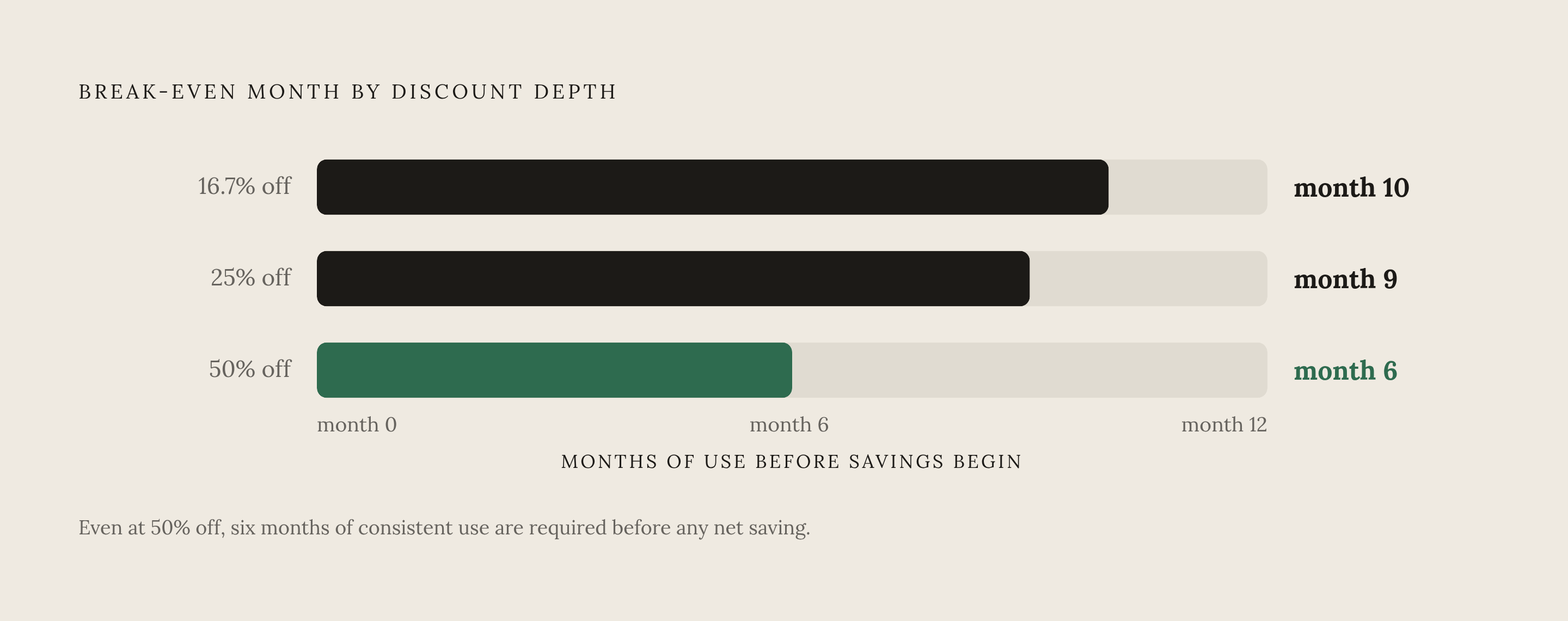
A 16.7% discount, the classic "two months free" pitch, puts break-even around month 10. A 25% discount drops that to 9 months. Push the discount to 50% and break-even falls to 6 months. Grammarly sits at the steep end of the market: $12 a month billed annually ($144 a year) against a $30 monthly rate, a discount deep enough to make the annual plan look almost impossible to turn down.
A deeper discount lowers the bar. It never removes it. Even a 50% deal, generous by any standard, still asks for half a year of consistent use before the annual plan saves a cent. Most plans cluster in that 9-to-10-month range, and that's the number worth sitting with: the typical annual upgrade is a bet on nearly a full year of steady use, not six months, and definitely not "probably."
Where the math breaks down: the stock photo designer scenario
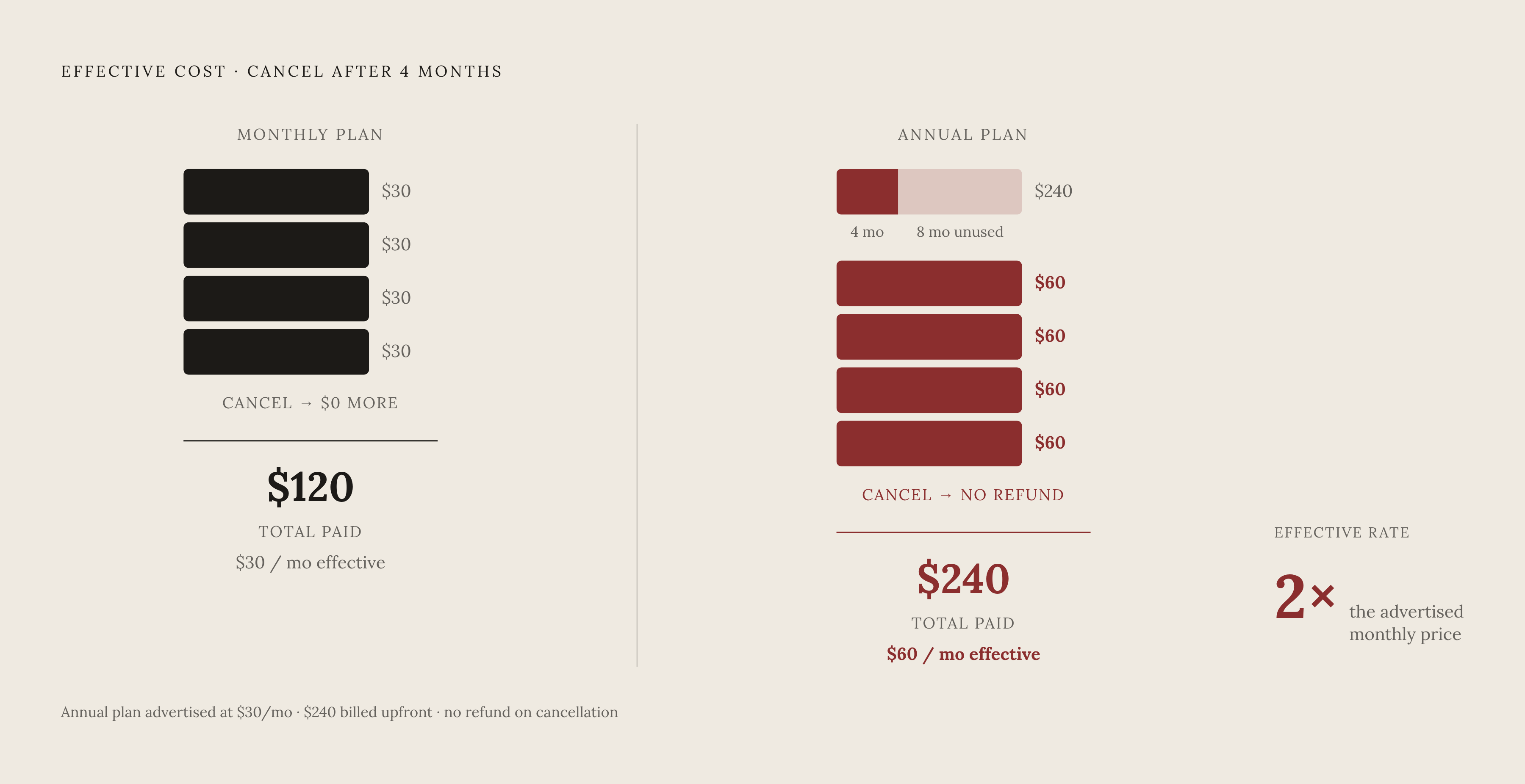
Picture a freelance designer who signs up for a stock photo subscription. Monthly rate: $30. Annual rate: $240, which works out to $20 a month, a discount that looks obviously smart on paper. The designer takes the annual plan to "save" $120 over the year.
The project wraps after 4 months.
On the monthly plan, total spend would have been $120, then a clean cancellation. On the annual plan, $240 is already gone. No refund, no partial credit. Net result: the designer spent $120 more by choosing the plan built to save money. The effective rate on that four-month stretch comes out to $60 a month, double the advertised monthly price.
That's not bad luck. It's the default outcome whenever someone upgrades based on how they feel about a service today instead of how they've actually used it over the past few months. The stock photo scenario is the rule worth warning about. It's closer to the norm.
The psychology that makes annual plans feel safer than they are
Once money's spent, it stops feeling like a decision and starts feeling like a fact. That's sunk-cost lock-in, and it's the main reason annual plans survive long past the point where they've stopped making sense. People don't cancel a service they've already paid a year for, even once usage drops to nothing, because the cost feels absorbed rather than active.
Pricing pages lean into this on purpose. Plenty of them default the toggle to annual and present that number as the headline price, which quietly makes monthly look like the workaround option instead of the safer one. Wix and Hootsuite go further, showing only one pricing option prominently, so the true gap between plans never sits side by side where anyone would notice it. Hootsuite compounds it by leaving taxes out of the displayed price, so the number at checkout doesn't match the number on the page.
Then there's the intention trap. People commit to annual based on how excited they are about a tool right now, not on a clear-eyed read of what month 8 looks like. Loss-aversion does the rest of the work: a banner reading "save 20%" makes the monthly option feel like leaving cash on the table, even when monthly is the financially correct choice. And the contradiction is worth naming directly: Optionality is a selling point people actively want, right up until they're asked to trade it away for a discount that hasn't been earned yet.
When the annual plan is genuinely the right call
Annual plans aren't a trap across the board. But the conditions that make one the right call are narrower than the pricing page wants anyone to believe, and all of them need to hold at once.
The service has to work as daily, essential infrastructure, not something used in bursts. There needs to be 3 or more months of proven, consistent usage behind it already, meaning the upgrade responds to behavior, not intention. And the discount needs to sit at 20% or higher, enough to justify giving up the flexibility monthly provides. Anything short of that trio, skip the annual plan.
Put plainly: don't move to annual until 3 to 6 months of steady monthly use are already on the books. Treat that stretch as a trial period the service has to earn its way out of, not a formality before the "real" plan kicks in.
Services with high switching costs make the annual call easier, not harder. A password manager holding hundreds of saved logins, or a project management platform carrying years of team history, isn't something anyone's realistically walking away from anyway, so the annual plan's lost flexibility costs less. Annual plans can also offer some insulation against pricing changes, which matters given how often software pricing moves upward. One practical habit if the plan does get upgraded: divide the annual cost by 12 and count that fraction against the monthly budget. Skip that step, and a single large upfront charge throws off every budget check for the rest of the year.
The scale of the problem: how much money is already leaving unnoticed
A 2024 C+R Research survey found the average American spends $219 a month on subscriptions but estimates the number at just $86. That's a $133 monthly blind spot, and it adds up to $1,596 a year going unnoticed.
That gap isn't a one-time miscalculation. It compounds, service by service, across a household's entire subscription stack, and the annual-plan lock-in effect explains a good chunk of why: once the money's paid, people stop asking whether the thing is worth keeping. Every stock-photo-designer scenario buried inside that number never gets a partial refund. It just sits there, absorbed, uncounted.
How to run the break-even test before every annual upgrade
Before clicking "upgrade to annual," run the numbers in this order.
Start with the break-even calculation itself: annual price divided by monthly price, before even glancing at the advertised savings percentage. Then audit actual usage, not intended usage: count the months in the past six where the service was genuinely used, not just paid for. Apply a 3-month minimum. If consistent use doesn't already stretch back that far, stay on monthly. Check the discount depth next. Anything below 20% pushes break-even close enough to a full year that flexibility is worth more than the discount.
Then sort the service into one of two buckets. Daily essential with real switching costs: annual is probably right. Seasonal, project-based, still in the exploratory phase, entertainment, or anything supplemental: monthly protects against exactly the stock-photo-designer outcome.
The easiest place to start this audit is three months of bank or credit card statements, scanned line by line for renewals that don't match how the service actually gets used. Running this check on every renewal, not just the big ones, beats any individual annual discount over time. Catching even one wrongly-timed upgrade before it charges can offset a meaningful share of what that upgrade was ever going to save.
Sources
- Monthly vs. Yearly Subscription: 2025 review | by Guy Barner | Medium
- Subscription Calculator — Total Cost, True Price & Savings (2026)
- Annual vs Monthly Subscriptions: The Break-Even Math (and the Traps) Most People Miss
- How to Decide Annual vs Monthly Subscriptions with Break‑Even Math | Monee - Budget & Expense Tracker