Subscription Audit Spreadsheet Method Versus Automated Monitoring
Automated tools catch drifting subscriptions that manual spreadsheets miss.

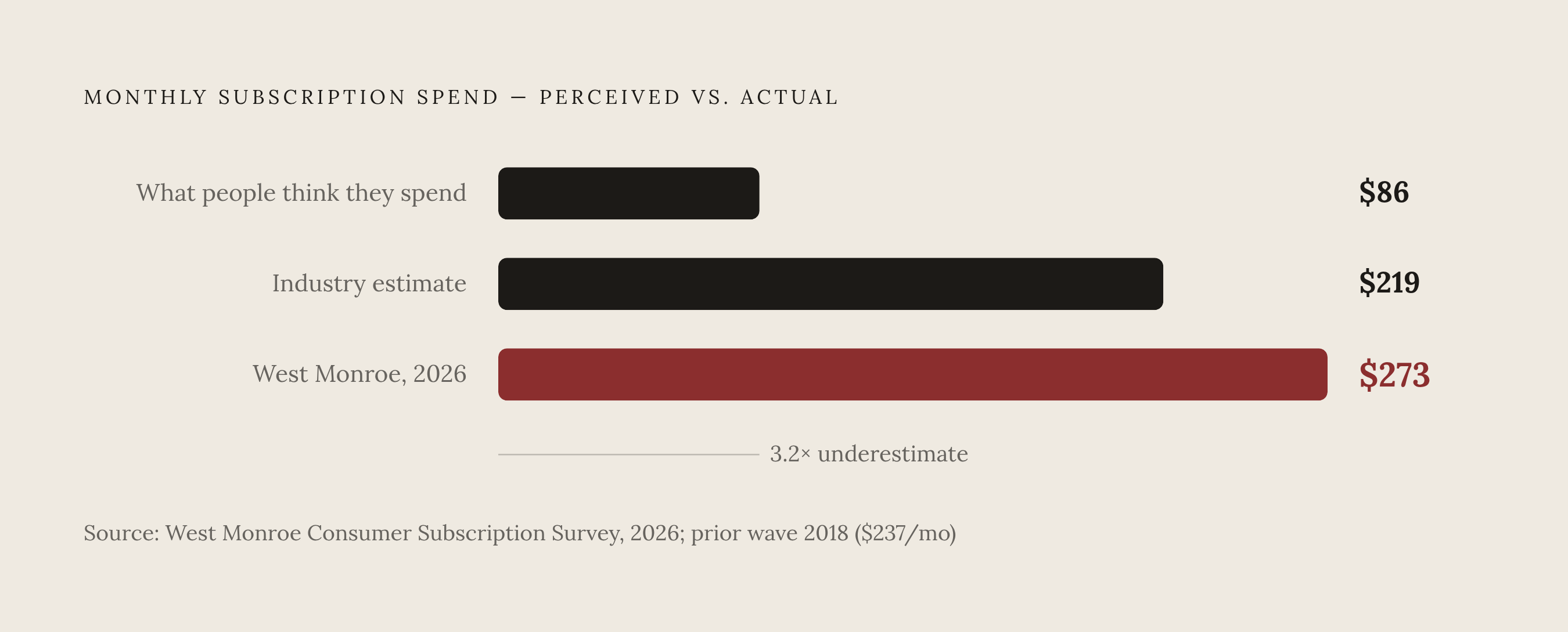
The average American guesses they spend $86 a month on subscriptions. The real number is $219, according to a commonly cited industry estimate, and West Monroe's research puts it higher still: $273 a month, up from $237 when the firm first measured it in 2018. Pick whichever figure feels right and the conclusion is the same. People are wrong about their own spending by a factor of roughly 2.5, and the tool most of them reach for to fix that, the subscription audit spreadsheet, was never built to close a gap that size.
That gap isn't a memory problem. It's a design problem, and no amount of diligence with a spreadsheet changes what the spreadsheet can see.
Charges get sized to feel harmless one at a time. Billing dates scatter across the calendar so the totals never line up in a way that trips an alarm. Auto-renewal removes the one moment that used to force a decision: the moment you'd have had to re-buy the thing on purpose. A lot of the spending lives in app-store billing too, which can be invisible to anyone checking only a bank statement. Streaming alone now averages $51.71 a month. That's one category, and it's outrunning most people's awareness of it.
So the scale of the problem is real, and the spreadsheet is the default answer. It deserves a fair look, both at what it does well and at exactly where it runs out of road.
What a subscription audit spreadsheet actually does, and what it was never designed to do
The method is simple, almost old-fashioned in a good way. Pull twelve months of statements, not three, because annual subscriptions only charge once a year and a shorter window misses them by design. Search by merchant name instead of scanning line by line, since that's how the eye actually catches a pattern. Convert every charge to its annual cost. That one move, turning a small monthly charge into its full annual cost, changes how the number feels in a way a monthly figure never does. Sort everything by annual cost, highest first, and ask one honest question per line: has anyone used this in the last month?
Done carefully, in one sitting, this surfaces real waste. The annual reframe alone is worth the exercise.
But a spreadsheet only sees what it's told to look at, and most people only think to check their bank statement. SubTracker's audit guide lays out four places subscriptions actually live: bank and card statements, Apple's App Store billing (Settings, then your name, then Subscriptions), Google Play billing (Play Store, profile, Payments and subscriptions), and PayPal's automatic payments (Settings, Payments, Automatic payments). That last one is the sneaky one. A PayPal subscription survives a card replacement. It can run for years without ever showing up on a new statement, because the payment method changed but the PayPal authorization never did.
Only the first of those four sources can be partially automated by a bank-linked tool, and only for accounts that are actually connected. The other three require a person to open an app and look. That's the honest limit of the method, and it's a limit most "audit tool" marketing skips right over.
Add it up, and even a careful, patient manual audit tends to catch somewhere around 60 to 70% of what's actually out there. The rest sits in billing channels a spreadsheet structurally cannot see, not because anyone did the audit wrong, but because the format was never built to look there.
None of that erases the value of the exercise. For a one-time reset, for the annual reframe, for spotting duplicates sitting side by side, a spreadsheet does the job with zero software involved. The real question is what happens to that clean baseline the day after the audit ends. It starts going stale immediately.
Why subscriptions re-accumulate faster than any manual audit cycle can catch
Drift isn't a discipline problem, and treating it like one is where most audits quietly fail. It's structural, and it starts working against the spreadsheet the moment the audit closes.
New subscriptions get added and never logged. Prices climb quietly between audit cycles, a service moving from a lower to a noticeably higher price over four years is the normal outcome, not some rare exception. Annual renewals show up without warning. Bundles bury individual costs inside a single line item: a growing share of subscriptions are now bundled, often through a cell phone provider or a retailer like Walmart or Amazon. A bundle line item on a phone bill doesn't announce what's inside it. Untangling it means calling the provider directly.
Free trials keep the pipeline full on their own, and the mechanics have shifted against anyone trying to track them by memory. Short-window trials have become increasingly common, which crushes the window for a calendar reminder set at signup. The industry is also drifting from free trials toward paid intro offers, which changes what "tracking a trial" even means, since there's no longer a clean free-to-paid line to watch for.
The environment isn't neutral either. Reviews of subscription websites and apps have found widespread use of dark patterns, with many services employing at least one, and others using several. The user isn't just forgetful. The user is navigating something built, on purpose, to be forgotten.
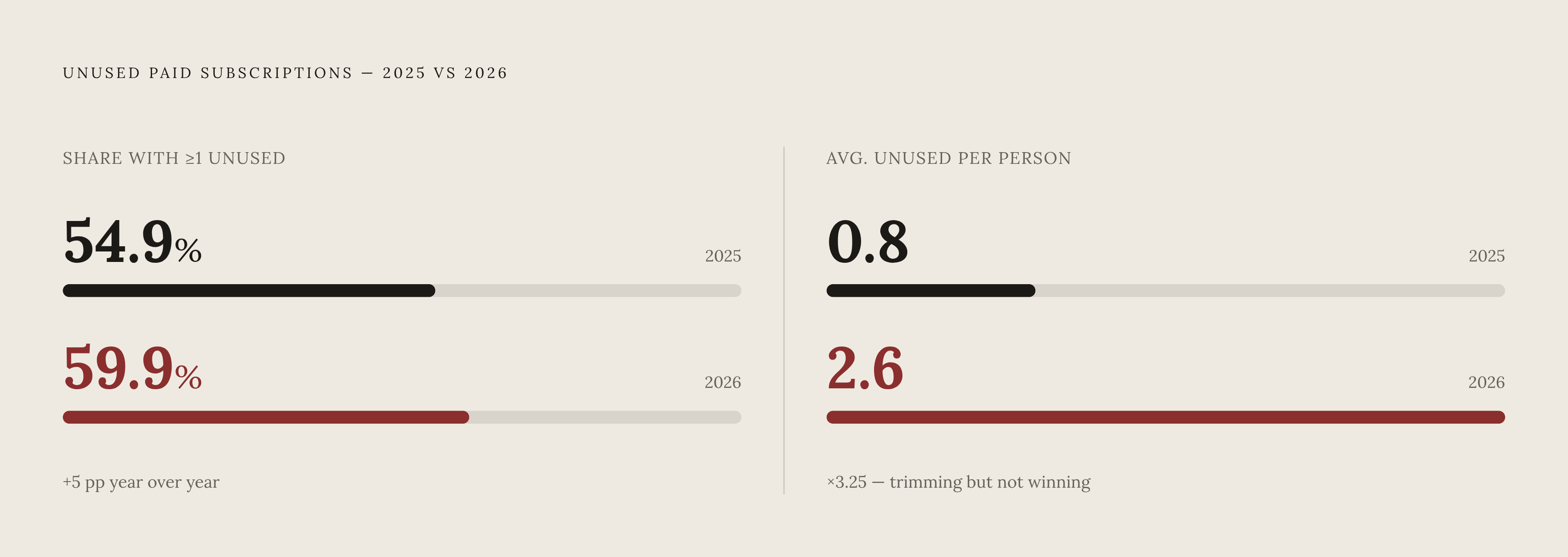
Subscription-count data backs this up in an uncomfortable way. One 2026 survey found 59.9% of respondents carried at least one unused paid subscription, up from 54.9% the year before, and the average number of unused subscriptions jumped to 2.6 from 0.8 the prior year. People are trimming. They are not winning, and that gap between effort and outcome is the whole story here.
A spreadsheet audit is a snapshot of a target that never stops moving. The drift that made the audit necessary in the first place resumes the very next day, and no amount of care in the spreadsheet slows it down.
What automated monitoring does that a spreadsheet structurally cannot
The real difference is time. A spreadsheet freezes one moment. Automated monitoring watches continuously, and that single fact changes what's catchable.
New charges show up as they happen, not whenever the next audit gets scheduled. Price increases become visible because there's a stored baseline to check against: without a recorded original price, that kind of price creep is invisible no matter how attentive someone is. Renewal dates get tracked ahead of time, with reminders timed to the actual notice window (seven days out for monthly plans, thirty or more for annual ones), instead of getting discovered the moment the charge already posted.
Name the tradeoff honestly, though. Bank-linked tools connect through aggregators like Plaid, TrueLayer, or Tink, and they end up holding a continuously updated record of the entire account, not just the subscription slice of it. That's real exposure, not a hypothetical one. Manual trackers like SubTracker never connect to a bank account at all, so the actual choice is setup speed against data exposure, and reasonable people land differently on it.
Read-only access is the correct default here, full stop, and anything less shouldn't be trusted with the job. A monitoring tool should see transactions without being able to move money. That's the line separating a monitoring tool from a financial control. Compass+ works on exactly this principle: it connects to bank accounts, email, calendar, Amazon, and subscription services to surface findings, unused subscriptions, price increases, trials about to convert, each attached to a specific dollar figure and a next step, without ever touching the money itself.
Even so, the App Store, Google Play, and PayPal sweeps still need a human to go look. Automating the rest of the system doesn't make that limit disappear.
How the two approaches handle the specific failure modes subscriptions are designed to exploit
The forgotten free trial. A spreadsheet only catches this after the charge has posted, and only if someone remembered to check before the window closed. Automated monitoring watches the conversion date directly and surfaces the deadline before the charge happens, which turns a basic consumer right into something actually claimed instead of quietly lost.
The quiet price increase. Invisible to a spreadsheet unless someone happens to compare this month's charge against a number written down months ago, and almost nobody does that. Automated monitoring catches it because a stored baseline price sits there for every new charge to be checked against. That comparison is the entire point of keeping a baseline.
The bundle that buries costs. Bundles now account for a growing share of the subscriptions Americans carry, folded into a single phone or retail bill. A spreadsheet sees one line item and stops. Automated monitoring only does better here if it can actually read the email or account data that itemizes what's inside the bundle, and that's a real limitation for any tool working from bank statements alone.
The annual renewal with a hard cancellation deadline. SubTracker's own guide calls this the one genuinely urgent item in a manual audit. If the notice period is 30 days and renewal lands in three weeks, the window is nearly shut already. Automated monitoring tracks the date continuously and surfaces a 30-day warning without anyone needing to remember when they signed up in the first place.
Duplicate charges and bundle overlap. A spreadsheet that covers all four billing sources, bank, App Store, Google Play, PayPal, can catch these, but only if the audit is thorough enough to notice the overlap. Automated monitoring that reads across accounts and email can flag paying separately for something a bundle already covers, but only if it's connected to enough sources to see both sides of that equation.
The regulatory shift that changes the cost-benefit of staying passive
Enforcement is starting to catch up to design. It doesn't fix the underlying problem, but it changes what happens after a person actually finds something worth canceling.
The FTC's Click-to-Cancel rule, finalized in late 2024 and in enforcement through 2025 and 2026, requires cancellation to be exactly as easy as signing up. Even so, the friction it targets, multi-step cancellation flows built to make acting on an audit finding feel like more trouble than it's worth, is exactly what most people hit right after they find something to cancel.
Amazon's 2025 settlement makes the point concrete: roughly a billion dollars in civil penalty plus billions more in refunds, tied to a requirement that the company disclose subscription terms clearly at enrollment, get express consent before charging, and strip out manipulative sign-up and cancellation flows. Internal documents reportedly referred to the cancellation process by the codename "Iliad," a nod to the six-page, multi-click gauntlet built specifically to wear people down before they finished canceling.
State and federal pricing rules are closing a related gap. California's Honest Pricing Law took effect July 1, 2024. Massachusetts regulations followed on September 2, 2025. The FTC's Total Price rule took effect May 12, 2025. All three require upfront disclosure of mandatory fees, cutting into the hidden-fee problem that made bill creep hard to catch even for a careful spreadsheet audit.
None of this replaces the need for monitoring. It just means that once monitoring surfaces a problem, acting on it gets easier. Enforcement is catching up to design, but consumer vigilance is still losing the race against scale, and no rule change fixes that on its own.
Which approach fits which situation, and where they work together
The spreadsheet earns its keep as a starting point, not an ongoing system. Treat it as anything more than that, and it will let you down exactly when the drift resumes.
It's the right tool for someone who's never done a full review and needs a clean, one-time reset. The annual-figure reframe, turning a small monthly charge into its full annual cost, is a genuinely useful trick no software replaces. And the App Store, Google Play, and PayPal sweeps have to happen manually no matter what comes after, SubTracker's own guide is upfront that these are structurally unautomatable. Once the list is built, cancel in order of annual cost, highest first: duplicates and unused services first, then annual plans coming up for renewal, then anything still used but not worth what it costs.
Automated monitoring earns its keep for everything after that reset, which is really everything that matters over time. The drift resumes immediately: new sign-ups, quiet price increases, trial conversions, renewals nobody remembers agreeing to. A tool that watches continuously costs no ongoing effort once it's set up. A spreadsheet demands a re-audit on a calendar the user has to enforce alone, and SubTracker's own advice to repeat the process every six months is sound, but it still depends on someone actually showing up to do it. Monitoring doesn't need that person to show up.
Run both, in sequence. Do the four-source manual sweep once, bank, App Store, Google Play, PayPal, to get a genuinely clean baseline. Then hand the recurring surveillance job, price increases, approaching renewals, trial conversions, new recurring charges, duplicate coverage, to something built to watch continuously. Compass+ sits in that second role: connecting to bank accounts, email, calendar, Amazon, and subscription services to surface specific findings with a dollar figure and a next action attached, running read-only the whole time, asking nothing further of the user once it's connected.
The data-access decision underneath all this is real, not a formality to click past. Bank-linked tools expose full transaction history to an aggregator, and that's worth sitting with before connecting anything. Read-only access is what makes the tradeoff reasonable, since the tool can see the money move without ever being able to move it. And connecting more accounts, not fewer, is what actually surfaces the savings that matter: email catches trial confirmations a bank statement never shows, calendar integration catches renewal dates before they hit, an Amazon connection surfaces credits and price-drop windows a card statement wouldn't think to look for.
A spreadsheet is the right tool for exactly one job: the one-time reset, the annual reframe, the manual sweep across corners a bank feed can't reach. It was never built to keep pace with a system engineered to outrun that kind of attention, and pretending otherwise is how the gap between $86 and $219 stays open.