Unused Gym Membership Cancellation Policies by Major Chain
Every major gym chain hides its cancellation rules behind different requirements and fees.

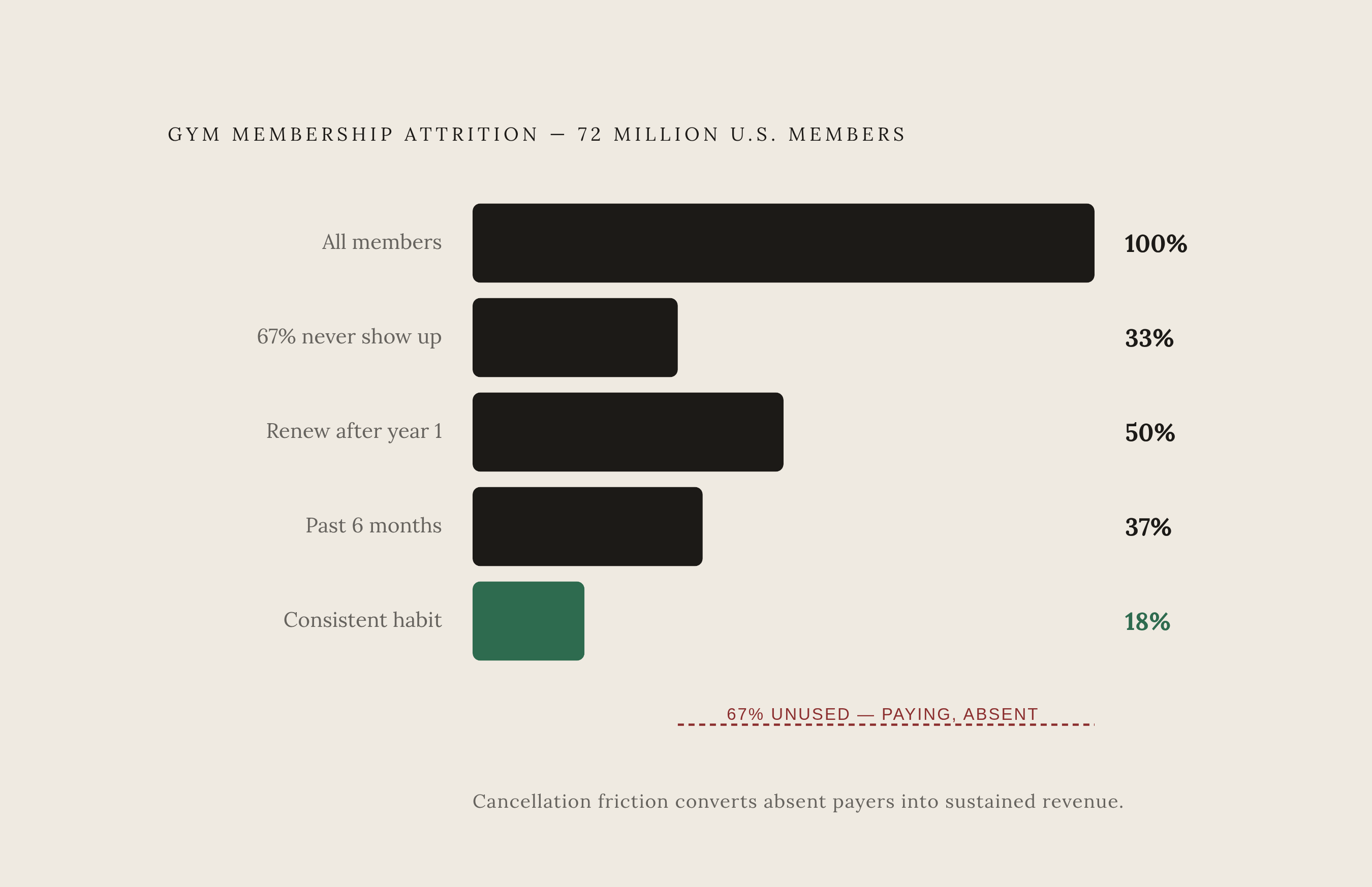
About 72 million Americans pay for a gym membership, roughly 22% of the population. And 67% of those memberships sit unused, month after month, while the charge keeps hitting the card. That gap between "I pay for this" and "I use this" is where the real story lives, and the reason it persists isn't laziness. It's that every chain buries its cancellation process behind a different set of rules, and most people don't find out what those rules are until they're already trying to get out.
Only about half of members even renew after a year. The ones who leave cite cost, time, and life changes, and 63% quit within the first six months. Just 18% work out consistently enough to call the membership a habit rather than a subscription. MyProtein's survey put the average waste at up to $319 a year per person on memberships nobody bothered to cancel. One widely cited estimate puts the national total at $1.3 billion a year in payments for gym time nobody used; a separate, older Finder.com figure puts it closer to $1.8 billion. Either way, the number is large enough that "just cancel it" deserves a real answer, chain by chain.
What gym contracts actually obligate you to, before you try to cancel
Almost every gym contract runs in two phases. First comes a commitment term, where you're locked in and an early termination fee applies if you bail. After that, you drop into month-to-month, where you can generally leave anytime, no fee attached. The rules are night and day between the two phases, and knowing which one you're in changes everything about how to proceed.
Watch for the annual fee too. It's separate from monthly dues, and it tends to get billed mid-contract, sometimes right before you were planning to cancel. Timing your cancellation around that date is part of the math, not an afterthought.
Price tiers matter here. Budget gyms run $10 to $30 a month. Mid-range clubs land at $30 to $60. Luxury clubs can run $150 to $350 or more. The average monthly gym fee in 2024 was $69, but the median was only $38, which tells you something: a small number of expensive clubs are pulling that average way up, while most people pay closer to budget-tier prices. Getting the cancellation process wrong costs a Planet Fitness member a few dollars. Getting it wrong at a luxury club costs real money.
One more trap: add-on memberships. Personal training packages, guest passes, add-on classes, these are frequently separate contracts from your base membership. Canceling the gym doesn't cancel the trainer package. Before starting anything, track down your original membership agreement, your billing confirmation emails, and the mailing address of the specific club you signed up at. That paperwork is the whole ballgame.
Planet Fitness: in-person or certified mail, with a $58 buyout if you're still in term
Planet Fitness memberships run cheap, $10 to $24.99 a month, so the monthly stakes are low. But cancellation still requires either an in-person visit to your home club to fill out a cancellation form, or a certified letter sent to that club's mailing address. Some membership types and locations do allow online cancellation, but that's not universal: call your home club first and ask before planning a trip you didn't need to take.
If you're still inside your minimum-term contract, expect a $58 buyout fee to cancel early. And watch the calendar around the annual fee, $39 to $49, billed once a year. Cancel a few days after that fee posts and you've paid for twelve months of access you're walking away from.
Better Business Bureau records show more than 2,500 complaints against Planet Fitness in the last three years, with billing problems among the most common. And here's the detail that trips people up: "home club" isn't a suggestion. Planet Fitness processes your cancellation through the specific location where you originally signed up, not any location near you now.
Equinox: an attorney general settlement changed the rules in 2025
Equinox memberships can run past $500 a month in major cities, so a cancellation mistake here isn't a rounding error, it's real money. Before May 2025, members reportedly could only cancel during their first year if they moved more than 25 miles from a location, a restriction that wasn't disclosed when they signed up.
That changed after a May 2025 settlement with the New York Attorney General. Equinox now accepts cancellations by email, at Cancellations@Equinox.com, and through its online portal. In-person visits are no longer required. A 30-day written notice is still part of the process. Members past their first 12 months can cancel anytime with no fee. Members still inside that first year owe an early termination fee of $50 to $100, unless they qualify for an exception: relocation, a documented medical condition, or military deployment. Unused prepaid months get refunded on a prorated basis.
The Equinox case is worth remembering for a reason beyond Equinox itself: policies change. What was true a year ago at any given gym may not be true today, and checking the current policy before assuming the old rules still apply is worth the five minutes it takes.
LA Fitness: mail or in-person, and an active FTC case over deliberate delay tactics
LA Fitness accepts cancellation two ways: in person at any location with a written cancellation request, or by certified mail sent to P.O. Box 54170, Irvine, CA 92619-4170. Some states allow email or account-portal cancellation, so check your membership agreement or call the club directly to find out if that applies where you live.
Contracts with an initial term of three months or more carry a termination fee if you cancel early. That part is standard. What's not standard: in August 2025, the FTC filed a case alleging LA Fitness trained staff to actively delay cancellation requests, a specific, documented allegation of the kind of institutional friction that usually stays invisible. That case is ongoing as of this writing, so treat it as an allegation, not a finding of wrongdoing.
Given that, request written proof, a receipt or a confirmation email, the moment you submit a cancellation request. If billing continues after you think you've canceled, that piece of paper is the difference between a quick fix and a drawn-out dispute.
24 Hour Fitness, Anytime Fitness, and Gold's Gym: what varies by location and what to check first
24 Hour Fitness gives members the most digitally accessible process of the group. Cancel by calling 866-308-8179, by calling the local club directly, or by filling out the online cancellation form. Add-on memberships still need to be canceled separately, or the charges keep coming. Early cancellation fees apply only if you're inside your commitment period; month-to-month members generally owe no cancellation fee.
Anytime Fitness works differently because each location is independently owned. Corporate doesn't set the cancellation policy, the individual franchise does. Online cancellation options are limited or unavailable at most locations, so phone or in-person is typically required. Your signed agreement is the only real source of truth on your specific fees and notice period, find it before calling. One contract that circulated on Reddit showed a substantial early termination fee paired with a 30-day written notice requirement, but that number isn't universal, your location may differ entirely.
Gold's Gym varies by location too: phone, email, or in-person, depending on the club. A handful of Pacific Northwest locations allow online cancellation. Most locations require 30 days written notice. Early cancellation fees apply unless you can document a move of more than 25 miles or provide a doctor's note confirming you can't work out.
Across all three chains, the same rule holds: read the contract you actually signed. What's posted on the gym's website today may not match the terms printed on your paperwork.
The relocation loophole and other legitimate exceptions that waive cancellation fees
Most major chains, Planet Fitness, LA Fitness, 24 Hour Fitness, and Anytime Fitness, will waive cancellation fees if you move more than 25 miles from any of their locations. You'll need documentation: a utility bill, a lease, or official mail showing the new address. Keep copies of whatever you submit.
Medical hardship is a second path. A doctor's note documenting an injury or condition that prevents exercise is accepted by several chains as grounds for fee-free cancellation. Military deployment is a third exception, and several chains accept active-duty orders as qualifying grounds for fee-free cancellation independent of their standard contract terms. Equinox lists all three, relocation, medical condition, and military deployment, explicitly as qualifying exceptions for members still in their first year.
These aren't loopholes in the sneaky sense. They're real consumer protections. They go unused mostly because gyms have no incentive to advertise them, and members simply don't think to ask.
The FTC's Click to Cancel rule, why it was struck down, and what fills the gap now
On October 11, 2024, the FTC finalized its Click to Cancel rule: if a business lets you sign up online, it has to let you cancel online too, no redirects, no forced phone calls, no dead-end forms. It sounded like exactly the fix this whole industry needed.
Then, on July 8, 2025, a federal court vacated the rule, just days before it was set to take effect, ruling that the FTC hadn't followed proper rulemaking procedure. So gyms can still legally require an in-person visit, a certified letter, or a phone call to cancel, even when signing up took thirty seconds on a website.
The complaint numbers tell you how big the underlying problem still is. The FTC logged an average of 42 complaints a day in 2021 about negative-option and recurring billing practices; by 2024 that had climbed to nearly 70 a day. The agency's case against LA Fitness in August 2025 shows it's still pursuing individual enforcement even without the broader rule behind it.
State law is picking up some of the slack. New York, as of 2024, requires gyms to accept cancellations through multiple channels and issue refunds within roughly 10 business days, giving members a short window after signing to reconsider. Other states have pursued similar consumer protections. California has its own subscription-cancellation protections on the books. Practically speaking, this means your cancellation rights depend a great deal on your zip code: New York and New Jersey residents have real legal backing here that residents of most other states don't.
Hidden fees and billing patterns that keep charges running after you think you've canceled
Making cancellation hard is profitable. A report from the Groundwork Collaborative found that friction in the cancellation process can boost corporate revenue by more than 200%. That's not a side effect of bad customer service, it's the business model working as intended.
The billing problems that follow tend to look similar across chains: charges that continue because a cancellation request was never confirmed in writing, add-on memberships that survive the main cancellation because nobody thought to cancel those separately, annual fees that post after the cancellation request went in but before it took effect. Planet Fitness's $39-to-$49 annual fee is a common flashpoint here. If it bills within days of your cancellation request, there's a legitimate case to dispute it, but only if you can prove exactly when you submitted that request.
Zoom out and the pattern gets bigger. Subscription services across categories have a habit of quietly raising prices, and multiplied across a household's full subscription list, it adds up fast. The Groundwork Collaborative's "annoyance economy" report estimates that hidden fees, billing hassles, junk charges, and related friction cost Americans roughly $165 billion a year across all consumer spending, not just gyms. Gym memberships are one line item in that pattern, not the whole story.
The fix, at minimum: always get written confirmation of a cancellation, an email, a receipt, a letter, and then check your bank statement for at least a couple of months afterward to make sure the charge actually stopped.
What to do when a gym won't process your cancellation
Start by documenting everything: dates, names of staff you spoke with, copies of anything you sent in writing. That record is what turns a frustrating phone call into a winnable dispute.
If the gym keeps billing after a documented cancellation request, a chargeback through the bank or credit card issuer is a legitimate tool, not an overreaction. File a complaint with the FTC directly at ReportFraud.ftc.gov, since complaint volume feeds directly into which businesses get prioritized for enforcement. State attorneys general are worth contacting too: the Equinox settlement traces straight back to the New York AG's office, and state-level complaints have a track record of producing real policy change, not just a written apology.
For anything that escalates past a phone call or an email chain, a consumer protection attorney is worth consulting, and some states allow small claims court for disputed membership fees. Living in New York or California gives an added advantage here: strong automatic-renewal laws mean the state AG's office is often the fastest path to a resolution, faster than fighting the gym directly.
Why gym memberships are a useful test case for a broader subscription problem most people aren't watching
Gym memberships are just the most visible version of a much wider pattern: a charge that keeps running long after it stopped being worth the money. Streaming services do the same thing. So do software subscriptions, free trials that quietly converted to paid plans, and annual renewals nobody remembered agreeing to. None of these charges announce themselves when they turn into waste. They just keep hitting the account, month after month, until someone notices, remembers, and actually acts.
That's the real difficulty. It's not that people can't figure out how to cancel a gym membership once they decide to. It's that most people don't have the bandwidth to re-check every recurring charge on their statement every single month, for years, across every subscription they've ever signed up for. Canceling one unused gym membership today doesn't stop a new one, or a forgotten streaming trial, from slipping through six months from now.
This is where ongoing account monitoring earns its place. Tools that connect to bank accounts and email, in read-only mode, can flag a subscription that's gone unused, a price that quietly crept up, or a charge that kept running after a cancellation request should have stopped it. Compass+ is built around exactly that job: it watches connected accounts continuously, flags recurring charges that have increased or gone stale, and hands back each finding with a specific dollar figure and a clear next step, so the user isn't the one who has to comb through months of statements looking for the leak.
The gym membership problem has a solution once someone knows the policy: call the right number, send the right letter, get it in writing. The bigger subscription problem doesn't work that way. It only gets solved by something that's watching all the time, because the charges that hurt the most are never the ones anyone remembers to check.