FTC Regulations on Automatic Subscription Renewal Disclosures
The rule that was supposed to fix subscriptions got killed before it took effect.
The FTC's Negative Option Rule was supposed to fix subscriptions for good, requiring clear terms before you pay, a cancel button as easy as the signup button, and no more hoops. It got vacated in July 2025, three months before most of it ever took effect. What that ruling actually means for the money leaving your account every month is a lot narrower than the headlines made it sound.
Why the rule was vacated and why enforcement continued
The Negative Option Rule, officially the "Rule Concerning Recurring Subscriptions and Other Negative Option Programs," was announced October 16, 2024. It had four core requirements: no material misrepresentations in a negative option program, clear disclosure of terms (price, frequency, how to cancel) before billing info gets collected, express consent obtained as its own separate step, and a cancellation process that's just as easy as signing up. The rollout was staggered. The misrepresentation piece kicked in January 14, 2025. Disclosure and consent were supposed to follow on May 14, then got pushed to July 14, alongside the "click to cancel" requirement.
None of it made it. On July 8, 2025, six days before that deadline, the Eighth Circuit vacated the entire rule.
The Eighth Circuit's ruling isn't what most people assume. The Eighth Circuit didn't rule that the substance of the rule was wrong. It ruled on procedure: the FTC skipped a preliminary regulatory analysis required for any rule expected to affect the economy by $100 million or more annually. That's a paperwork failure; grayed-out cancel buttons and 20-screen retention loops remain illegal under the standards still in force. The court never even reached the merits.
So enforcement didn't stop. Section 5 of the FTC Act, which bars unfair or deceptive practices, was never touched. Neither was ROSCA, the Restore Online Shoppers' Confidence Act, which already required clear disclosure and easy cancellation for online negative-option sales. Those statutes pre-date the vacated rule and remain the FTC's working toolkit. By March 2026 the agency had opened an Advance Notice of Proposed Rulemaking to try rebuilding the rule properly, and FTC Bureau of Consumer Protection Director Christopher Mufarrige said publicly that same month that fighting deceptive subscription practices stays a priority. The ANPRM is also reopening questions the original rule left half-answered: retention offers, "save" flows, and the role of third-party billing processors.
The vacatur changed which legal lever the FTC pulls. It didn't touch what counts as deceptive.
Enforcement Against Amazon, Uber, and Others
Court filings and settlements are, honestly, the clearest map of what regulators consider a violation. A few recent cases spell it out in detail.
Amazon settled with the FTC in a federal court order entered September 25, 2025, over Prime enrollment and cancellation. The number alone should stop you: $1 billion in civil penalties plus $1.5 billion set aside for consumer refunds, the a major subscription enforcement action. The order now requires Amazon to disclose material Prime terms clearly, give shoppers an unambiguous way to decline Prime at checkout, and let people cancel through the same method they used to sign up. The underlying allegation was straightforward: consent that wasn't really informed, and a cancel process built to be harder than enrollment.
Uber is still fighting a similar case. The FTC sued Uber on April 21, 2025, in the Northern District of California, alleging Uber One used small grayed-out text to bury cancellation and pricing terms at signup. The complaint claims some customers had to click through as many as 23 screens to cancel, got looped back to earlier screens, or were told to call support with no number provided. It also alleges Uber sometimes charged the renewal fee before the billing date or before a trial even ended, and advertised savings that didn't materialize. The FTC wants a permanent injunction and refunds.
Then in January 2026 the FTC filed against JustAnswer, alleging customers believed they were paying a one-time fee when they'd actually been enrolled in a recurring subscription. The FTC's filing treats framing a subscription as a one-time charge as a core allegation of deception.
The dollar exposure here isn't abstract. Penalties under the FTC Act run up to $51,744 per violation. Multiplying that by even a modest customer base leaves a company staring at real money. For a subscriber trying to spot trouble before it happens, the pattern across these cases is consistent: grayed-out or tiny text, cancellation flows with far more steps than signup, and advertised savings that don't show up on the actual bill.
The state patchwork now filling the federal gap
With the federal rule gone, states didn't wait around. Roughly 30 states now have their own auto-renewal statutes, and several go further than what the vacated federal rule would have required.
California's AB-2863 took effect July 1, 2025, and set a high bar: affirmative consent to auto-renewal, 7 to 30 days' notice before any price increase (even ones you already agreed to in advance), cancellation through the same medium used to sign up, and a rule that retention offers are only allowed if a cancel button sits right there on the same screen. Arkansas passed its first-ever auto-renewal law, HB1820, effective August 3, 2025, closely mirroring California's approach.
Colorado's SB 25-145 requires a one-step online cancellation link, with the cancellation piece effective August 6, 2025, and a broadened definition of "consumer" (arguably reaching some B2B subscriptions) landing February 16, 2026. Massachusetts issued final regulations through its Attorney General's office, effective September 2, 2025, that require written disclosure even for offers made verbally, cancellation as easy as signup, written renewal reminders 5 to 30 days out, and clear written terms for any trial offer. Connecticut's SB3, effective July 2026, adopts California's language defining "clear and conspicuous" and treats recordkeeping of consent as a compliance factor regulators will actually check.
New York's omnibus bill (S-3008, Part W), effective November 5, 2025, handles price increases directly: a business either gets your affirmative consent to the new price, or lets you cancel penalty-free within 14 days of the first charge at that price, with a pro-rated refund. Maine's SP 650, effective January 1, 2026, requires consent to the auto-renewal provision specifically, separate from consent to the purchase itself. Maryland passed its first auto-renewal statute, requiring clear disclosure, reminder notices, and same-medium cancellation.
Congress has a bipartisan answer sitting on the table too. The Unsubscribe Act, introduced in January 2026, would set one federal standard instead of this state-by-state quilt. Congress has not passed it. Until it does, where someone lives determines what protection they actually have, and in California, Massachusetts, and New York, that protection is arguably stronger than the vacated federal rule ever would have been.
The specific rights subscribers can act on right now
Stripping away the legal citations leaves a subscriber with a short, usable list of what they're owed, and where.
Before any card gets charged, a company has to tell someone the price, how often they'll be billed, and how to cancel, and that information can't be buried three pages into a terms-of-service document. Consent to auto-renewal has to be its own distinct action, not something implied by clicking "submit" on an unrelated purchase. Trial offers, under both FTC standards and Massachusetts's new rules, need to spell out what gets charged, when, and how to back out before the clock runs out.
Cancellation has its own set of guarantees. Nobody who signed up online can be told to call a phone number instead. The cancel flow has to match the signup flow in complexity, not multiply it. A company is allowed to offer a discount or a pause to keep someone from leaving, but only if a plain cancel button sits on that same screen, under California, Colorado, and Arkansas law.
Price increases carry their own protections in the states that have addressed them. New York gives subscribers 14 days after a price hike takes effect to cancel and get a pro-rated refund, unless they affirmatively agreed to the new price first. California requires 7 to 30 business days of advance notice before any increase, full stop, even for people who pre-consented to future hikes.
Reminder notices aren't a courtesy anymore in some states, they're law. Massachusetts mandates written reminders 5 to 30 days before a renewal deadline. New York requires advance notice before the first post-trial charge, for any trial running longer than a month.
When a company blows past these lines, the fix is procedural: screenshot the signup flow and every cancellation attempt, file with the FTC through ReportFraud.ftc.gov, file with the state attorney general too, and call the bank for a chargeback. The legal groundwork from Amazon, Uber, and similar cases backs up a consumer's position in that dispute.
Free Trials as the Highest-Risk Moment
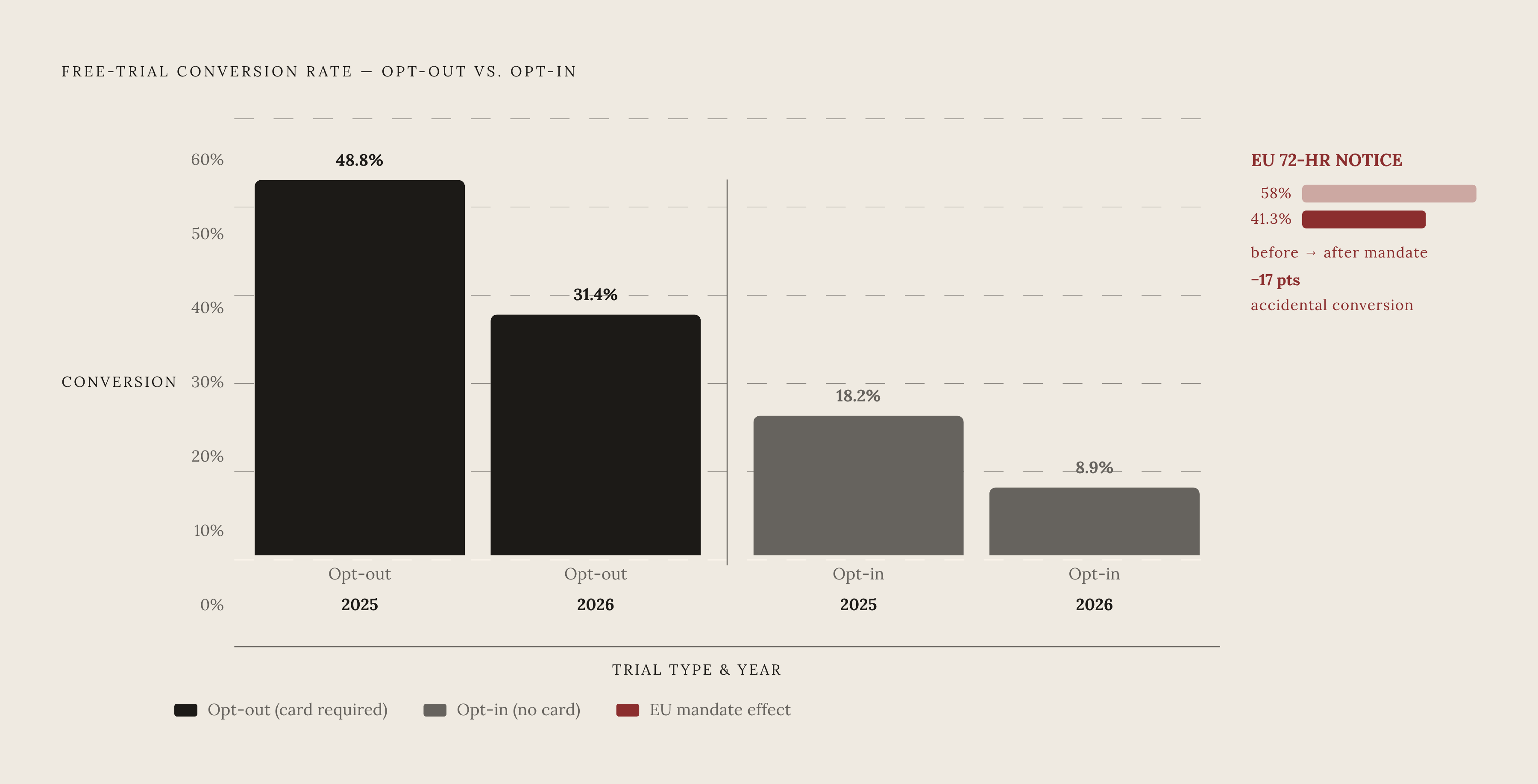
The free trial is where most of this actually goes wrong, and the data on why is stark. Trials that require a credit card upfront, the opt-out model, convert to paid subscriptions at far higher rates than trials that don't ask for payment info. Per 2025-2026 figures from PulseAhead, opt-out trials converted at roughly 48.8% in 2025 and 31.4% in 2026, compared to 18.2% and 8.9% for opt-in trials over the same years. That gap is the entire reason the opt-out model is everywhere.
Published figures show something telling: when the EU required 72-hour advance notice before a trial converted to a paid charge, opt-out conversion rates fell from 58% to 41.3%. Advance notice alone, no other change, moved behavior by 17 points. That number is really a measure of how many people were converting by accident, not by choice.
The current legal requirements try to close that gap directly. Massachusetts demands written disclosure of the financial obligation, what's covered, and the exact cancellation deadline, delivered at the time of the trial offer itself. New York requires notice 3 to 21 days before the cutoff on any trial running longer than a month. California requires same-medium cancellation and 7 to 30 days' advance notice on price increases regardless of prior consent.
The practical advice holds regardless of jurisdiction: set two reminders, one at seven days before a trial ends and one at three days out, because cancellation requests don't always process the instant you submit them. The Consumer Federation of America recommends exactly this, calendar reminders tied to trial end dates, and flags a specific pattern: if a company takes payment online but still makes you call to cancel, that's a legal red flag under the standards now in force, not just an inconvenience.
How bill creep works after the trial ends and why it's hard to catch by hand
Bill creep is slower and more diffuse than a single price hike. It's slower and more diffuse than that. That's why it's harder to catch. A promotional rate quietly expires after 12 months and the account rolls to standard pricing. A service with a lower introductory price rolls to a higher one with little or no notice. A streaming tier gets renamed and repriced in the same update. An AI feature gets switched on by default starting next billing cycle, with its own line item attached.
None of these appear as one dramatic charge. They appear as a dollar or two extra, scattered across six or eight different subscriptions, none of which individually looks worth disputing. This kind of drift across streaming and software services, small per-service increases that add up fast, is the pattern regulators and consumer advocates have flagged repeatedly.
Catching that by scanning a bank statement once a month doesn't really work, because the whole mechanism depends on each individual change being too small to notice. Companies count on the fact that most people won't track terms closely enough, or won't have the time to chase down a two-dollar increase across a dozen accounts, the same dynamic behind the Amazon and Uber cases, just quieter. Software built to watch for exactly this, tools like Compass that use an AI agent to flag price changes, surprise renewals, and duplicate charges as they happen, exist because that gap between what the law requires and what actually gets enforced day to day is still wide open. The legal rights still apply, in every state listed above and under federal law that never went away. Whether anyone catches the violation in time is still, mostly, on the subscriber.
Sources
- Updated California and FTC Auto-Renewal Regulations Take Effect | Paul Hastings LLP
- FTC Signals Enforcement on Auto-Renewing Subscriptions and Sales | Insights | Holland & Knight
- Automatic Renewal Mid-Year Update: Legal Landscape Imposes Increasingly Complex Obligations on Subscription Businesses
- States Press Forward with Automatic Renewal Laws Amidst Vacating of the FTC’s Negative Option Rule
- Spring Cleaning Your Subscription Practices: What to Toss Before Regulators Do
- Auto Renewal and Subscription Compliance | Fasthoff Law Firm PLLC
- U.S. FTC Click-to-Cancel Rule Struck Down | Insights | Sidley Austin LLP
- kirkland.com