Undelivered or Damaged Package Refund Process by Carrier
Know your carrier's deadline and documentation rules before filing a claim.
SafeWise's Annual Package Theft Report found that roughly 104 million packages went missing from doorsteps in 2025, adding up to $15 billion in losses. That's about 250,000 packages a day. Theft is only part of the picture, too: a HubBox survey found 53% of shoppers in one country's market. orders arrived late, damaged, or at the wrong address entirely. Most of that money is recoverable. Recovery depends on knowing which carrier's rules apply, what deadline governs the claim, and what paperwork to have ready before filing, because missing a window by even a day usually means forfeiting the claim outright.
This piece breaks down that process, carrier by carrier, so anyone filing a claim already knows what to expect before they start.
Who is responsible when a package doesn't arrive, the seller, the carrier, or you
Start here: in most consumer purchases, the seller carries the risk until the package physically reaches the buyer. Under UCC §2-509, a merchant seller doesn't hand off risk of loss until the buyer actually receives the goods. That means a lost or damaged shipment is the seller's problem to sort out with the carrier.
The FTC's Mail, Internet, or Telephone Order Rule backs this up. Sellers have to ship within the timeframe they promised, or give the buyer the option to cancel for a full refund. So the right first move, almost always, is contacting the retailer. The retailer holds the shipping contract. They're the ones with leverage over UPS, FedEx, or USPS, not the person who placed the order.
If the buyer arranged their own carrier separately from the seller's shipping options, risk shifts to the buyer the moment the seller hands the package off. That's uncommon in everyday retail, but it happens with freight and some marketplace transactions.
One more thing sellers can't hide behind: a tracking scan that says "delivered." Delivery confirmation is not the same as actual receipt. A scan proves the driver marked it delivered. It doesn't prove the box landed in the buyer's hands, so a seller pointing to that scan as case-closed isn't telling the whole story.
If the seller won't budge or goes quiet, filing directly with the carrier becomes the next move, run in parallel rather than instead of pressing the seller. And if both routes dead-end, credit card chargebacks under the Fair Credit Billing Act and an FTC complaint at reportfraud.ftc.gov exist as backstops. More on those later.
What every carrier claim has in common: documentation, timing, and the consequences of throwing the box away
Every carrier claim, regardless of who's processing it, comes down to the same three things: documentation, timing, and the existence of physical evidence. Skip any one of those and the claim is dead on arrival.
The documentation kit looks about the same everywhere:
- Photos of the damaged item, multiple angles
- Photos of the inner packaging, the cushioning or void fill that surrounded the item
- Photos of the outer box, showing crushed corners, punctures, or water damage
- A photo of the shipping label and tracking barcode
- Proof of value: the original invoice, order receipt, or marketplace sales record
Don't throw out the box. This is the single most common way people torpedo their own claim. Carriers can require a physical inspection, and if the packaging's already in the trash, there's nothing left to inspect. For damage claims specifically, the outer packaging needs to show real, visible damage, because if the box looks fine on the outside, the carrier's default assumption is that the damage happened before it ever left the warehouse, and the claim gets denied automatically.
Somewhere between 20% and 30% of damage claims get denied for exactly these reasons: bad packaging, late filing, thin evidence. Denials aren't always final, though. Most carriers allow an appeal if the filer submits better documentation afterward.
None of this happens automatically. No carrier is scanning its own network for late or lost packages and cutting checks unprompted. The claimant has to file, and has to do it inside a specific window. Those windows are where things get carrier-specific, and that's the whole reason this matters: the rules below aren't the same across USPS, UPS, FedEx, and Amazon. Treating them as interchangeable is how people miss deadlines.
USPS: the 60-day window, what Priority Mail covers, and why "delivered" kills a claim
USPS builds in $100 of coverage automatically on Priority Mail and Ground Advantage labels that carry a USPS Tracking barcode. No add-on purchase required.
Either the sender or the recipient can file, but whoever files needs the original mailing receipt in hand. In practice, that usually means the seller should file, since they're the one holding proof of value.
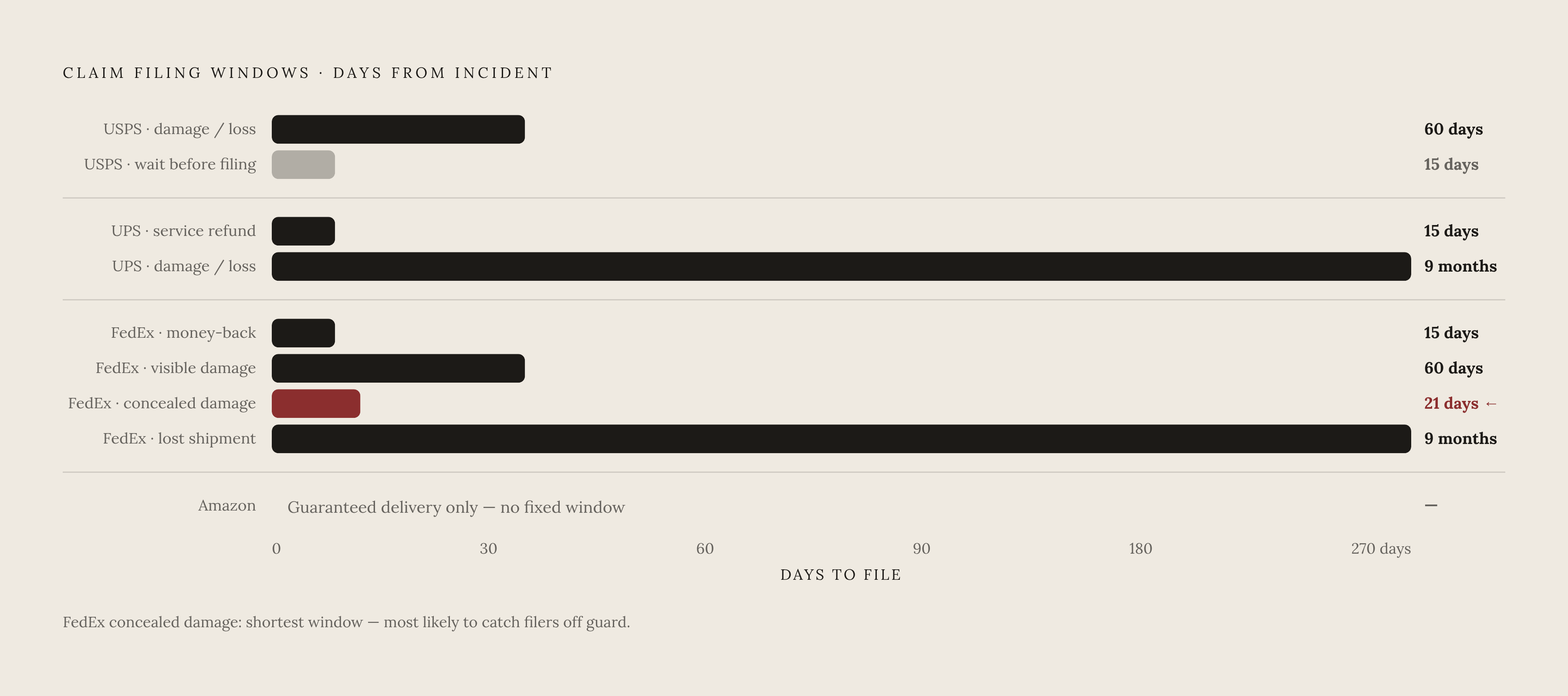
Damage claims can go in right away, no waiting period, and USPS gives claimants up to 60 days from the mailing date to file. Lost packages work differently: there's a mandatory waiting period before USPS will even accept the claim. Priority Mail Express requires a 7-day wait after the mailing date; Priority Mail and Ground Advantage both require 15 days.
If USPS's tracking system shows the package as "delivered," the claim path closes, period, even if the recipient does not actually have the package in hand. That's a hard stop.
To file, head to usps.com/help/claims.htm, sign in with a free USPS account, enter the tracking number, and select the issue as damage or missing contents. Upload the proof of value and damage photos there. USPS sometimes asks the recipient to bring the damaged item and its packaging into a Post Office in person, which is one more reason the box shouldn't hit the recycling bin early.
Claims decisions usually land within 5 to 10 days. Once approved, payment arrives in 7 to 10 business days. USPS won't pay out more than the item's actual value, so inflating a claim doesn't help. If a claim comes back denied or only partially paid, there's a 30-day window from the decision to file an appeal. Worth turning on email notifications when filing online; claims history stays visible in the USPS.com account afterward.
UPS: $100 automatic coverage, the 9-month claim window, and the 15-day deadline that's easy to miss
Every UPS package ships with $100 of liability coverage built in, free. Anything more than that has to be purchased when the label gets created, not tacked on after the fact once something's already gone wrong.
UPS splits recovery into three separate paths, and picking the wrong one wastes time:
- Guaranteed Service Refund (GSR): the package missed its guaranteed delivery time on an eligible service
- Lost or damaged package claim: tracking's gone quiet, or the package showed up damaged
- Billing dispute: a wrong surcharge or a duplicate charge on the invoice
Only a handful of domestic services currently carry a delivery guarantee: a carrier's Next Day Air Early, Next Day Air, Next Day Air Saver, and 2nd Day Air morning-delivery option. Ground and standard 2nd Day Air aren't currently guaranteed, so a GSR claim on those services won't go anywhere.
The GSR deadline is tight: 15 calendar days from the scheduled delivery date. Miss it, and the refund's gone for good, no exceptions. Damage and loss claims get a much longer runway, 9 months from the delivery date domestically, 60 days for international shipments.
Either the sender or the recipient can file a damage claim, but filing through the sender's UPS account tends to move faster since they usually have full access to shipment records. Depending on how the original shipment was set up, UPS may route the payment back to the shipper's account rather than the recipient's.
Filing happens through the UPS Claims Dashboard at ups.com. Enter the tracking number, select damage, then upload photos along with documentation of value, an invoice or a certification of costs. UPS may want to physically inspect the package, so the item and all its packaging need to stay put until the claim resolves.
One packaging detail specific to UPS: slapping a "Fragile" sticker on the box does nothing. UPS doesn't honor those markings. The packaging itself has to actually protect the contents, or the claim gets denied regardless of what the label said.
Standard damage claims usually resolve in 8 to 10 business days. Cases that need a physical inspection can stretch to 15 business days. Once approved, payment arrives by electronic transfer within 2 to 3 business days, UPS doesn't cut paper checks anymore. And on GSR refunds specifically: approval covers the transportation charges, credited or refunded to whoever paid for shipping. It doesn't cover surcharges or the full invoice.
FedEx: three recovery paths, a 60-second rule, and the service suspension that changes what's eligible
FedEx runs the same three-path structure as UPS, with its own set of rules layered on top:
- Money-Back Guarantee (MBG) refund: the package missed its delivery commitment on a currently guaranteed service
- Lost or damaged package claim: tracking's gone dark, or the package arrived damaged
- Billing dispute: a wrong surcharge or duplicate charge
As of one carrier's current domestic Service Guide (domestic services effective January 13, 2026, international effective February 12, 2026), the guarantee only covers that carrier's First Overnight, Priority Overnight, Standard Overnight, 2 Day morning-delivery option, specific Extra Hours contract services, and a defined list of international services. Everything else, including Ground and Home Delivery, is suspended from the guarantee until FedEx says otherwise. That suspension matters enormously: if the service used isn't on that list, an MBG claim isn't even an option, no matter how late the package showed up.
FedEx defines a service failure with what amounts to a 60-second rule: delivery 60 seconds or more past the published commitment time counts as a miss, but only when the shipment rode on a currently guaranteed service, no exclusion applies, and the refund request gets filed on time.
That timing matters just as much as the delay itself. The MBG deadline is 15 calendar days from the invoice date for invoiced shipments, or 15 calendar days from the ship date for anything paid by credit card, cash, check, or money order upfront. An approved MBG refund covers the eligible transportation charges.
Damage and missing-contents claims run on a different clock entirely. Visible damage gets 60 calendar days from the shipment date to file. Concealed damage, where the box looked fine but something inside broke, only gets 21 days, a much tighter window that catches people off guard. Lost or undelivered shipments get 9 months.
Default liability is $100 for the contents of most shipments. FedEx Ground Economy carries no liability coverage at all, so damage or loss on that service isn't recoverable through a standard claim.
None of these MBG refunds happen on their own. FedEx doesn't proactively issue them, someone has to file the request inside the deadline. Before filing anything, confirm the shipment actually rode on a currently guaranteed service. If it didn't, the MBG path is closed, and the correct route is a lost/damaged claim or a billing dispute instead.
Amazon: guaranteed delivery dates vs. estimated delivery dates, and what compensation looks like in 2026
Amazon sits in an unusual spot: it's the retailer and, increasingly, the carrier too. A single order might move through Amazon Logistics, USPS, UPS, or a third-party seller's own shipping arrangement, and each of those carries a different chain of responsibility.
The single most important detail is the difference between a guaranteed delivery date and an estimated one. A guaranteed date is a firm commitment, shown at checkout and repeated in the order confirmation email. An estimated date is just Amazon's best guess. Only orders with a guaranteed date qualify for compensation if delivery slips. Estimated dates don't create any entitlement, no matter how late the package runs.
Amazon shifted its compensation approach in 2026. The old model of blanket Prime extensions for late deliveries is gone. In its place: targeted refunds and account credits, scaled to the actual issue. Current options include shipping fee refunds, promotional credits, Prime membership extensions, partial refunds, and in some cases a full refund while letting the customer keep the item.
For packages that go missing entirely, if the item comes back to Amazon marked undeliverable, a refund follows where applicable. For third-party marketplace orders specifically, Amazon's A-to-z Guarantee kicks in if the seller's response is unsatisfactory, or if there's no response within two business days. That's a separate mechanism from Amazon's own logistics compensation, worth knowing since so much of Amazon's marketplace runs through outside sellers.
Scale matters for context here. Amazon's delivery network hit record performance in 2025, with more than 13 billion items arriving same-day or next-day globally. The compensation system is built to handle exceptions, not to manage a widespread failure rate. Before filing anything, check the order confirmation email for the exact wording. "Guaranteed" versus "estimated" decides the whole question before any other step matters.
When the carrier and seller both say no: credit card chargebacks, FTC rules, and escalation paths
If the seller flatly refuses responsibility, the FTC's Mail Order Rule gives grounds to demand a refund or replacement before pulling in outside help.
The Fair Credit Billing Act is the strongest tool available once a seller stonewalls. Consumers have a limited window from the date a charge posts on their statement to dispute it. Contact the card issuer directly, frame the dispute as non-delivery or item not as described, and the issuer takes it from there, investigating and reversing the charge if the dispute holds up.
Filing a complaint at reportfraud.ftc.gov won't put money back in anyone's account directly, but it builds a record, and enough of those records in one place tend to draw regulatory attention. A state attorney general's consumer protection office is another avenue to try, especially when a seller shows a pattern of refusing legitimate claims rather than a one-off mistake.
For purchases made through PayPal rather than a credit card directly, PayPal's Purchase Protection covers items not received or not as described, with a 180-day window from the purchase date, considerably longer than the credit card dispute window.
Carriers themselves also allow internal appeals if a claim gets denied the first time around. USPS gives claimants 30 days from the decision to appeal. Most carriers allow an appeal if the filer submits better documentation afterward.
None of this works if the deadline's already passed, which is really the whole problem. Money sits recoverable in a bank statement or an old email confirmation, and it just quietly expires because nobody was tracking the clock. Compass, built to monitor accounts in the background for exactly this kind of missed refund, can flag a package reimbursement that already landed, or catch a deadline before it closes, without requiring anyone to manually track USPS's 60 days against UPS's 15 against FedEx's 21-day concealed-damage window. The carriers built the deadlines. Somebody still has to watch them.
Sources
- FedEx Refund: Eligibility, Policy & How to Claim (2026)
- Package Damaged in Transit: What to Do (Seller's Guide 2026) | Ship.com | Shipping Made Simple
- Package Stolen or Never Delivered: How to Get a Refund in 2026
- Damaged Package Claims — How to Get Reimbursed
- parcelpath.com
- parcelpath.com
- FedEx Service Guide - Money Back Guarantee
- usps.com