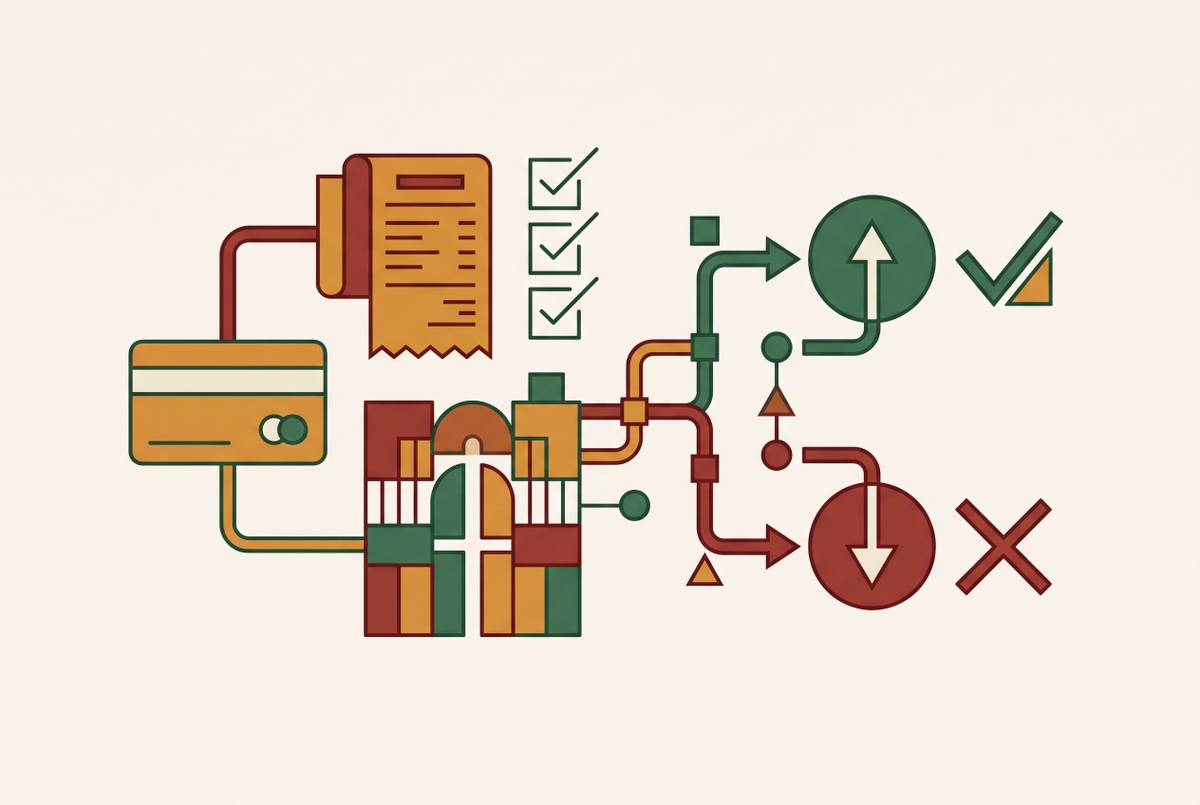
Tracking Unconfirmed Refunds Before They Disappear
Retailers and subscriptions hide refunds behind expiration dates most shoppers miss.
A price drop two days after you buy something isn't a loss unless you let it be. Most retailers will refund the difference, most subscription cancellations leave a door open for a "ghost charge," and the FTC is mailing out real refund checks right now that expire in 90 days if nobody cashes them. None of this is hidden exactly. It's just timed to run out while you're not looking.
A refund being owed and a refund being claimed are two different states, and the gap between them is where the money goes. Nobody denies you the refund. The window just closes.
How retail price-adjustment windows work
Price protection is a real policy at most major retailers, and most shoppers have no idea it exists. The mechanic is simple: buy something, the price drops within a set number of days afterward, and the retailer owes you the difference. Nobody tells you this at checkout. You have to know it, then act on it, inside a window that starts ticking the moment you pay.
The windows themselves vary a lot, and the variation changes how much time a shopper actually has to notice a price drop and file a claim before it's gone.
Target gives you 14 days to request a price adjustment against Target's own price drop. Best Buy offers a partial refund if the item drops in price at Best Buy or at one of its named competitors (Amazon, Costco, Walmart, Home Depot, Sam's Club, and a dozen others), within the standard return period. There's a holiday carve-out too: purchases made October 31 through December 31, 2025 can be price-matched through January 15, 2026. Costco gives 30 days, whether you bought online or in a warehouse. In-store purchases require a trip to the Returns counter at the specific warehouse where you bought the item. Costco does not match other retailers' prices, only its own drops. Crutchfield stretches the window to 60 days, and you can request the match by phone or chat. John Lewis in the UK runs a much tighter clock: 7 days from the date you placed the order, not from delivery. Amazon is the outlier here. It ended its formal price-drop refund policy back in 2016, and it's the only major retailer on this list with zero built-in protection of this kind.
Credit cards can add a second layer: some issuers offer their own price protection extending well past what most retailers give you, though exact terms vary by card and issuer. The exact terms depend entirely on the card and issuer, so it's worth checking your own benefits guide rather than assuming.
The friction here isn't just the clock, it's the fog around the clock. Ask three different customer service reps about a price-match policy and you might get three different answers. The burden of catching the drop, in every case, sits entirely on the shopper. Services like CamelCamelCamel and Keepa track Amazon price history (useful for timing a purchase, even without a refund path once you've already bought). But the spread from 7 days to 60 days means someone who shops across Target, Costco, and Crutchfield in the same month is quietly running three separate countdown timers, each with its own rules.
Subscription cancellation refunds and the ghost charge problem
Subscriptions are where the money adds up fastest, and where it's hardest to see. A YouGov survey for CNET, covering April 2024 to April 2025, found that 80% of adults in one country adults paid for at least one subscription during that stretch, spending an average of $1,080 a year. Of that, $205 went toward subscriptions nobody was using.
The undercount produces the real problem: people underestimate how many subscriptions they have, so they stop checking for charges they don't believe exist. Research from C+R Research found the average American thinks they have 3 active subscriptions, but actually carries a little over 5. Forty-two percent said they'd forgotten about a recurring charge at least once. On average, people underestimate their own monthly subscription spending by a substantial margin, one estimate puts it at $133. You can't claim a refund on a service you forgot you're paying for.
Cancellation itself is where the ghost charge lives. Cancel a subscription through an app store, and that doesn't necessarily cancel the billing relationship the underlying company has with you directly, the two systems often run independently of each other. So the charge continues, quietly, after you've already gotten a cancellation confirmation. Catching it requires checking again the following billing cycle, not just trusting the confirmation email.
The safer sequence: cancel inside the app, then confirm by email, screenshot both, remove your saved card if the service allows it, and check again next month regardless. The charge shows up anyway when the cancellation isn't confirmed and the saved card stays active, so the subscription renews on schedule.
Bill creep is the slower cousin of the ghost charge. Sixty-seven percent of consumers saw at least one subscription raise its price in the past year, often with barely any notice. Small per-service price bumps across multiple subscriptions quietly pushed many households meaningfully higher per month, without anyone actively deciding to spend more.
Regulation hasn't caught up, and that gap matters directly for anyone counting on rules to do the watching for them. The FTC's "click-to-cancel" rule got vacated by the Eighth Circuit in July 2025 on procedural grounds. A new Advance Notice of Proposed Rulemaking followed early in 2026, but as of this writing, no rule is actually in force. The bipartisan Unsubscribe Act, introduced in January 2026, would require a company to get your approval before charging you once a teaser period ends, but it hadn't passed either chamber as of early 2026.
States are filling in pieces of the gap on their own. Massachusetts now requires advance written notice, 5 to 30 days before renewal for subscriptions longer than 31 days, starting in 2025. Connecticut's version takes effect July 1, 2026. New York City proposed its own municipal "click to cancel" rule in April 2026, which would make it the first city, not state, to enforce protection at this level. The patchwork means your protection depends on your zip code, and enforcement is inconsistent enough that no consumer should assume the rules will catch a bad actor before the charge does.
The FTC's own enforcement record shows this isn't a hypothetical risk. Chegg paid $7.5 million over allegations that it made cancellation unreasonably difficult and kept billing customers after they'd already asked to cancel. In January 2026, the FTC filed action against JustAnswer, alleging it enrolled consumers in plans running $28 to $125 a month when those consumers believed they were paying a one-time join fee of $1 to $5.
FTC refund distributions: real money with a 90-day clock most people miss
The FTC is, right now, sitting on dozens of active refund programs, sending payments through 2026 to people affected by deceptive or unlawful business practices, subscription traps, fake debt relief operations, inflated earnings claims, overcharges. This isn't theoretical money. Checks are in the mail.
The detail that trips people up: recipients are asked to cash a refund check within 90 days. That deadline holds across FTC programs consistently. PayPal payments carry an even shorter fuse, 30 days to accept.
Some of the current programs, as listed on the FTC's own refund page:
Brigit Refunds (May 2026): the FTC sent over $9.8 million in payments in November 2024, then, with money still remaining, sent another 1,052,038 payments worth more than $6.8 million in 2026. Grubhub Refunds (August 2026): payments to drivers affected by deceptive earnings claims, and to diners hit by blocked accounts or blocked gift card redemptions, hundreds of thousands of payments totaling more than $23.8 million. Zurixx Refunds (June 2026): a second round, 19,744 payments worth more than $1.8 million, sent to people who'd already accepted their first payment. American Vehicle Protection Refunds (June 2026): a second round of 9,074 checks totaling more than $186,000. Golden Home Services Settlement (June 2026): almost $3 million going back to consumers who'd paid for mortgage debt relief.
- Also active: Amazon Refunds (September 2026), AT&T Data Throttling Refunds (August 2026), Ring Refunds (July 2026), University of Phoenix Settlement (July 2026), Credit Karma Settlement (April 2026), and FloatMe Refunds (April 2026).
Nobody notifies the public, individually, that a specific program applies to them. Checks and PayPal payments arrive with little context attached, which means plenty of people assume it's a scam and ignore it, not an unreasonable instinct, given that scammers do impersonate FTC refund programs. The FTC is explicit on this point: it will never ask anyone to send money or pay a fee to receive a refund.
The fact that Zurixx, American Vehicle Protection, and others are sending second (and in at least one case, third) rounds of payments, because money was left over after the first round went unclaimed, is itself the clearest evidence that people are missing these deadlines. The authoritative place to check is ftc.gov/refunds, directly.
The easiest refund to miss: late delivery credits
Delivery guarantees work on a promise: the retailer or carrier commits to a delivery date, and if they miss it, they owe a credit. But that credit almost never issues automatically. The consumer has to file the claim.
What sets this category apart from the others is when the clock starts. A price-drop window begins at purchase. An FTC check arrives with a deadline printed or implied on it. A delivery guarantee's window starts the moment the delivery is late, a moment most people don't register as the start of anything at all. It's just an annoyance, not a trigger.
That's exactly why the claim rate on these is so low. There's no notification that a guarantee was even missed, no prompt telling you to file anything. You have to independently connect the late package to a guarantee that existed, remember that guarantee applies, and act before a window that's typically short and varies by retailer and shipping method.
Catching this requires three things to happen at once: knowing the guarantee existed, noticing the delivery was late, and acting before the window shuts. That's a lot to ask of a person juggling five other things that same week, which is precisely why this category has the lowest claim rate of anything in this piece.
Why manual tracking fails each of these categories at scale
Add it up. A Target price-match window closing in 14 days. A Costco adjustment period running 30. A Crutchfield window open for 60. A credit card's price protection window, if the card offers one, potentially extending well beyond what retailers allow. A subscription ghost-charge risk that resets every billing cycle. An FTC check expiring in 90 days, or a PayPal payment in just 30. A delivery guarantee window that started by an event you didn't clock as significant.
Every one of these clocks starts at a different moment, on a different platform, and none of them show up on a shared calendar. That's a structural problem.
The undercount data makes it worse. If 42% of people have forgotten a recurring charge at least once, and the average person believes they carry 3 subscriptions when they actually carry a little over 5, then a lot of consumers aren't even tracking the right number of accounts to begin with. You can't watch a clock you don't know exists.
None of this is about laziness. Vigilance costs something real, attention, memory, time, and these systems are built (whether intentionally or not) in a way that puts the entire monitoring burden on the person least equipped to carry it consistently. Active monitoring, done manually, means checking purchase dates against retailer windows every time a price moves, confirming every cancellation by email and then checking again next cycle for ghost charges, recognizing an FTC check as legitimate before its expiration window closes, connecting a late delivery to a guarantee before that window shuts, and auditing subscription prices month over month for quiet increases.
That's a lot of separate habits to maintain forever. A calendar reminder helps with one clock. A spreadsheet helps with maybe two. None of it scales to the six or seven refund types most households are running simultaneously, because the clocks don't pause for anyone's attention span.
What a monitoring system needs to catch each refund type before the window closes
Strip it down to what each category actually requires, and a pattern emerges: every refund type needs someone, or something, watching a specific signal and comparing it against a specific deadline.
Price-drop adjustments need visibility into purchase history, plus a way to watch for price changes on those exact items inside the retailer's window, then surface the finding with the dollar amount and days remaining attached. Subscription ghost charges and bill creep need visibility into recurring transactions across every bank account and card, catching a charge that continues past a cancellation, a price that quietly ticks up, or a charge that posts twice. FTC refund checks need something scanning email and physical mail for incoming payments, flagging the 90-day check deadline or 30-day PayPal deadline before the envelope gets set aside and forgotten. Delivery guarantees need order history matched against actual delivery dates, with a prompt to file a claim before the short window closes. Free trial conversions need calendar and subscription visibility that surfaces the conversion date before the charge posts, not after it's already hit the account.
None of this is exotic. It's pattern-matching against deadlines, done consistently, across accounts most people don't check daily. Compass, an AI-powered financial watchdog, connects to bank accounts, email, calendar, Amazon, and subscription services in read-only mode, and monitors for exactly this list: unused subscriptions, price drops after purchase, late delivery credits, refunds that were promised but never showed up, duplicate charges, and free trials about to convert. It's one option among several price-tracking and subscription tools on the market, and the value proposition across all of them is the same: turning a refund from something you have to remember into something that gets flagged for you, before the window shuts.
The money was never hidden. It was just running on a clock nobody was watching.