Price Protection Policies at Major US Retailers
Target and Macy's quietly eliminated competitor price matching this year.
Price protection policies at most major US retailers got smaller in 2025, not bigger, and shoppers who assume the old rules still apply are the ones losing money. Three separate mechanisms get lumped together under "price match," and mixing them up is the fastest way to walk into a store and get told no. Standard price matching happens at checkout, against a competitor's price. Price protection happens after you've already bought the thing, when the retailer's own price drops. Price beating, rare in the US, means a retailer undercuts a competitor by some fixed margin rather than just matching it.
That distinction matters more this year than it has in a while. Most policies that still exist give shoppers a window of 7 to 30 days after purchase to notice a price drop and act on it. Miss that window and the claim is gone, no exceptions. Almost every policy still standing also demands the same core things. The SKU must be identical (same brand, model number, color, size), the item must be in stock at the competitor, the competitor must be on an approved list the retailer keeps, and the price must come from the retailer directly, not some third-party seller on a marketplace page. A "price adjustment" and a "price match" aren't the same ask either. One happens before you pay. The other happens after, in the area retailers have been quietly cutting.
The two biggest policy contractions of 2025 (Target and Macy's)
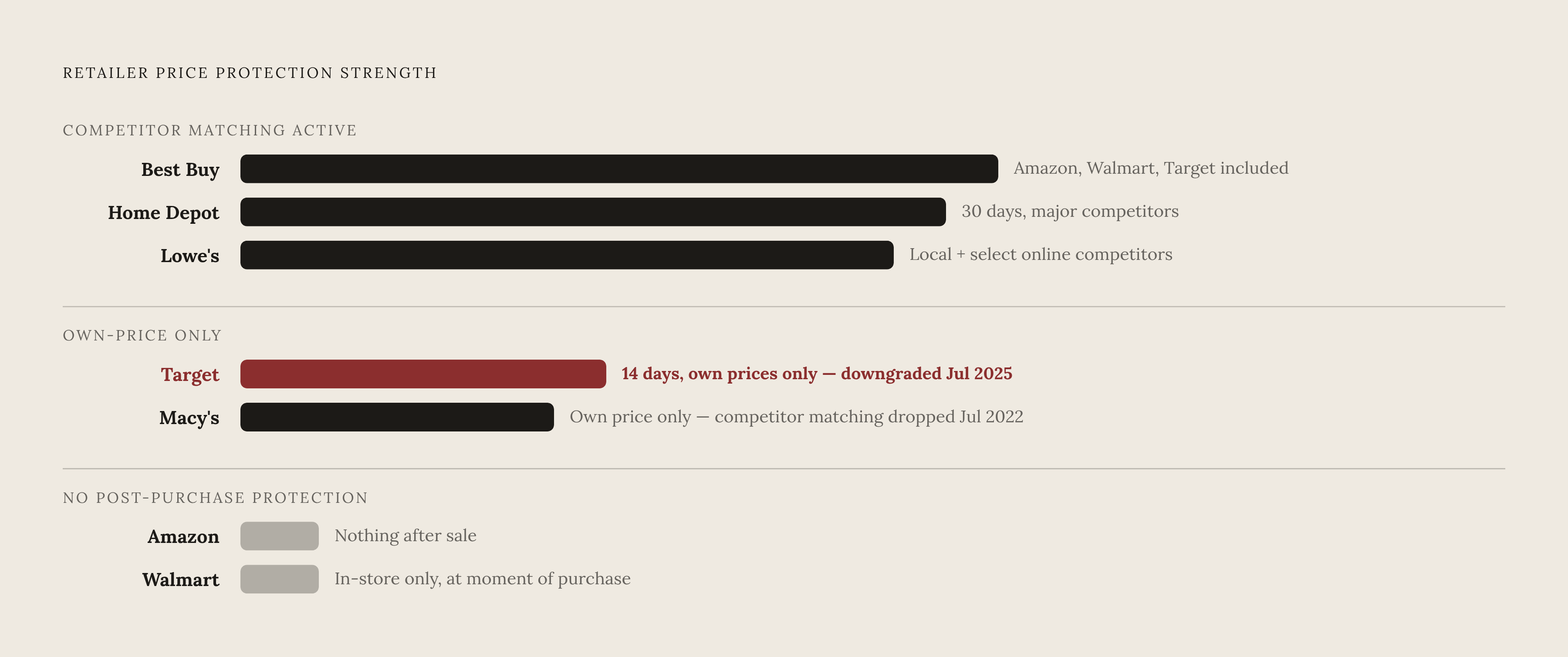
Target used to match Amazon, Walmart, and local print ads. That got narrowed to just Amazon and Walmart in 2024. Then, as of July 28, 2025, competitor matching stopped entirely. Target now matches only its own prices, whether at a Target store, on Target.com, or through a Target Circle deal, and only within 14 days of purchase. There's typically an extended window around the holidays too; last year's ran from November 7 to December 24. But store-to-store matching is done.
Macy's got there first. It dropped competitor matching back in July 2022, roughly three years ahead of Target. What's left is a narrow own-price adjustment: if Macy's lowers its own price on something you bought, you can ask for the difference, but only within a short window after the sale.
These two exits matter more than they might look on paper. Target and Macy's were go-to spots for apparel and home goods shoppers who leaned on competitor matching to avoid overpaying. Losing that option reshapes how a huge chunk of everyday retail purchases get protected, or don't. And neither company made much noise about it. Per Consumers' Checkbook reporting from October 2025, none of the major retailers loudly advertises that it'll match a lower price or issue a refund after the fact. These changes happened quietly, in a policy page update, not a press release.
Walmart and Amazon, the two biggest retailers and why neither is a price-protection resource
Walmart's 2026 policy only matches its own prices, specifically a gap between what a product costs in a US Walmart store versus the identical item sold directly by Walmart on Walmart.com. There's no post-purchase window for online price drops at all. Competitor price matching, the kind that used to let a shopper bring in a flyer from another store, isn't available after purchase and hasn't been for years: in-store competitor matching ended years ago, and the Savings Catcher program, which handled post-purchase adjustments, was also eventually shut down.
The in-store process that's left works like this: you bring it up with a cashier or at the customer service desk, and it only applies at the moment of purchase. Black Friday, Cyber Monday, clearance, Rollbacks, and other limited-time promotions are all excluded.
Amazon doesn't run a general price-match or price-adjustment program at all. The only exceptions sit in narrow corners: certain preorders, and some phones sold bundled with a service plan. Amazon's pricing moves constantly, but that's an internal competitive tool aimed at staying ahead of other retailers, not a promise made to the customer. If the price drops the day after you buy, Amazon owes you nothing. Sometimes a customer service rep will issue a one-time courtesy credit if you ask, but that's discretionary, not a policy, and it shouldn't be anyone's plan.
Here's what makes that gap expensive: per a 2024 EMARKETER survey, 43.3% of US shoppers said finding a better price was the single factor that pushed them to buy. Two retailers that dominate US e-commerce, the ones shoppers trust most to have the best price, offer close to zero protection once the sale's done. Most people don't realize they're standing in that gap until the price drops and they find out there's nothing to claim.
Best Buy, Home Depot, and Lowe's, where meaningful price protection still exists in 2026
Best Buy still runs one of the more usable policies out there. At checkout, it'll match prices from Amazon, Walmart, Target, Home Depot, Lowe's, Costco, Sam's Club, BJ's, Apple, B&H Photo Video, Crutchfield, and a handful of others. Third-party marketplace sellers don't count, and there's a blackout period from the Friday before Thanksgiving through the Monday after. To claim it, show a live listing to an associate in-store, or reach out through Best Buy Chat or by phone.
Home Depot's Low Price Guarantee covers US stores and matches identical, in-stock prices from a list of major competitors including home improvement, big-box, and online retailers. Shoppers get 30 days after purchase to catch a price drop and ask for the difference, longer than Best Buy's standard window. One thing worth clearing up: the policy that beats a competitor's price by 10% applies only to Canadian stores. US stores match; they don't beat. Anything claiming otherwise is either outdated or describing the Canadian policy by mistake. Seasonal items, discontinued products, clearance, and Black Friday or holiday sale pricing are all excluded. To claim it in-store, bring the ad or a screenshot to the cashier before paying; online, call or use Home Depot's process for it.
Lowe's runs a similar Lowest Price Guarantee, matching identical in-stock items from local competitors and select online ones, including HomeDepot.com and Amazon. One catch: the Amazon match only applies to purchases made on Lowes.com, not in physical stores. It covers both online and in-store purchases otherwise, and it can't be stacked with other discounts or offers.
This friction is not theoretical. Consumers' Checkbook researchers tested the process directly and found it worked about as advertised: Home Depot dropped the price on a Frigidaire refrigerator from $728 to $639 after being asked to match Lowe's price on the same model. The whole interaction usually comes down to pulling up the competing listing on a phone and asking.
Other retailers with active policies, and a few worth knowing by category
Nordstrom matches lower prices from a short list of competitors, including Bloomingdale's, whether you're buying online or in-store. Consumers' Checkbook confirmed one case directly: a pair of Vince sneakers dropped from $225 to $168.75 after Nordstrom matched Bloomingdale's price. Dick's Sporting Goods offers its own price matching too, and it shows up on Best Buy's list of approved competitors, which says something about where it sits in the retail pecking order.
A longer group of retailers, according to Krazy Coupon Lady's roundup, keep active price-match or price-adjustment programs running: Kohl's, PetSmart, Ashley Furniture, Michaels, Staples, Office Depot, Cabela's and Bass Pro Shops, JCPenney, and Dell. Terms differ retailer to retailer, so the window and the list of approved competitors need checking at the point of purchase rather than assumed.
Newegg's approach looks different from the rest. Rather than a standing policy, it ran event-specific protection tied to its FantasTech Sale II, October 6 through 12, 2025. Purchases made October 1 through 5 that carried the FantasTech Price Protection badge got an automatic refund if the price on Newegg.com dropped by October 12, and those refunds went out automatically by October 21, with no claim needed. It's a narrow model: useful while the sale event is live, invisible the rest of the year.
eBay's "lowest price guarantee" only applies to items tagged as an "eBay Deal" or "top product." If the same item turns up cheaper at one of a short list of named competitors within 48 hours of purchase, eBay issues a digital coupon worth 110% of the difference, valid for 30 days. It's the most specific, best-defined guarantee in the bunch, but it only fires under a narrow set of conditions.
Sephora's version is worth flagging as a cautionary example. It matches lower in-store prices from a select group of luxury and department store competitors, but only on non-sale prices at those stores. Since most price differences show up because of a sale, that carve-out guts the policy in practice.
A few exclusions show up almost everywhere, no matter the retailer: wholesale club pricing at places like Costco, third-party marketplace sellers, clearance or discontinued items, items out of stock at the competitor, and holiday sale windows.
Why most eligible claims never get made, the structural gap between policy and practice
Consumers' Checkbook's October 2025 reporting makes the core issue plain: retailers count on the fact that even shoppers who know about a price-match policy usually won't bother using it. Researching competitor prices, tracking down the right employee, explaining the price gap, and asking for money back feels like a hassle, so most people skip it. None of the retailers advertise these programs loudly, a silence that reflects deliberate choice.
Look at what the process actually demands. A live URL, not a screenshot. Confirmation the SKU matches exactly. Confirmation the competitor is on the approved list. Confirmation the item's in stock at that competitor. Then an actual conversation with customer service. Each one of those steps is a place where a shopper gives up and moves on.
The short, fixed post-purchase window sits at the center of the problem. A shopper has to notice the price dropped, recognize that it qualifies under the policy, and act, all before some deadline they were never handed a reminder for. Per an eMarketer Global Voices survey from November 2024, price ranks as the number one factor in online shopping decisions, at 35.5%. Yet the mechanisms built to protect that price after checkout require a level of active effort most people just don't put in.
This runs on the same behavioral pattern that makes subscription charges go unnoticed for months. Nobody's checking their bank statement line by line for a recurring $14.99 charge they forgot about, and almost nobody's checking the price of something they bought last week either. Consumers' Checkbook's finding cuts right to it: this isn't a knowledge gap. Shoppers who know the policy exists still don't use it. It's a vigilance gap, and vigilance runs out fast.
How automated monitoring closes the window shoppers keep missing
The mismatch is structural. Price protection windows are fixed and short, varying by retailer but typically measured in days to weeks. Human attention is neither. People check prices when they remember to, which is rarely exactly when it matters. Those two timelines don't line up on their own; something has to be watching in between.
That's the gap automated monitoring is built to close. Instead of a shopper manually rechecking prices day after day, a system tracks the price from the moment of purchase straight through the end of the eligibility window, flags the exact dollar amount of any drop, and tells the shopper how many days are left to act. It surfaces the next move instead of leaving the shopper to start the research from scratch.
Compass+ works this way: it connects to bank accounts, email, and purchase history to catch price drops on things bought recently, and it surfaces each one with the exact dollar amount and a clear next step. Access is read-only, and once it's set up, there's no ongoing effort required.
That's a meaningfully different thing from a dashboard that just shows transaction history. A transaction list won't tell a shopper that the jacket they bought last Tuesday just dropped $30 at the same store, with six days left to claim it. A system built to watch for that will. The same logic covers subscription price hikes and free trials that quietly convert into paid charges. The pattern underneath all of it is the same: time-limited consumer rights go unclaimed whenever nobody's watching the clock, whether that's a price adjustment, a late-delivery credit, or a trial nobody remembered to cancel. Newegg's automatic refund model, no claim needed, processed on its own, is what this looks like when a retailer builds it in from the start. Automated monitoring on the shopper's side does the same job everywhere else that retailers haven't.
What to do right now if you've bought something recently
Start by listing out what's been bought in the last 30 days and where. That list determines which policies are even still in play.
From there, check whether that specific retailer offers any post-purchase protection at all. Best Buy gives 15 days. Home Depot gives 30. Target gives 14, but only against its own price, not a competitor's. Walmart and Amazon generally offer nothing once the sale's final.
For any retailer where protection does exist, pull up the current price along with the price at qualifying competitors. It needs to be a live URL, the same SKU, and the item needs to actually be in stock there, not backordered or discontinued.
Then reach out before the window closes: in-store with the listing pulled up on a phone, or online through chat. Most of these conversations take a few minutes, not more.
Going forward, the only way to catch these drops consistently is to have something tracking prices after checkout, because doing it by hand for every purchase isn't something anyone keeps up for long. Setting up Compass+ to watch purchase history and flag price-drop opportunities inside the active window works as the passive version of that manual check, one setup, then it runs on its own. Price protection is a real right, but it's one retailers aren't required to advertise, and it runs out on a clock most shoppers were never handed. Claiming it takes either constant attention or a system built to hold that attention for you.
Sources
- Retailers that Price Match or Make Price Adjustments
- What Stores Price Match? Here
- Price Matching Explained [Strategies + Examples]
- Price Matching in 2026: What the New Rules Actually Mean
- Target is abandoning one of its biggest customer perks | CNN Business
- Target Announces Changes to Its Price Matching Policy
- Fantastech Sale 2025 – Price Protection
- axios.com