How Long Retailers Are Required to Process Refunds by Law
Federal law sets narrow refund timelines; state law and retailer policies fill the gaps.

No federal law guarantees a refund just because a shopper changed their mind. That surprises people, but it's true: the relevant federal regulatory agency doesn't force brick-and-mortar stores to take back non-defective merchandise, full stop. What exists instead is a couple of narrow federal rules, a state-by-state layer of disclosure requirements, and whatever policy a retailer decides to post above all of it. Knowing where those layers sit, and where they stop, is the only way to tell a slow refund from an illegal one.
Two federal obligations do exist regardless of any posted policy. A refund is owed when a product is defective in a way that contradicts how it was advertised, and a refund is owed when the seller breaks the terms of the sales contract. Neither of those, on its own, sets a clock for how fast the money has to come back. That's where the rest of this gets specific.
The FTC's Cooling-Off Rule: a three-business-day window for high-pressure sales
This one lives in 16 CFR Part 429, and it's built for a very particular situation: a seller who corners a buyer somewhere other than a permanent place of business. Think a salesperson at the buyer's front door, a pitch made in a hotel conference room, a table set up at a fairground or convention center, even a sales rep working a dormitory lounge.
The rule only kicks in above certain dollar amounts. Sales made in the buyer's home need to exceed $25. Sales made at a temporary location, like a hotel suite rented for a weekend sales event, need to exceed $130.
Once triggered, the buyer has until midnight of the third business day after the sale to cancel, and Saturdays count toward that window. If the product already showed up before the buyer cancels, they need to send it back promptly to lock in the refund.
What this rule does not touch matters just as much. Standard purchases made inside a normal retail store aren't covered. Most online orders aren't covered. And anything under those dollar thresholds falls outside it. The Cooling-Off Rule was built to blunt high-pressure sales tactics in unusual settings, not to create a general right to change your mind about a purchase.
The FTC 30-Day Rule: where online shopping delays become legally enforceable refund rights with specific deadlines
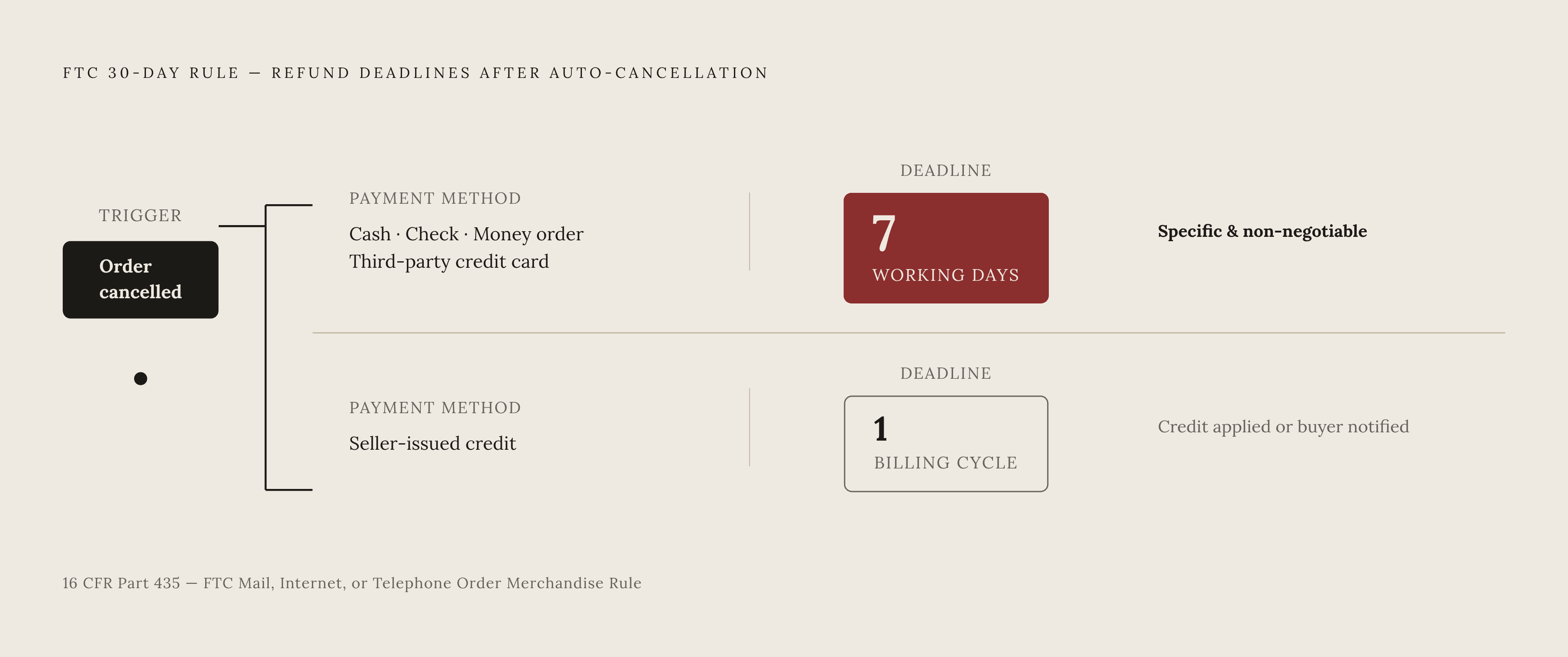
This is the rule that actually governs most modern retail disputes, since so much shopping now happens online. It comes from 16 CFR Part 435, officially the Mail, Internet, or Telephone Order Merchandise Rule, and it gets triggered the moment a seller can't ship within the time it promised, or within 30 days if it never gave a shipping estimate.
Once that happens, the seller has to give the buyer a real choice: accept the delay, or cancel and get a prompt refund. The seller can't just quietly push the ship date and hope nobody notices.
There's an automatic cancellation clause buried in here that does a lot of work for consumers. If a seller offers a new shipping date that's more than 30 days past the original deadline, the order cancels automatically unless the buyer says, in some affirmative way, that they're fine waiting. The same outcome applies if the seller can't offer any revised date. The buyer doesn't have to lift a finger for the cancellation to take effect.
Once that cancellation happens, the refund deadlines are specific and not negotiable:
- Paid by cash, check, money order, or third-party credit card: refund within seven working days.
- Paid with credit issued directly by the seller: the account gets credited, or the buyer gets told no charge is coming, within one billing cycle.
One definition determines how a return is legally classified and treated. A store credit that the seller just decides to issue on its own doesn't satisfy the refund obligation under the FTC 30-Day Rule. The buyer is entitled to get money back the way they paid it, unless that's genuinely impossible.
And the clock starts when the right to a refund vests, meaning when the cancellation condition is met. A retailer that sits on an order for six weeks doesn't get to reset the clock just by delaying its own paperwork.
How state law creates enforceable timelines
Federal law goes quiet on ordinary in-store returns of non-defective goods. States fill that gap, though unevenly.
A number of states require retailers to post their return and refund policy somewhere a shopper can actually see it. What happens when a store skips that step is the interesting part: most of these states create a default return window that kicks in automatically. Some give the buyer 30 days. Others land shorter, somewhere between 7 and 20 days, or fall back on a vaguer "reasonable time" standard. The common thread across all of them: a policy the store never posted can't later be used against the shopper trying to make a return.
California's version, laid out by the state Attorney General's office, is unusually specific. If a retailer won't give a full refund, credit, or equal exchange within seven days of purchase for an item returned with a receipt, it has to display that policy clearly. Skipping the posting makes the more restrictive policy unenforceable: the shopper gets treated as though the generous default applied all along.
Some states legislate further downstream, setting deadlines that reach past the return itself into how fast the money actually moves.
Every state, disclosure law or not, treats an unreasonable delay or an ignored refund request as a potential breach of contract. Every state, disclosure law or not, treats an unreasonable delay or an ignored refund request as a potential breach of contract, and that's the backstop. A retailer's own advertised promise becomes the standard it gets held to, state consumer protection law makes sure of that, whether or not the state also requires the policy to be posted somewhere visible.
Online purchases complicate things slightly, since not every state's return law was written with e-commerce in mind. Where a state's statute goes silent on it, the retailer's posted policy and the general consumer protection framework end up doing the governing instead.
The meaning of "processing time" once a return is accepted
Being legally owed a refund and actually having the money in hand are two different clocks, and conflating them is where a lot of frustration comes from.
Credit card refunds typically take 3 to 5 business days to process once the retailer initiates the credit on its end. Cash or check refunds can drag longer, sometimes up to two weeks. Plenty of retailers aim for a 7 to 14 business day window from the moment they receive the returned item, but that's industry norm, not statutory law, in most states. Utah's 30-day requirement is the exception that proves states can legislate this stage too, not just the return window itself.
Retailers do have one real obligation here: communicate the processing timeline clearly in the return policy. A policy that says nothing about how long processing takes is much harder to hold to any standard, because there's no promise on record to enforce.
Adding it up (shipping transit back to the warehouse, internal processing, bank settlement), a fully lawful refund can take close to three weeks to actually run before landing in an account. A refund that's slow but compliant differs from one that has actually blown past its legal window.
How major retailers stack up against the legal floor
Return windows vary a lot by retailer, and every single one of these sits above the legal floor, not at it:
- Amazon: 30 days for most items, tighter windows for categories like electronics. Price-match terms vary and shoppers should consult Amazon's current policy for specifics.
- Walmart: 90 days for most items, with exceptions for certain categories per its posted policy.
- Target: 15 days for electronics and entertainment products, with return windows for other categories set by its posted policy. Price-match runs 14 days post-purchase, extended for the full period during the 2025 holiday season (November 1 through December 24).
Every one of these numbers is a business decision. The legal floor only shows up for defective goods, broken contracts, or the specific delay scenarios the FTC's 30-Day Rule covers. For everything else, non-defective merchandise a shopper just doesn't want anymore, the posted policy is the entire enforceable right. That's why states like California make posting mandatory: without it, there's nothing to point to.
The emerging layer: return-tracking disclosure and consumer rights
Retailers have been quietly tracking how often individual shoppers make returns for a while now, using that history to limit or flat-out deny future returns from high-volume returners. Shoppers generally have no way of knowing they're being watched this way, or that their return rights might already be narrower than the posted policy suggests.
New York is trying to change that. Senate Bill S2440, introduced for the 2025 to 2026 legislative session and sponsored by Senator Leroy Comrie of the 14th Senate District, sits in the Senate Consumer Protection Committee as of a January 7, 2026 referral. It would require any store using an electronic system to monitor the frequency and volume of a customer's returns to disclose that system clearly and conspicuously.
The enforcement mechanism has teeth: fail to post the tracking disclosure, and the buyer is automatically entitled to a refund or credit. There's a companion bill in the Assembly, A7182, moving through the same session.
This isn't new territory legislatively. Versions of this idea go back to Assembly bills from the 2009 to 2010 session, and none of them have passed yet. The fact that lawmakers keep bringing it back says something on its own, even without a law on the books. It follows the same logic as the posting requirements already discussed: if a policy exists that quietly limits what a consumer thinks they're entitled to, the consumer deserves to know it exists before they rely on a return right that might not actually be there.
When a refund is legally owed but still doesn't arrive
A handful of situations point to a retailer actually being out of compliance, not just slow:
- An online order delayed past 30 days with no consent given: cancellation already happened automatically, and the refund clock (seven working days for cash, check, or third-party credit; one billing cycle for seller-issued credit) already started.
A door-to-door or temporary-venue purchase canceled within three business days with no refund issued is a Cooling-Off Rule violation. Withholding a refund on a defective product returned to the seller is a federal law violation, regardless of what the store's posted policy says.
- A state posting law ignored, with the seller enforcing a policy it never displayed: grounds for a state consumer protection claim.
- A retailer blowing past its own stated processing window: breach of contract, enforceable under consumer protection law in every state.
When a refund is overdue, the first move is writing down the purchase date, the date the refund was requested, the retailer's stated policy, and every message exchanged since. Contacting the retailer in writing creates a dated paper trail and can restart or trigger the internal clock. If the purchase was made by card, a dispute with the card issuer runs on its own timeline, separate from whatever the retailer is doing. Online orders governed by the 30-Day Rule can be reported straight to the FTC at reportfraud.ftc.gov, and state-law violations go to the state attorney general's office.
Most of this breaks down at the vigilance stage. Few consumers know exactly when their seven-working-day or one-billing-cycle clock actually started. Fewer still track whether a promised refund actually posted to their account. The window to dispute it quietly closes while nobody's watching. The refund was owed the whole time. It just went unclaimed because no one was checking.
That's the exact gap a tool like Compass+ is built to close, by watching connected accounts for a refund that was promised but never showed up. A discrepancy that arises from that gap is flagged, with the dollar amount attached and a clear next step alongside it, so the burden doesn't fall on the shopper to comb through statements looking for money that should already be back in their account.