streaming services ranked by price-increase notification practices
Which streaming services actually warn you before raising your price.
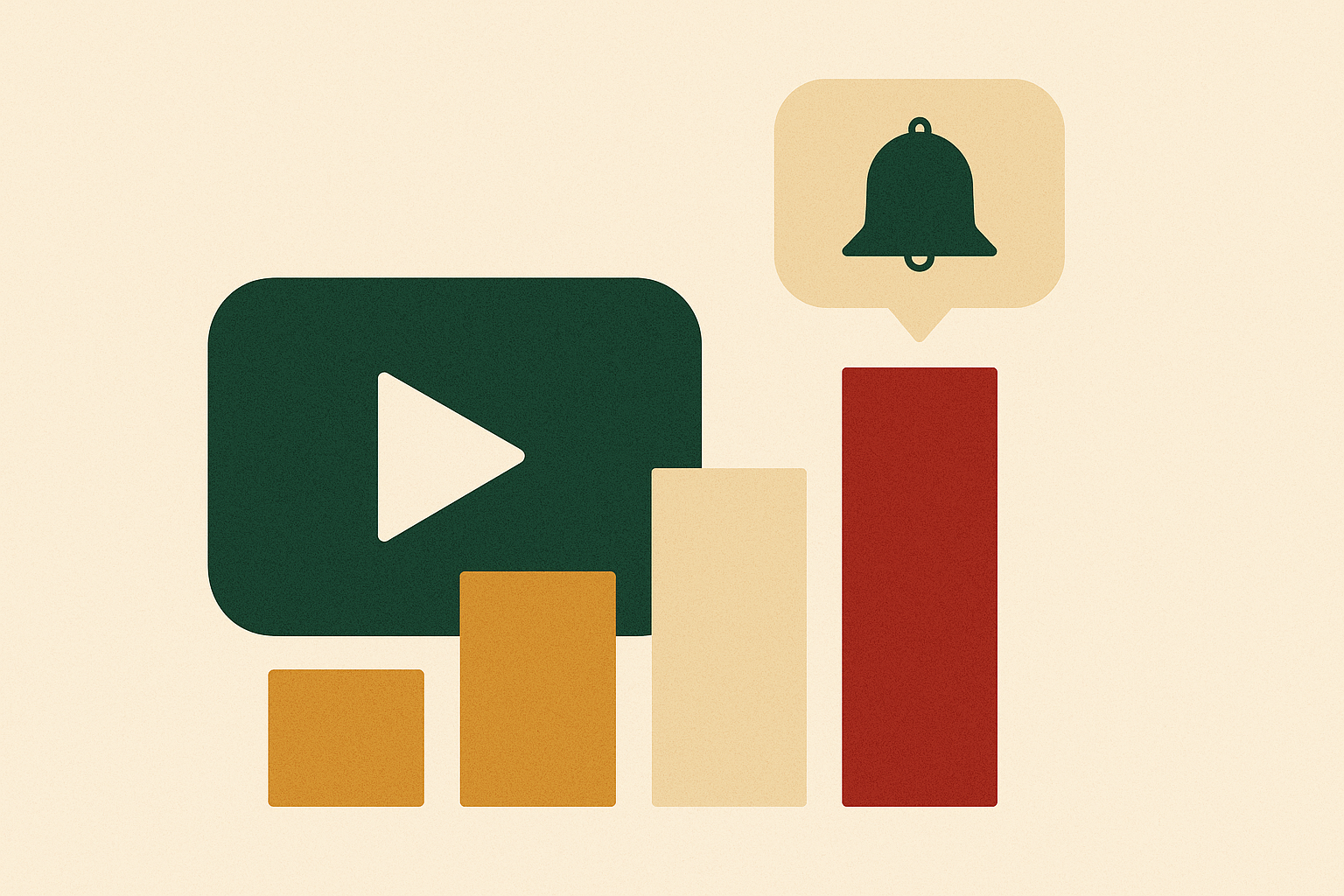
Streaming was supposed to be the cheap alternative to cable. Three years of steady price hikes have quietly eroded that promise, and the average subscription stack now costs 40 to 60% more than it did in 2022. Some of that spending crept up so gradually that most people never noticed the moment it stopped being a bargain.
Three forces are driving it. Content costs keep climbing: Netflix spent $17 billion on content in 2024 alone, and Disney spent roughly $24 billion across its whole portfolio. Subscriber growth has also slowed down across the industry, so raising prices on the people already signed up becomes the easiest lever left to pull. And tiering plus ad-supported plans give companies cover, since the "starting at" price stays low in the ads even as the plan most people actually use quietly gets more expensive.
Six separate price increases landed across major streaming services in 2025, close to one every two months. Roughly two out of three consumers saw at least one subscription raise its price in the past year, and in most cases, the notice was minimal at best. The hikes aren't going away. What varies, service by service, is whether subscribers ever see them coming.
What "good" notification actually looks like and why most services fall short of it
On paper, the industry norm is simple: notify subscribers by email about 30 days before a price change kicks in. In practice, that norm breaks down at almost every step.
Those emails often land in a Promotions or Updates tab, the same place marketing spam lives, so most subscribers never open them. The subject lines don't help either. "We're updating our pricing" reads nothing like "your bill goes up on this date," and companies know the difference. New subscribers are typically charged the new price from the moment they sign up, with no prior notice window. And annual subscribers are frequently treated as a separate case entirely, with protections that vary by service.
A genuinely subscriber-friendly notice does four things: names the exact date the new price takes effect, states the specific dollar increase per plan, gives enough lead time to cancel before the next bill, and makes sure annual subscribers hear about it before their renewal date, not after.
None of that is required by law. Federal consumer protection rules don't mandate any specific notice window for a price increase. That's a separate issue from the FTC's click-to-cancel rule, which makes it easier to cancel a subscription but says nothing about warning someone before the price goes up. That gap is exactly why practices vary so widely across services, and why it's worth knowing which ones actually tell you and which ones let you find out on your bank statement.
HBO Max: the most explicitly documented notice policy among major streamers
HBO Max's price increase went into effect October 21, 2025, immediate for anyone signing up fresh. But for people already subscribed, monthly or annual, the company committed to a 30-day advance notice before the new price applied. That symmetry between monthly and annual billing is rare, and it's the clearest, most even-handed notice policy of any service reviewed here.
The tier changes: Basic With Ads went up $1 a month to $10.99 (or $10 a year, to $109.99). Standard rose $1.50 a month to $18.49 (or $15 a year, to $184.99). Premium climbed $2 a month to $22.99 (or $20 a year, to $229.99).
Churn held at 7% between May and June 2025, low by industry standards, and that stability may reflect something simple: subscribers who trust they won't be blindsided tend to stick around. A major media company. CEO David Zaslav had already said publicly that HBO Max was "way underpriced" before the hike landed, so in a sense, subscribers got two warnings: one from an executive on record, one from the formal 30-day notice that followed.
Dropout.tv: the outlier that froze prices for existing subscribers when it raised them for new ones
Dropout.tv announced its increase on April 7, 2025, with the change taking effect a full month later on May 7. That's a full month of lead time before anything changed.
New subscribers saw the monthly plan go from $5.99 to $6.99, and the annual plan from $59.99 to $69.99. Here's the detail that sets this streaming service apart: existing subscribers were explicitly locked in at their old price. It was the service's first increase since 2022, and rather than applying it across the board, the service carved out its current subscriber base and left them untouched.
That's a rare move at any size. It directly answers the complaint subscribers raise most often about price hikes, the feeling of being penalized for sticking around. Dropout is a smaller platform, so the financial stakes aren't comparable to Netflix or Disney+. Still, the model is worth naming regardless of scale, because it shows the carve-out is possible, not just theoretical.
Netflix: large, frequent hikes with a narrow notice window for existing subscribers
Netflix's latest increase took effect January 21, 2025, immediately for new sign-ups. For existing subscribers, the company confirmed only that the new price would show up "in their next Netflix billing cycle." No confirmed 30-day window, no specific date attached to the notice.
The numbers: Standard With Ads rose from $6.99 to $7.99. Standard Without Ads jumped from $15.49 to $17.99, a $2.50 increase that ranks among the steepest single hikes tracked across any service this year. Premium Without Ads went from $22.99 to $24.99, and the Extra Member add-on rose another dollar.
Zoom out to 2022 and the pattern gets clearer. The Standard plan rose about 16% from $15.49 to $17.99 over that stretch, with a pause in 2024 before the January 2025 hike hit. This isn't one adjustment, it's a rhythm of repeated increases spaced out just far enough to avoid looking like a pattern.
Netflix's churn rate held at 2% through the hike, the lowest of any major service tracked. That kind of subscriber loyalty cuts both ways: it's a sign of a product people don't want to give up, but it also removes a lot of the pressure to improve how the company communicates about price. A Rome court found Netflix's fee increases between 2017 and 2024 violated Italian consumer protection law, with unauthorized increases reaching €8 a month for Premium subscribers and €4 for Standard. Long-term Premium members dating back to 2017 may be able to claim refunds approaching €500, Standard users up to €250. The court imposed daily penalties of €700 for non-compliance. Similar complaints have surfaced in Poland, Spain, and Germany. Low churn paired with legal pushback across multiple countries paints a picture of a company that knows its subscribers aren't going anywhere, regardless of how the notice gets handled.
Disney+: price announced weeks before effective date, but the timing landed in a PR storm
Disney announced its price increase on September 23, 2025, effective October 21, roughly four weeks of public notice, which sounds reasonable on its face.
Disney+ With Ads rose from $9.99 to $11.99 a month. Disney+ Premium, ad-free, climbed from $15.99 to $18.99. The bundles moved too: Disney+, Hulu, and HBO Max with ads went from $16.99 to $19.99, and the no-ads version of that same bundle rose from $29.99 to $32.99. Plans that included ESPN were affected as well.
The timing is what complicates the story. The announcement landed during the Jimmy Kimmel Live! controversy, a moment when subscriber goodwill toward Disney was already strained. Churn rates for Disney+ and Hulu doubled around the announcement, Disney+ from 4% to 8%, Hulu from 5% to 10%, among the most notable churn spikes recorded in this review. Four weeks of notice didn't prevent that spike, which suggests the real driver wasn't a lack of warning. The timing suggests that adequate notice alone may not be enough when subscribers are already dissatisfied.
Apple TV+: a 30% price jump with no subscriber-specific notification practice documented
Apple TV+'s price increase took effect in August 2025, taking the monthly price from $9.99 to $12.99. That's a 30% jump, and the service's third price increase since launch.
Apple TV+ still doesn't offer an ad-supported tier, unlike nearly every other major streamer on this list. And there's no confirmed subscriber-specific notice window in the record: no subscriber-specific notice beyond the public announcement has been documented.
Churn stayed relatively low, 6% in May 2025 and 5% in June, which may be part of why there's little pressure on Apple to build out a more formal notice process. There's a separate friction point worth flagging too: subscriptions purchased through Apple have to be cancelled through Apple's own systems, not through the app developer directly. That's not a notice issue, but it compounds the problem when a subscriber wants to act quickly after finding out about a price hike. A 30% increase with no confirmed advance notice is about as blunt a combination as any service on this list.
Discovery+: a quiet January hike with no documented subscriber notification window
Discovery+ raised prices on January 7, 2025, just a week into the new year. The ad-supported tier went from $4.99 to $5.99 a month, its first increase since the tier launched back in 2021. The ad-free tier also increased, and that's on top of an earlier jump from $6.99 to $8.99 in October 2023, meaning the ad-free tier climbed roughly $3 a month in about two years.
Existing subscribers were told the change would show up in their "next 2025 billing cycle or after February 7," language that tells subscribers when they'll notice the change on a statement, not when it actually took effect. New subscribers, meanwhile, were charged the new price immediately. No advance-notice window for existing subscribers has been documented in the available record.
A one-dollar increase is easy to shrug off, which is exactly the point. Small, quiet hikes like this one are the textbook case of subscription price creep operating exactly as designed, low enough to avoid backlash, frequent enough to add up.
Paramount+ and Peacock: mid-2025 hikes with minimal documented notice
Paramount+ raised both its Essential and Premium tiers by $1 a month, effective January 2026. No specific announcement date and no confirmed subscriber notice window show up anywhere in the record.
Peacock raised prices in mid-2025, $3 a month across both its ad-supported plan and its limited-ads Premium Plus tier. That's one of the largest single dollar increases among mid-tier streaming services this year, and again, there's no confirmed notice policy documented.
Both companies compete in a crowded middle of the market, where subscriber retention should, in theory, matter enormously. Yet neither has a documented practice of giving subscribers real lead time to react. A $3 monthly hike at Peacock adds up to about $36 a year, quietly, with no clear moment built in for a subscriber to stop and decide whether it's still worth paying for.
What the ranking reveals about how the industry treats subscribers by default
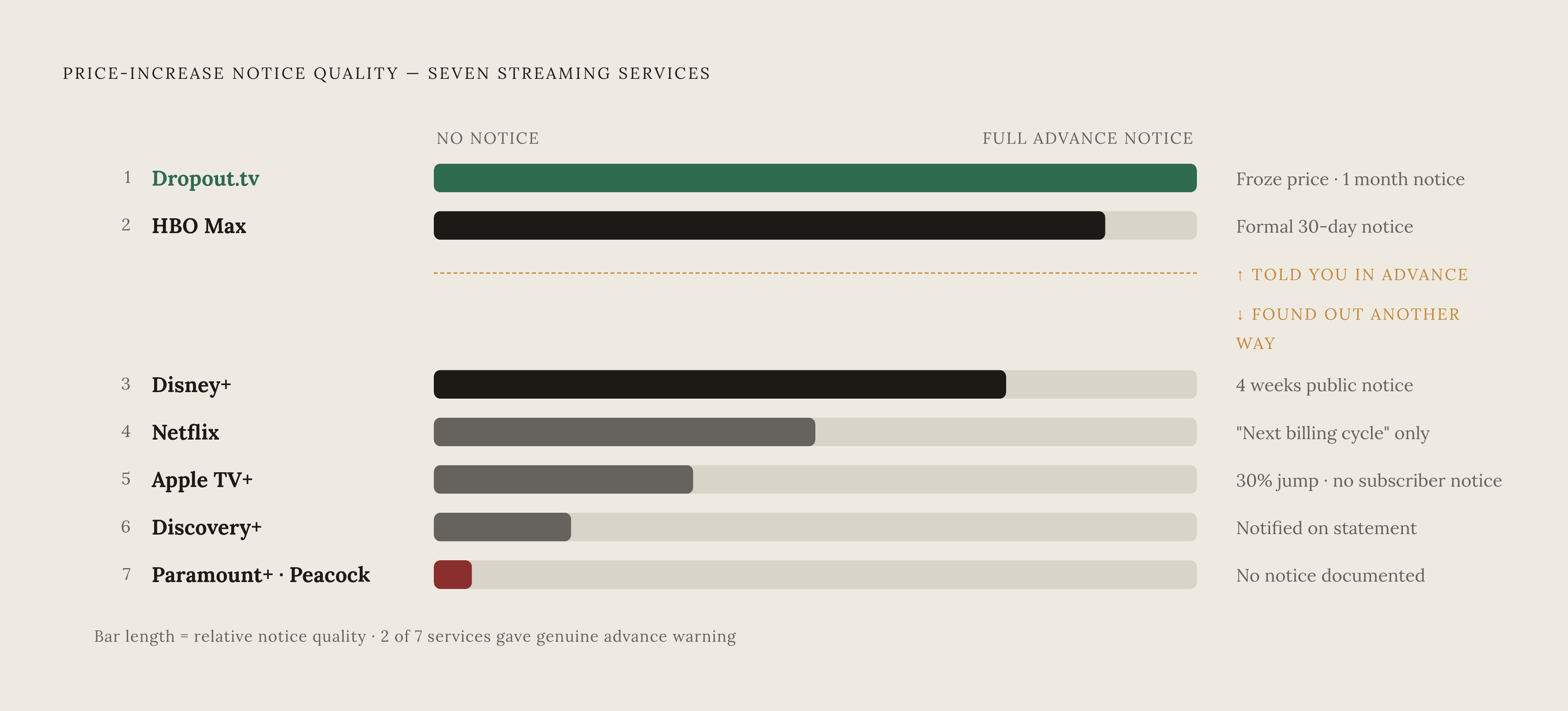
Line them all up and the pattern is stark. HBO Max is the only service with a formally documented, symmetrical 30-day notice policy covering both monthly and annual subscribers. Dropout.tv is the only one that actively shielded its existing subscriber base from a price increase altogether. Everyone else, Netflix, Disney+, Apple TV+, Discovery+, Paramount+, Peacock, leans on general billing-cycle language or a public press announcement as the main way subscribers find out.
The practical result: anyone who isn't actively checking email around their billing date is likely to find out about a price hike from a bank statement, not before one. That's not a hypothetical risk. One study found consumers underestimate their monthly subscription spending by $133 on average, and 42% have kept paying for services they'd already stopped using without realizing it.
Companies know their churn numbers are low, Netflix's 2% rate barely moved through a major hike, and that gives the market very little incentive to build better notice practices voluntarily. The FTC's click-to-cancel rule, enforced starting July 14, 2025, makes cancellation itself easier. It says nothing about warning subscribers in advance that a price is about to change. There's still no federal standard forcing a 30-day heads-up before a hike takes effect.
Signing up for any of these services takes seconds. Noticing a price increase and doing something about it takes vigilance that most subscribers simply don't have time to keep up.
How to stop absorbing price increases you didn't see coming
Waiting for a notification email doesn't work. Those emails live in Promotions tabs, and the language inside them is written specifically not to sound alarming.
A better approach starts with tracking billing dates directly, in a calendar, for every subscription. That gives a built-in check-in moment before a charge hits, rather than after. When a price increase notice does show up, it's worth running through three quick questions: how often is this actually getting used, what are the alternatives, and is this even the right tier for the way it's being used.
Downgrading a single tier can offset an entire price hike. Ad-supported plans exist precisely because the math works for anyone willing to trade a few ad breaks for real savings. Paying annually locks in a rate for a full year, so timing an annual payment just before a hike takes effect can buy up to twelve months at the old price. And rotating services, subscribing to one or two at a time and cycling through rather than stacking five or six simultaneously, cuts out the slow accumulation that makes price creep invisible in the first place.
People who actually sit down and audit their subscriptions tend to find they can cut 30 to 50% of that spending without missing a single cancelled service. The root issue is attention, not affordability: roughly 80% of consumers in one country. adults pay for at least one subscription, the average household spends around $1,080 a year on them, and about $205 of that goes toward services nobody's using anymore. That money doesn't disappear because it's expensive. It disappears because nobody's watching the billing cycle closely enough to catch it.