Overlapping Streaming Subscriptions Consumers Typically Duplicate
Most households pay for overlapping streaming services without realizing their catalogs duplicate.
Most Americans pay for streaming twice without ever deciding to. The industry runs on invisible overlap: the same movies, shows, and sports broadcasts get licensed across multiple platforms at once, so a household holding four or five services is almost guaranteed to be double-paying for something. Deloitte's 2025 Digital Media Trends report puts the average household at 4 paid streaming subscriptions. TiVo's Q2 2025 Video Trends report counted 7 per household across the US and Canada, up from 5 a year earlier. The count depends on who's asking, but every source moves the same direction: up.
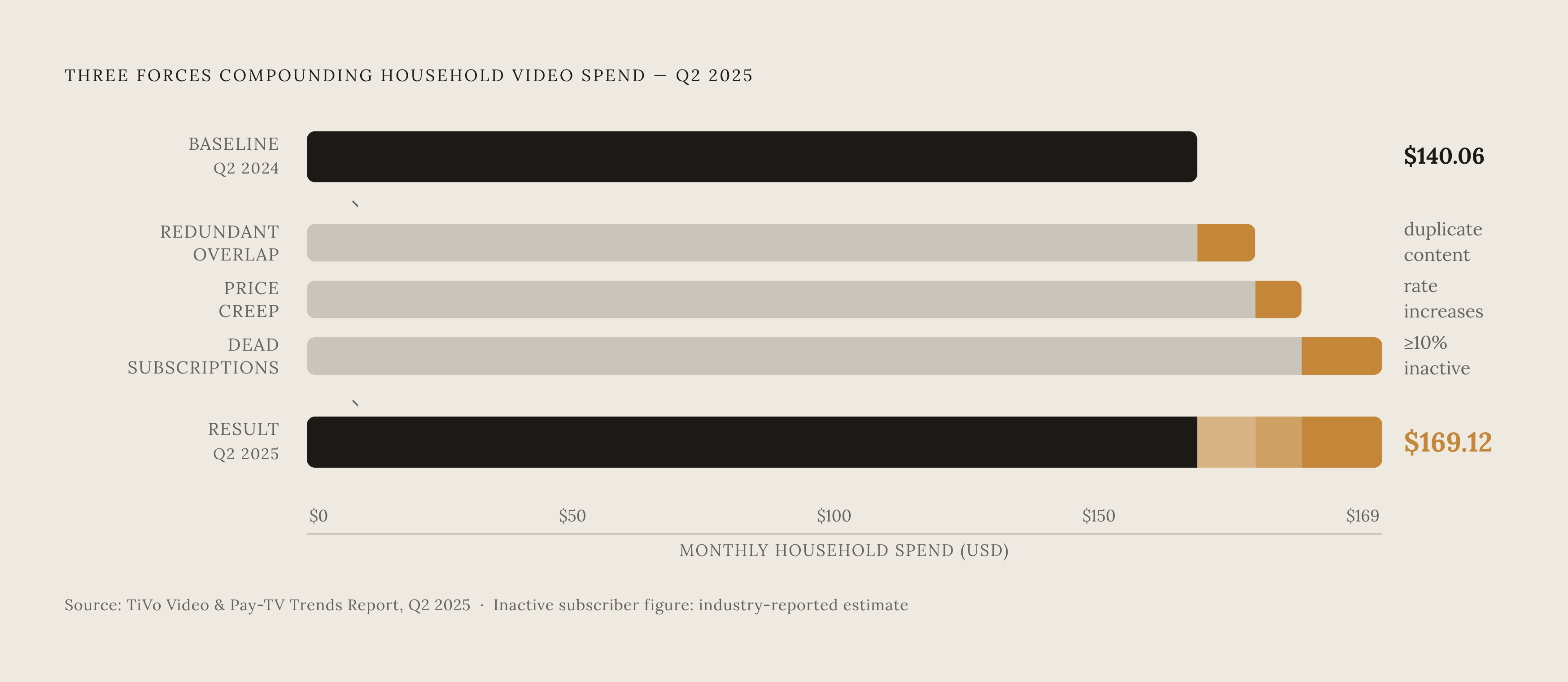
Spending climbed right alongside it. TiVo found households spending $169.12 a month on video and TV services in Q2 2025, up from $140.06 a year prior. A Motley Fool survey found 62% of consumers already say there are too many streaming services, and they're adding subscriptions anyway. People are clear about the problem. They're just not tracking it in real time, and that's a different failure.
None of this is a personal failing. Studios license the same movies and shows across competing platforms constantly, so the "exclusive" content each service markets is rarer than the marketing suggests. Overlap is baked into how licensing deals actually work, not an accident of anyone's attention span.
The platform pairs that reliably trap subscribers into paying twice
Some combinations are so common they're practically predictable, and the mistake most subscribers make is treating every pairing as equally risky. It isn't. Disney+ and Hulu is the pair to check first.
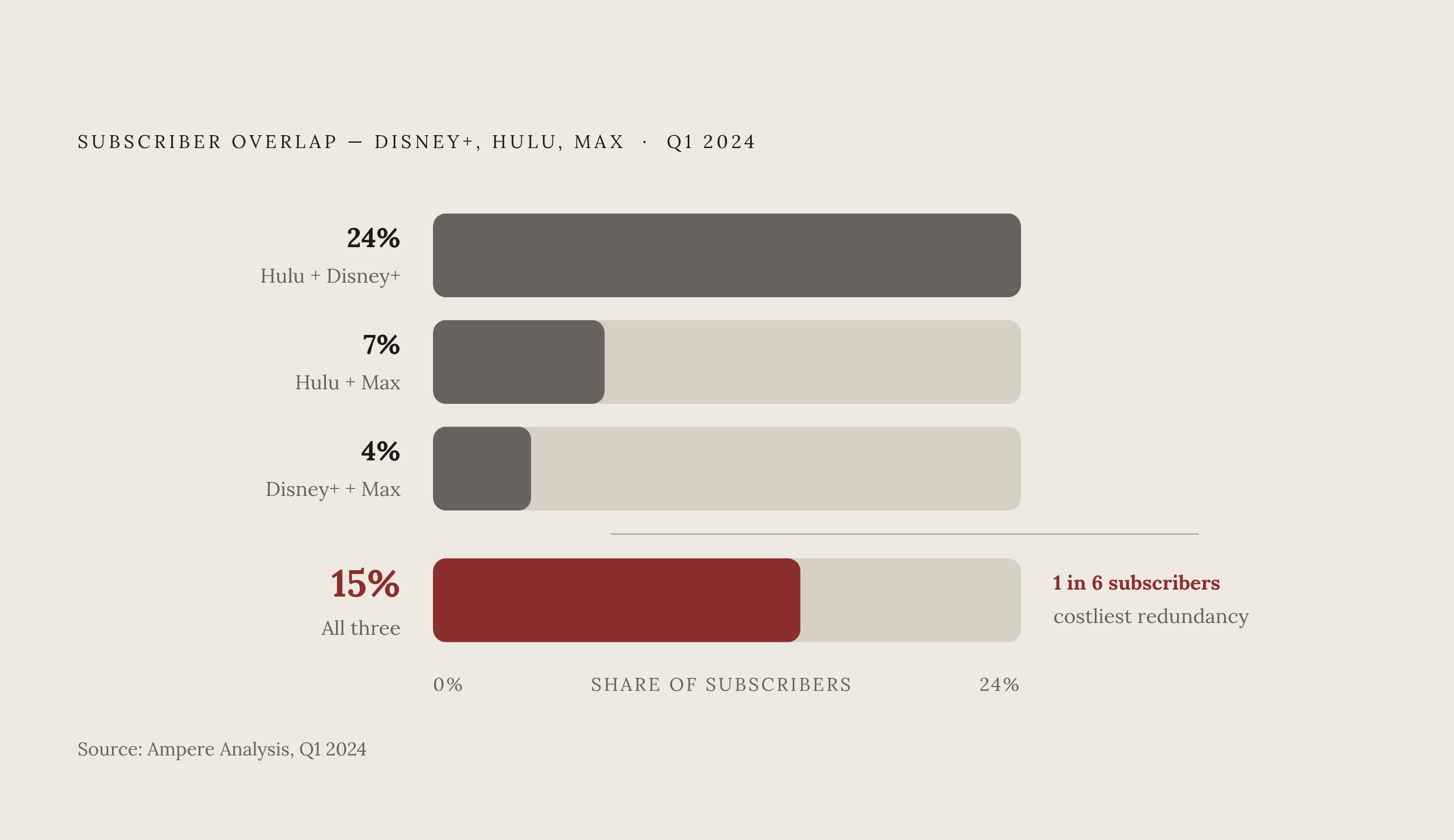
Ampere Analysis data from Q1 2024, cited by Statista, found nearly 1 in 4 Hulu subscribers (24%) also paid for Disney+. Both are Disney-owned, and Hulu carries current-season broadcast TV plus older library titles that regularly turn up on Disney+ too. Subscribers hold both without checking whether the catalogs actually differ, because nothing on the bill prompts them to.
Add Max and the redundancy compounds. The same Ampere dataset found 15% of households subscribed to Disney+, Hulu, and Max at once, the single most expensive and most duplicated combination measured. Hulu and Max overlapped for 7% of subscribers on their own; Disney+ paired with Max accounted for 4%. Catalog licensing across the industry means content availability shifts between platforms over time, and what's exclusive to one service today may not stay that way.
Other pairs follow the same logic without the same hard numbers attached. Amazon Prime Video and Netflix both license studio films during theatrical holdback windows, so their catalogs draw from the same pool of available titles. Peacock and Hulu both carry NBC and Universal shows, but current-season NBC broadcast content moved to Peacock exclusively starting with the 2022-23 season, after Hulu lost next-day streaming rights. Households that kept both "for live TV" are often just paying twice for the same back catalog.
Apple TV+ breaks the pattern instead of fitting it, which makes it a different kind of consideration when auditing overlap.
Naming these pairs isn't trivia. Licensing deals, studio ownership, and broadcast rights windows make certain combinations reliably redundant, so a subscriber checking Disney+ against Hulu doesn't need to browse blind. The ownership chart already tells you what to expect.
Where live sports turns overlap into the costliest duplication
Sports is where overlap gets expensive fast, because it's the one category people will pay a premium for no matter how tired they are of the bill. Every platform knows exactly which lever that is.
NFL rights alone split across Peacock (Sunday Night Football and select playoff games), Amazon Prime Video (Thursday Night Football), and ESPN/ABC (Monday Night Football), on top of traditional broadcast. A household holding all three streaming services just to follow one league is paying three separate subscription fees to watch one sport across one season.
Digital viewership keeps pulling more platforms into the fight for those rights. Mountain Research and EMARKETER project that by 2027, the US will have 52 million more digital sports viewers than traditional TV sports viewers, and that growth fragments broadcast rights across more services, not fewer. Amazon's scale shows exactly how that fragmentation gets funded: Amazon's advertising business has grown large enough to fund the kind of rights bids that pull live sports off single-platform arrangements.
Rights windows are seasonal, and they move without warning. That's the actual trap. A platform that carried a league last season may lose that contract entirely this season, but the subscriber doesn't get a notice. They just keep paying, out of habit, for a service that no longer carries what they signed up for. Before the next season kicks off, don't check which platform carried the games last year. Check which one holds the rights now.
Why the dollar amount keeps rising even when no single bill looks alarming
Small recurring charges just don't register in memory the way a single large purchase does. Nobody feels $14 a month the way they'd feel a $170 charge, even though $14 a month for two years adds up to more than that one-time hit ever would.
Mastercard and FT Strategies found average annual subscription spend rose to $1,887 in 2025, up from $1,416 in 2024, with 44% of consumers reporting they spent more on subscriptions this year than last. Price increases compound the drift quietly on top of that. Redundant subscriptions that were cheaper when first added have grown more expensive through successive price increases, as EMARKETER and Antenna have tracked across major streaming services. The overlap itself didn't get more redundant. It just got more expensive, one price hike at a time, with no single moment where a subscriber noticed a threshold getting crossed.
Then there's the subscriptions nobody's using at all, arguably the worse category, since there's no viewing to even weigh against the cost. Businesses report that at least 10% of their subscribers are inactive, so a real slice of streaming spend goes toward services abandoned months ago and simply never canceled. Stack overlap, price creep, and dead subscriptions on top of each other, and TiVo's $169.12 monthly figure stops looking surprising. It looks like the predictable output of three forces running at once, none of which anyone was tracking in isolation.
How to map your own overlaps without browsing every catalog manually
A real audit doesn't take guesswork. It takes five steps done in order, and skipping the order is where most people lose the thread.
List every active subscription and its monthly charge. Include anything billed through a carrier bundle, Apple, or Amazon, not just what shows up on a direct statement. Note the billing channel for each: Apple-billed subscriptions have to be canceled through Apple, not through the app developer's own settings, which trips up more people than it should.
Check what actually got watched in the last 30 days, not what was intended. Intended viewing is aspirational. Actual viewing is the only honest signal a service is earning its keep.
Run the known overlap pairs as hypotheses, not open-ended questions. Holding Disney+ and Hulu? Check whether what's being watched on one also sits on the other. Holding Peacock and Hulu? Check which NBC and Universal titles each service currently carries, since rights between them have shifted.
Confirm with a universal search tool instead of guessing. JustWatch is a commonly cited free option for checking where a specific title streams right now. If a favorite show sits on two paid services already, one of them is redundant for that title, full stop.
Check sports rights for the current season, not last season's. Rights move every year, and the service kept around for one sport might not carry it anymore.
Rotation beats holding everything simultaneously. Deloitte's 2025 report gives this pattern a name: "churn and return," subscribing for a season, canceling, then rotating back in later. It works because a library doesn't need permanent access, just access when something's actually getting watched. Rotation got meaningfully easier on July 14, 2025, when the FTC's "click-to-cancel" rule took effect, requiring subscription companies to make canceling as simple as signing up and capping sellers to one retention pitch before letting the cancellation go through. That rule strips out the friction that used to make rotating annoying, even for people who weren't worried about the money.
Bundles need their own gut check, separate from the rotation logic. The Hulu, Disney+, and Max bundle launched in July 2024, and Magid data cited by Deadline in June 2024 found bundle subscribers were 15% more likely to keep their subscriptions after six months. For a household that genuinely uses all three, the bundle lowers the combined cost below paying separately, which makes it the right call. For a household that only really watches one or two, the bundle still bills for the third whether it gets opened or not, and that's the wrong call.
What makes overlapping subscriptions so hard to catch without help
Catalogs don't sit still, and that's the whole problem with a one-time audit. A title exclusive to one platform this month can migrate to another next month, so an overlap that didn't exist at signup can show up six months later with zero notification to the subscriber footing the bill.
There's real movement toward trimming, worth crediting. Motley Fool's 2024 State of Streaming survey found 37% of respondents said they'd cut down to fewer services than a year prior, up sharply from 13% in 2022. But 46% said they'd added more, down from 54% in 2022. The group actively trimming is growing faster than the group piling on, though the group piling on is still bigger, and that gap is exactly why the overlap keeps getting worse in aggregate even as individual households wise up.
Manual audits hit a ceiling fast, and it's a low one. Most people can sit down and do one thorough review of what they're paying for. Almost nobody keeps up the month-to-month monitoring it takes to catch the overlap that shows up after a studio quietly relicenses a catalog to a new platform. Prices creep. Rights windows shift without warning. Free trials convert to paid without anyone marking the date. Whatever made a subscription worth keeping when it got added doesn't necessarily hold six months later, and nobody's rechecking on a schedule, because rechecking on a schedule isn't how people actually live.
That gap, between a one-time audit and the ongoing surveillance actually required, is where automated tools earn their keep. Something that connects to bank accounts and email on a read-only basis can flag the moment a free trial converts to paid, catch a price increase before it compounds across a year, or surface a charge for a service with no recent activity behind it. Compass+ is built around exactly that kind of monitoring: it surfaces each finding with a specific dollar figure attached and a clear next step, and it doesn't ask the user to remember anything, because the checking already happened before the bill did.
The 62% of consumers who say there are too many streaming services aren't wrong, and they're not uninformed either. Awareness was never the missing piece here. What's missing is the ongoing check that names exactly which overlap is costing a specific household money this month, on this bill, rather than the vague sense that something, somewhere, is probably getting paid for twice.