Airline Refund Rights Under DOT Rules
New federal rules finally guarantee cash refunds instead of vouchers when airlines delay flights.
A federal rule that took effect in October 2024 finally spells out, in hours and dollars, when an airline owes cash back instead of a voucher. Before that, refund eligibility was whatever the airline decided it was. Now it's math, and knowing the exact numbers is what separates a passenger who gets their money back from one who walks away with a travel credit they never wanted.
For years, there was no federal definition of what counted as a disruption serious enough to earn a refund. Airlines set their own bar, case by case, flight by flight. A common outcome: cancel the flight, drop a voucher into the customer's account, and hope nobody asks about cash. Plenty of passengers took the voucher because nobody told them cash was even on the table. COVID-19 blew the lid off how big this problem actually was. In 2020, refund complaints made up 87% of all air travel service complaints the DOT received. That single number is why this rule exists. It wasn't a scattering of annoyed travelers. It was a systemic breakdown large enough to force Washington's hand.
What the 2024 DOT rule changed and what it covers
The rule has a name: Refunds and Other Consumer Protections, and it lives in the federal code at 14 CFR Parts 259, 260, and 399. The core provisions covering tickets and baggage kicked in on October 28, 2024, and they're still the law in 2026.
Three things changed in one stroke. First, the rule defines, for the first time, what counts as an event that triggers an automatic refund. That refund has to land back on the original form of payment, unless the passenger actively says they'd rather have a voucher or travel credit instead. Third, it locks in hard deadlines for how fast the money has to move (more on that below).
The reach is broad. It covers every flight taking off from or landing in the United States, no matter which country's airline is running it. A British carrier landing at JFK owes the same refund protections as a domestic carrier.
The exact thresholds that turn a schedule change into a refundable disruption
This is where most passengers get tripped up, and where airlines have historically had the most room to maneuver. There's a real gap between a "schedule change," which an airline can make freely, and a "significant change," which is the legal trigger for a refund. Knowing which side of that line a delay falls on matters more than almost anything else in this rule.
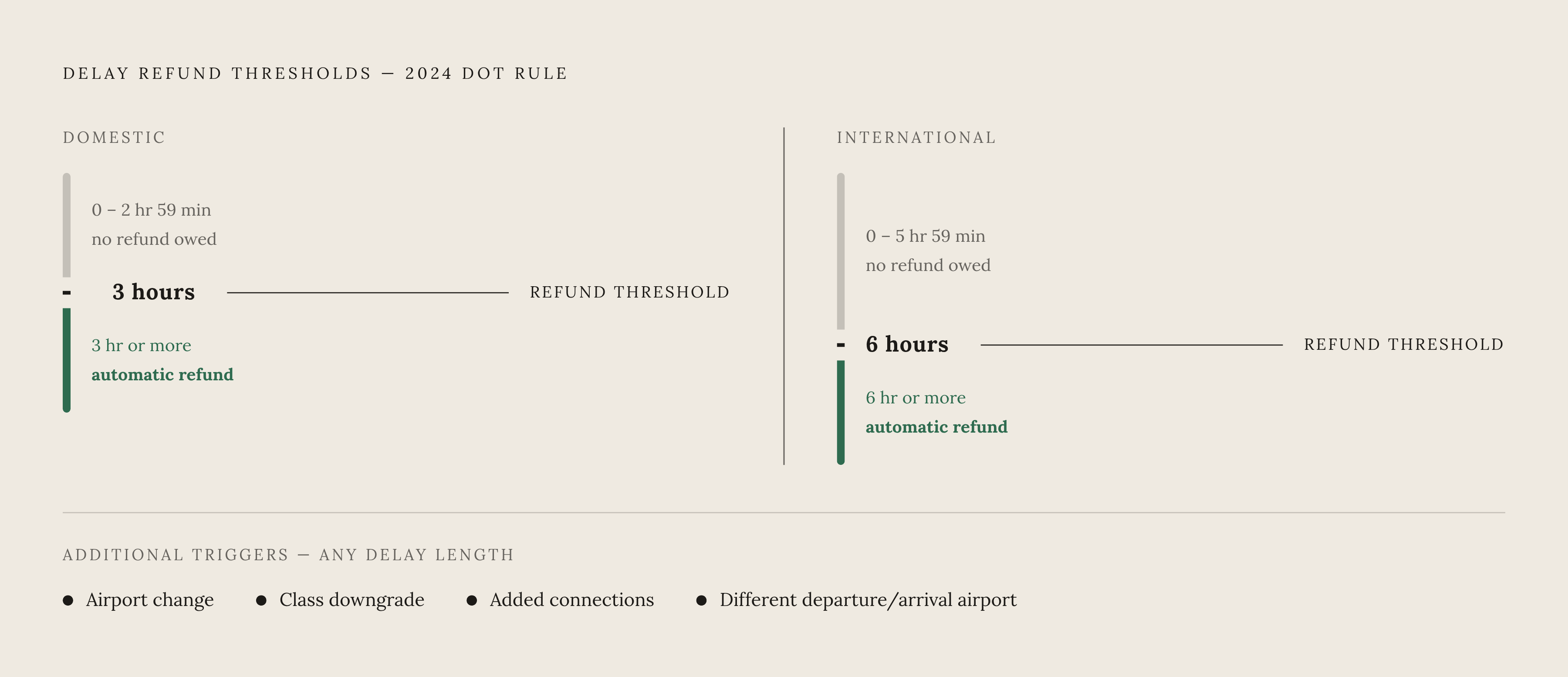
Start with time. On domestic flights, a departure or arrival time that shifts by 3 hours or more counts as significant. On international flights, that threshold doubles to 6 hours. Both numbers get measured against the flight's original scheduled time, not whatever revised time shows up on the departure board later. Airlines don't get to reset the clock by updating the app.
Time isn't the only trigger. A few itinerary changes count too, regardless of how long the delay is:
- The departure or arrival airport changes, even a swap within the same metro area (moving between two nearby airports serving the same city counts)
What doesn't qualify matters just as much. A domestic delay of 2 hours and 55 minutes is frustrating, but it's 5 minutes short of the line. A different plane on the same route, same schedule, same seat class, isn't a significant change either. Neither is a flight that departs less than 3 hours early. Annoying, sure. Refundable, no.
Ancillary fees the rule covers beyond the base ticket price
The rule doesn't stop at the ticket price. Anything a passenger paid extra for and didn't actually get is refundable too, automatically, back to the original payment method.
That covers seat selection fees when the airline reassigns the seat, in-flight Wi-Fi that never connected, a lounge day pass bought for a lounge that turned out to be closed, a meal that was paid for but never loaded onto the plane, and priority boarding a gate agent simply ignored.
Baggage runs on its own clock. On domestic flights, a bag has to be refunded if it shows up more than 12 hours after landing. International flights get a longer window: 15 hours if the nonstop segment from the country of departure was 12 hours or less, 30 hours if it ran longer than that. The catch here is that this one isn't automatic. The passenger has to file a mishandled baggage report with the airline first. And the refund only covers the bag fee itself, not the whole ticket.
Some carriers had charged $10 to $50 extra to seat a child 13 or younger next to a parent or adult traveling with them, a practice the rule aimed to address.
How fast airlines must issue refunds and what "automatic" means in practice
"Automatic" is doing real legal work in this rule. It means the airline has to start the refund on its own, without a passenger calling in, filling out a form, or arguing with a chatbot for twenty minutes.
The deadlines depend on how the ticket was paid for. Credit card purchases have to be refunded within 7 business days, and business days exclude weekends and federal holidays, so a request filed Friday afternoon might not start counting until the following Tuesday. Every other payment method, cash, check, wire transfer, gets 20 calendar days.
These clocks apply whether the ticket came straight from the airline or through a third-party booking site. And if a passenger decides they'd rather take a voucher than cash, the airline still has obligations: the voucher has to be good for at least 5 years.
The flight-renumbering carve-out through July 2027
One quirk in the rule's original language: if an airline gives a flight a different number than the one a passenger bought, that counts as a new flight, which makes the old one a cancellation, which triggers a refund.
That sounds simple until a merger between two carriers happened, which required renumbering a huge volume of flights as one of the airline's codes got retired. The DOT paused enforcement of this specific piece of the rule, and that pause now runs through July 7, 2027, while the agency works on new rulemaking to reconsider what "cancelled flight" actually means.
The practical upshot: if a flight number changes but the departure time, route, and airports all stay the same, that alone doesn't count as a cancellation right now. Passengers shouldn't assume a renumbered flight automatically qualifies for a refund. Check whether an actual significant change, the 3-hour or 6-hour thresholds, or one of the itinerary triggers, happened alongside it.
What the Trump DOT has rolled back
The Biden-era DOT had also finalized a separate rule requiring airlines to pay passengers $200 to $300 in cash compensation for domestic flights delayed 3 hours or more. Something similar to what the EU already does. The current DOT withdrew that rule.
Its stated reasoning: the compensation requirement "went beyond what Congress has required by statute." The agency said it would keep enforcing every consumer protection Congress actually mandated, the automatic refund rule included.
So here's where things stand. Passengers are still owed every dollar they paid, in full, when a significant change or cancellation happens. What they're no longer owed is extra compensation for the disruption itself, even when the airline caused it. The refund rule, the 3-hour and 6-hour thresholds, the ancillary fee refunds, the baggage delay windows, the processing deadlines: all of that is untouched.
How enforcement works and which airlines generate the most complaints
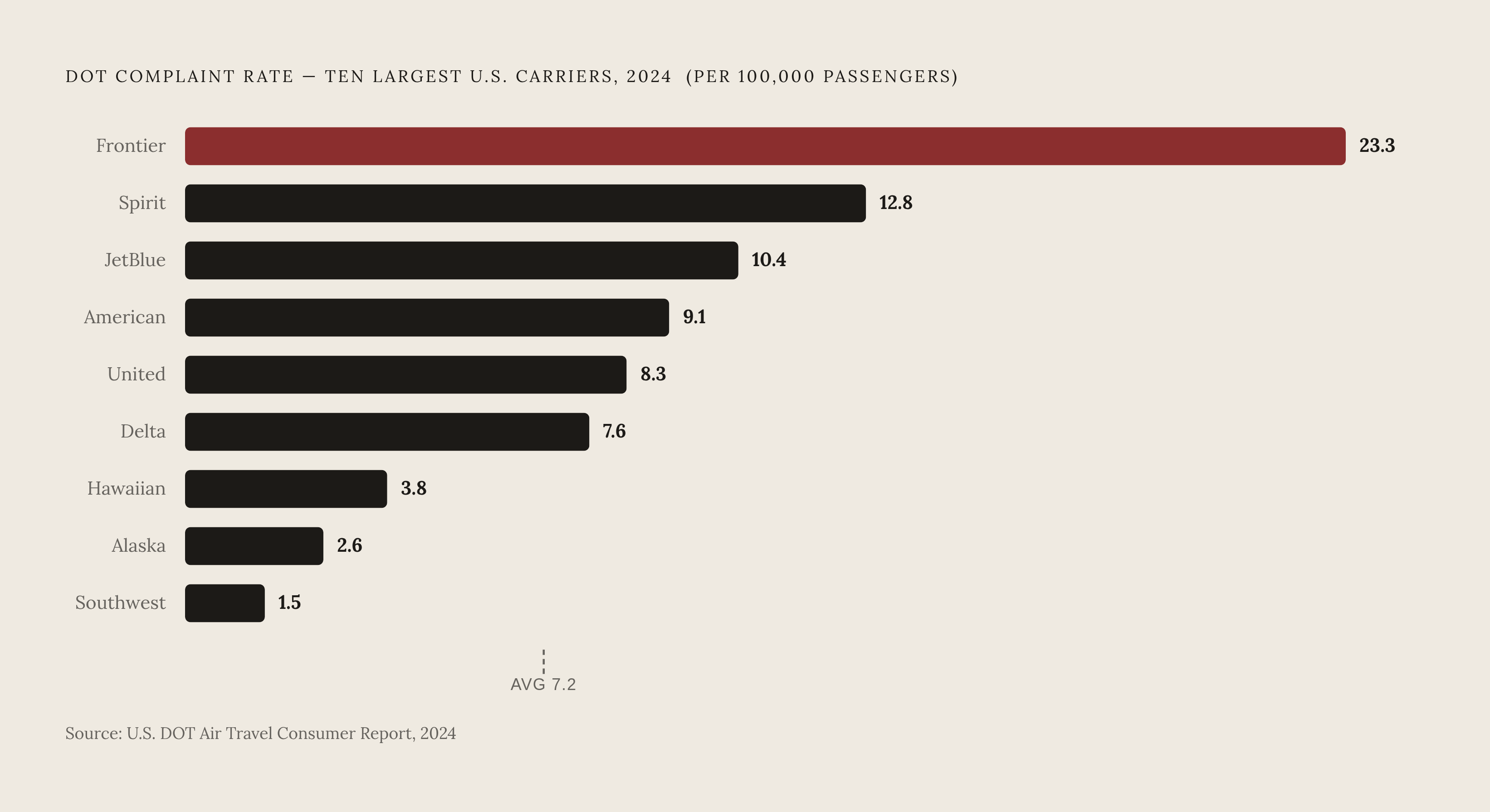
Numbers here tell most of the story. U.S. PIRG's analysis of 2024 DOT complaint data put Frontier's complaint rate well ahead of every other carrier, the worst mark among the ten largest domestic airlines for the third year running. Spirit came in at 12.8, JetBlue at 10.4. The average across those ten largest carriers sat at 7.2. On the other end, Southwest posted 1.5, Alaska 2.6, Hawaiian 3.8.
That gap between Frontier's 23.3 and the industry's 7.2 says something real: this rule isn't being followed evenly across the industry, and which airline a passenger books with still changes the odds of getting a refund without a fight.
Enforcement itself has gotten softer. Frontier was fined $650,000 in January 2025 over three chronically delayed flights, with half the penalty suspended. Then in spring 2026, the DOT canceled that second installment entirely, crediting Frontier $85,534 for compensating affected passengers and another $76,966 for improving push notifications in its mobile app. Compare that to the Biden-era DOT, which returned more than $3 billion in refunds and reimbursements to passengers and issued over $164 million in penalties against airlines. The dollar figures alone show how much the enforcement posture has shifted.
Claiming a refund when the airline doesn't issue one automatically
Automatic doesn't always mean automatic in practice. When it doesn't happen on its own, the fix starts with paperwork, not phone calls.
Document everything before reaching out to anyone. Screenshot the original itinerary alongside the cancellation or change notice the airline sent. Hold onto the booking confirmation, the payment record, and any message the airline sent afterward. Write down the exact delay, measured against the original scheduled time, not whatever revised time got posted later. That original time is the number that decides whether the 3-hour or 6-hour threshold was actually crossed, and it's the detail airlines are most likely to gloss over when a passenger pushes back.