Credit Card Price Protection Benefits Still Available in 2024
Only three credit cards still offer this benefit, and most shoppers won't qualify anyway.
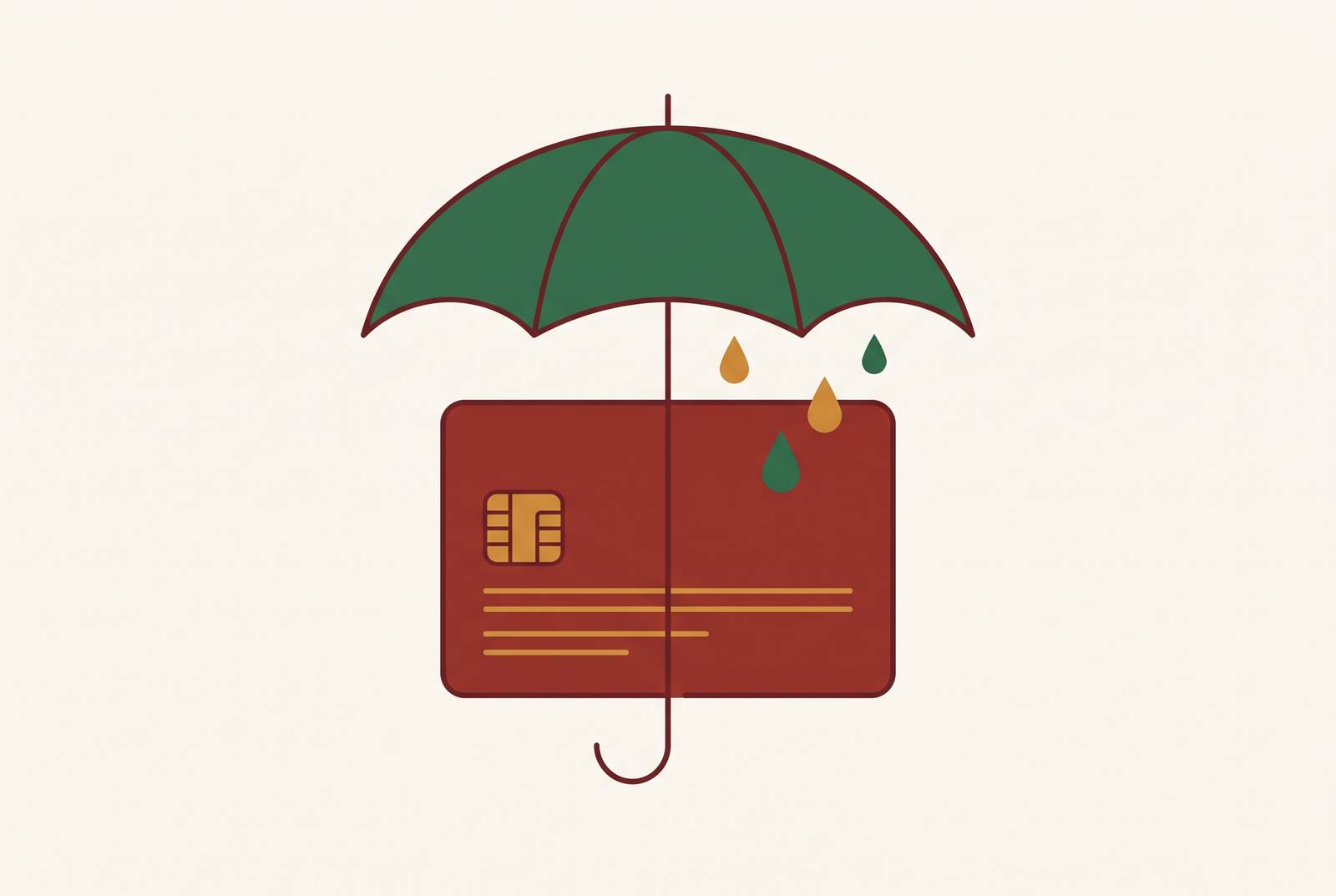
If a card offers price protection, it means the issuer will refund the difference when something you bought drops in price within a set window, up to a set dollar cap. If a card offers price protection, it means the issuer will refund the difference when something you bought drops in price within a set window, up to a set dollar cap, and that's it. It's often mixed up with purchase protection, which covers something totally different: theft or accidental damage to the item itself. The two get lumped together constantly, but one watches prices and the other watches the product.
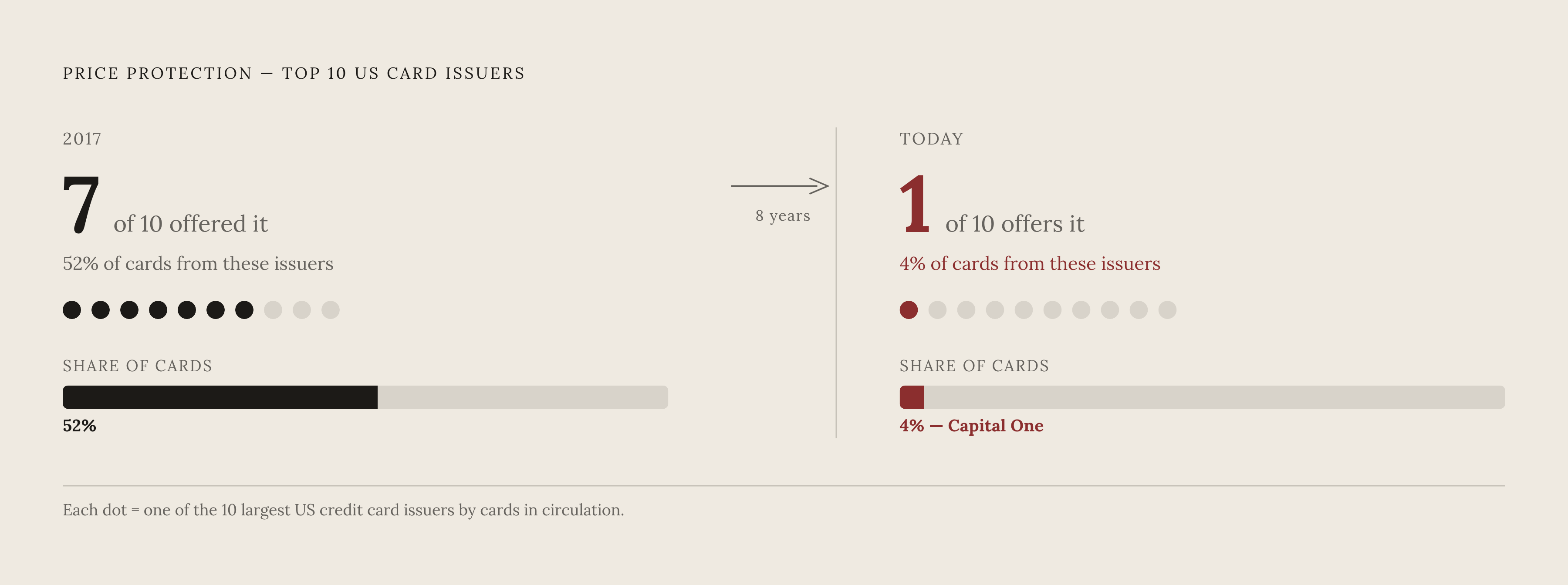
The bigger story is how few cards still bother with price protection. Only 4% of credit cards from the 10 largest issuers offer it today, down from 52% eight years ago. Back in 2017, seven of the top ten issuers had some version of the benefit on their cards. Now just one does: Capital One. That's a benefit issuers walked away from almost entirely, not a gradual decline, and most cardholders never noticed it disappear. That's a benefit issuers walked away from almost entirely, and most cardholders never noticed it disappear.
The cards that still carry price protection and exactly what each one offers
A handful of cards still carry the benefit, and each one runs it differently. Worth checking your wallet against these before assuming you're covered, or before picking a card specifically for this reason.
UBS Visa Infinite Credit Card covers up to $500 per item, with a $1,500 annual cap, inside a 90-day window from the purchase date. The card carries a $650 annual fee, which puts it well outside casual use, but it also stacks extended warranty, return protection, purchase security, and event ticket protection on top. This is a card built for someone who already wants a heavyweight benefits package, with price protection as one piece of a larger set.
Wells Fargo Visa Signature offers up to $250 per item and $1,000 per year, with a shorter 60-day window from purchase. No annual fee. Wells Fargo has stopped accepting new applications for this card, so this only matters if there's already one sitting in a wallet somewhere.
HSBC Premier World Elite Mastercard covers up to $250 per item, caps claims at four per year rather than a dollar total, and gives a 120-day window, the longest of the three.
Three cards, three different structures. None of them overlap much on coverage caps, claim windows, or cost, so the right one depends entirely on what's already in a cardholder's pocket and what kind of purchases they make.
The fine print that gets claims denied
Carrying one of these cards doesn't guarantee a payout. The exclusions are where most claims actually die, and they follow a pattern across issuers.
Limited-quantity deals, doorbusters, and auction items get excluded almost everywhere, which matters most during Black Friday when those are the exact kind of price drop shoppers are trying to catch. Perishables, plants, animals, and pets don't qualify. Neither do jewelry, art, or collectibles. Items bought for resale are out, along with anything customized or personalized. Motorized vehicles, boats, aircraft, land, and buildings sit outside the benefit entirely, as do traveler's checks, tickets, cash, and cash equivalents.
Then there's the matter of documentation. Some policies only accept a printed advertisement showing the lower price, not a screenshot of an online-only deal. Anyone planning to use this benefit around Black Friday should hang onto physical copies of sale ads, because a digital-only price drop might not count depending on the issuer's rules.
There's also a quieter trap buried in holiday retail: model number mismatches between an advertisement and a receipt can cause a claim to be denied, even when the items are functionally identical. It looks like a technicality that carries real weight. It's the exact detail issuers check first.
How to document a price drop and file a claim that goes through
Filing a successful claim comes down to sequence. Skipping a step early means there's no fixing it later.
Start with the purchase itself: the entire charge, or the points used, needs to run through the covered card. Confirm this before checkout, not after, because there's no going back and re-charging a purchase once it's done.
Next, calculate the coverage window immediately, and calculate it from the purchase date, not the delivery date. A 60-day window that starts on a delivery three weeks later is a very different deadline than one that starts the moment the card gets charged. Set a reminder the same day.
From there, it's a matter of watching the price. Coverage kicks in when the same item shows up advertised for less, in a printed ad or, if the issuer allows it, a non-auction internet ad. Once that happens, capture everything: screenshot or print the ad, and record the full model number, the retailer's name, the date, and the advertised price. That packet of evidence is what turns a claim from a maybe into a paid-out difference.
Alternatives when your card doesn't offer price protection
Retailers run their own version of this, and for most shoppers it's the more realistic path since it doesn't depend on having one of three specific cards.
Target refunds the difference for up to 14 days after purchase if the same item shows up cheaper at Target, Target.com, or in the Target app. Bring proof to a store or file it online. During the 2025 holiday season, running November 1 through December 24, Target extended that window so anything bought during that stretch qualifies for a refund if it goes on sale before the end of that stretch, proof of purchase required. As of July 2025, Target stopped matching competitor prices altogether, so this only covers Target's own price drops now, not a lower price found somewhere else.
John Lewis in the UK runs its Price Promise across both in-store and online purchases. For online orders, a customer can file a request before the item even arrives, as long as the original order was placed within the last seven days. The clock runs from the order date, not the delivery date, which mirrors the model-date issue that trips people up with credit card price protection too.
Across most retailers, the pattern holds steady: adjustment windows run somewhere between 7 and 14 days, clearance and promotional items usually get excluded, and in-store purchases sometimes follow different rules than online ones.
Three things that get talked about interchangeably differ in a precise way. Price adjustment is same-retailer only, the store lowers its own price and refunds the gap. Price matching covers a competitor's lower price. Credit card price protection can cover either scenario, but only within whatever exclusions that specific card's policy carries.
Amazon has largely stepped away from this. It no longer honors refunds for price drops after purchase, with limited exceptions such as TVs sold directly by Amazon. Compass+, a background watchdog that connects to shopping and email accounts to surface price-drop refunds and delivery credits, is one tool built around exactly that monitoring gap.
Paribus, owned by Capital One, automates a version of this by monitoring purchases at retailers like Amazon and Walmart and flagging both price drops and late deliveries.
Why manual price-drop monitoring fails most people, and what ongoing financial surveillance looks like
Price protection is a small example of a much bigger problem: money that's technically owed to consumers just sits unclaimed, because claiming it requires a level of ongoing attention most people don't have room for in daily life. Nobody wakes up thinking about day 58 of a 60-day window.
The same blind spot appears with subscriptions. 42% of consumers admit they've forgotten about a subscription entirely while it kept charging them. research from C+R Research and Resubs found that Americans spend an average of $219 a month on subscriptions but estimate the number at just $86, a gap that leaves the true cost roughly 2.5 times higher than what people think they're paying compared to what's actually leaving their account. Forgotten subscriptions alone cost the average person $204.
The thread connecting all of it: price drops, promised refunds, late-delivery credits, subscription charges that should've been canceled months ago. Every one of them needs something watching the clock continuously, not reviewed once a year during a budget cleanup. Automated tools can monitor for price drops after a purchase across shopping accounts, but even that tracking runs inside the same rules card issuers and retailers set. Knowing the exclusions, the model-number mismatches, the printed-ad requirements, is still what decides whether a claim gets paid or denied, coverage or no coverage.