Unused Gift Card Balances and State Escheatment Laws
Billions in unused gift cards follow different state rules with little consumer awareness.

Roughly 43% of adults in the country adults are sitting on at least one unused gift card, voucher, or store credit right now, and the national total adds up to something like $27 billion in dormant value. That money doesn't just wait patiently on a shelf until you remember it. It moves through a legal pipeline built from federal minimums, state escheatment law, and corporate incorporation rules, and where your balance ends up depends on details most people never think to check.
What federal law guarantees, and what it leaves open
The CARD Act sets a floor, not a finish line. It says a gift card can't expire in under five years from the date it's issued or last loaded with funds. That's the national minimum. States can extend it, and many do.
Inactivity fees are a separate mechanism, and this is the one that quietly does the damage. The CARD Act allows issuers to charge these fees, but only after 12 months with no activity on the card, and only if the fee is clearly disclosed upfront. So while the card itself might legally survive for five years, a modest monthly dormancy fee starting at month 13 can hollow out a $50 balance well before the expiration date ever becomes relevant.
Federal law never says what happens to the money after five years. It doesn't require the retailer to refund you. It doesn't require the retailer to hand the balance to the state; it just sets a lifespan and stops there. It just sets a lifespan and stops there. What fills that silence is a patchwork of state unclaimed property laws, and that patchwork is where things get complicated fast.
The three-tier system states use to handle balances that go unclaimed
Every state, plus D.C., Guam, Puerto Rico, and the U.S. Virgin Islands, has some version of an unclaimed property or escheatment law covering intangible property. Gift cards fall into one of three buckets depending on where you are.
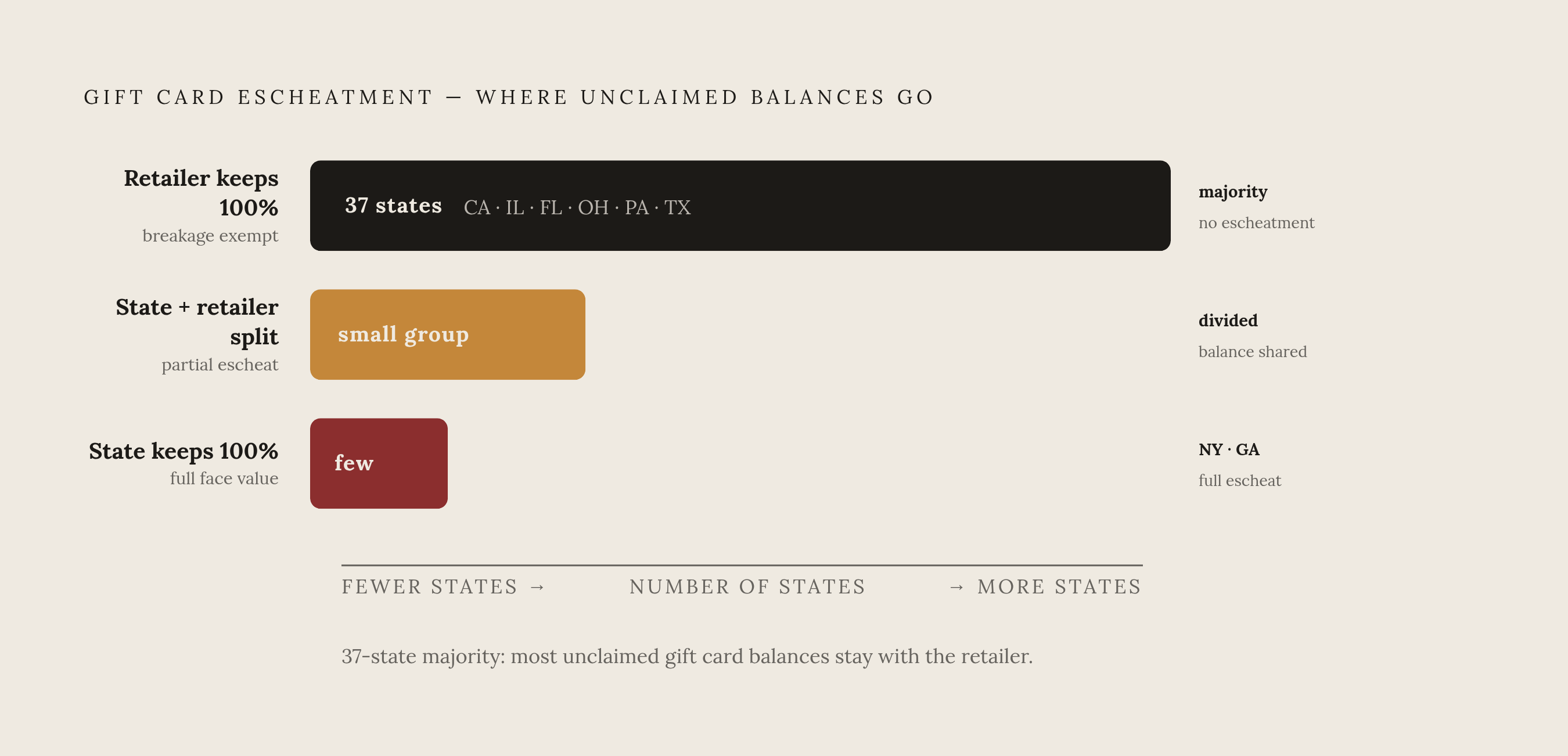
Some states exempt gift cards from escheatment entirely, usually on the condition that the card carries no expiration date and no maintenance fees. In these states, the retailer just keeps whatever goes unredeemed. Accountants call this "breakage," and it's treated as ordinary revenue.
Other states split the difference: a portion of the remaining balance gets escheated to the state, and the retailer keeps the rest. And a smaller group of states requires the full remaining balance to go to the state once a dormancy period passes, no retention allowed.
Thirty-seven states, including California, Illinois, Florida, Ohio, Pennsylvania, and Texas, exempt gift cards from escheatment altogether or simply have no law requiring it. Where escheatment is required, dormancy periods typically run three to five years before a balance counts as abandoned. There's no single national rule: the same gift card can trigger three completely different outcomes depending on the zip code where the issuing company happens to be incorporated.
Why the same gift card can face different rules depending on the state
California exempts gift cards from escheatment, so an unredeemed balance just sits with the retailer indefinitely.
New York takes the opposite approach. It classifies the full value of an expired card as abandoned property, meaning 100% of the balance has to be escheated. No retailer retention, no partial breakage kept in-house. Georgia works the same way: full face value goes to the state, period.
Delaware's unclaimed property rules are highly favorable to issuers, and this matters more than its size suggests. A huge share of corporate America is legally domiciled in Delaware, so Delaware's rule doesn't just govern Delaware residents. It governs any company incorporated there, no matter where its customers live.
Which state's law governs your card: the priority rules most consumers don't know
Unclaimed property law runs on a two-step priority system, and almost nobody outside the compliance world knows it exists.
First priority: a balance is reportable to the state matching the owner's last known address, if the issuer actually has that address on file. Second priority: if there's no address on record, the property defaults to the issuer's state of corporate domicile, usually the state where the company incorporated.
Most gift card programs don't collect a buyer's address at the point of sale. Think about how you actually buy a gift card: you hand over cash or swipe a card at a register, nobody asks where you live. That means the first priority rule almost never applies, and by default, balances without a recorded owner address fall under the second rule, governed by wherever the issuer is incorporated. Given how many companies incorporate in Delaware for unrelated legal reasons, Delaware's rules can end up governing cards bought and forgotten in other states entirely.
The card in your drawer might say "Target" or some regional retailer, but if that company is incorporated in Delaware and never logged your address, it's Delaware's clock ticking.
How the compliance environment tightened in 2024
2024 was a busy year on the enforcement side. States rolled out stricter audit protocols, revised reporting requirements, and tightened self-audit programs, with new deadlines landing across multiple jurisdictions at once.
Idaho's H.B. 471 is the clearest example of the trend. It eliminated a $50 de minimis exemption that had let companies skip reporting small unclaimed balances, and replaced it with a narrower exemption limited to gift cards that never expire and never carry fees. Companies that had incorporated in Idaho specifically to take advantage of that old de minimis rule now face a very different calculus.
After Idaho's change, only Florida and Michigan still have de minimis exemptions on the books. Everywhere else, in practice, any unclaimed balance is reportable no matter how small it is. Multistate audits, often run by private third-party audit firms working on contract for state treasuries, now routinely cover several years of records at once, and the penalties and interest for missed or late reporting aren't symbolic. They add up.
What happens to your money once it's escheated, and how to get it back
Escheatment sounds like a one-way trip, but it isn't. Once a balance transfers to a state's unclaimed property fund, the money doesn't vanish and it doesn't get spent by the state. It sits, waiting for someone to claim it.
Many states operate on this principle: dollars that move into an unclaimed property fund can be reclaimed later, and states generally allow claims to be filed well after the initial escheatment.
The real obstacle is proof. That paper trail is proof. Recovering a balance usually means producing the card number, a purchase receipt, or some other paper trail showing the money was yours to begin with, and most people throw that stuff away the same day they buy the card. The fund does its job. People fail at locating their claim in it.
Forgotten gift card balances, forgotten subscriptions, and unclaimed refunds are the same problem
Gift cards are one instance of a much wider pattern. They're one instance of a much wider pattern: about a third of adults in the country simply forgot they had a gift card at all, and 34% of adults in the country adults report having lost money to some kind of gift card misstep already.
Compare that to subscriptions. Roughly 48% of adults in the country adults admit to forgetting to cancel a free trial before it quietly converted into a paid plan, and unused subscriptions collectively account for a substantial sum in wasted spend every year when tallied across the population studied. Same mechanism, different product.
In both cases, the money is technically still yours. It's sitting in a state fund, or ticking away inside a subscription you stopped using, or waiting in a refund window that's about to close. Claiming it back requires you to know it exists, track where it lives, and act before some deadline quietly passes. Most people don't, not out of carelessness exactly, but because nobody built a habit of checking. That's the real cost here: not one dramatic loss, but a slow accumulation of small, forgettable amounts that eventually adds up to something you'd notice if it disappeared all at once. Tools built to surface this kind of dormant money, like Compass+, start from the same premise: most people are owed money they don't know about, and a gift card sitting in a junk drawer is one of the cleanest examples of that blind spot.
The practical steps to audit your own gift card exposure before a balance disappears
Start with an inventory. Check your wallet, your junk drawer, your email inbox for digital cards, and any retailer app that might be holding a store credit from an old return. Most people underestimate how many of these are floating around until they actually look.
Next, check balances directly, either through the issuer's website or the phone number printed on the card. While you're at it, try to find the issuer's state of incorporation. If the issuer never recorded your address, that detail becomes a key factor in determining whose escheatment rules apply to your money.
Then search your state's unclaimed property database, usually hosted by the state treasurer's office. Search under any former addresses too, since a card tied to an old address might have been reported to a state you no longer live in.
If you find something and need to file a claim, gather your documentation first: card number, purchase receipt, any email confirmation from the original purchase. The claim itself is free, but the state needs proof it's actually yours before it lets go of the money.