Airbnb and Hotel Refund Policies for Cancellations and Complaints
Know your cancellation tier before you book, because the policy that matters most isn't the brand's.
The refund a traveler is entitled to gets decided long before anything goes wrong. It's decided the moment someone clicks "book," picks a rate, or scrolls past a policy tier without reading it. Whether the booking is an Airbnb or a hotel room, the rules that matter most sit in two layers stacked on top of each other: a platform-level policy and a host or property-level policy, and most guests never learn to tell the two apart. That confusion causes refund disputes to get ugly. A guest assumes Airbnb's rules protect them, when really it's the host's chosen cancellation tier doing the deciding. A guest assumes a hotel brand's reputation guarantees flexibility, when really a specific rate code locked them into a non-refundable deposit the moment they hit confirm.
None of this is a small inconvenience. Travel sits among the largest discretionary expenses a household takes on in a given year, and a non-refundable booking gone wrong isn't pocket change; it's a real financial hit, often landing at the worst possible time, right when plans have already fallen apart for some other reason.
How Airbnb's cancellation policy tiers work
Airbnb doesn't run one cancellation policy. Each host picks a tier from a fixed menu when they list their space, and that choice is what governs every booking made against it. The tiers carry names that sound similar across listings but behave very differently in practice. Flexible is the generous end: cancel at least 24 hours before check-in and the guest gets a full refund, with only partial or no refund once that window closes. Further along the spectrum are tiers with names like Moderate and Firm, which push the full-refund cutoff earlier and shrink what's recoverable the closer a guest gets to check-in.
The service fee is where a lot of the disappointment appears. Whether it's refundable depends entirely on timing, on whether the cancellation falls inside that free-cancellation window, and guests who don't check this in advance are routinely surprised that their "full refund" doesn't cover everything they paid. Long stays, the kind that run many weeks or months, follow a separate set of rules entirely, often demanding a longer notice period before any money comes back.
None of it is negotiable after the fact. Whatever policy tier a host sets for a listing is what governs the booking; guests must check it on each individual listing rather than assuming consistency across listings. The tier is a host's decision, not Airbnb's, and it has to be checked listing by listing.
What Airbnb's Extenuating Circumstances Policy covers
Airbnb keeps a separate policy that can override a host's cancellation tier entirely, built for situations no traveler could have planned around. It covers things like declared government travel bans, natural disasters hitting the destination or the traveler's home region, military conflict, and large-scale failures of essential utilities. What it does not cover is just as important: a change of plans, a work conflict that came up, a flight delay, weather that's merely bad rather than declared a disaster, or getting cold feet about travel in general. None of that qualifies, no matter how legitimate the underlying reason feels to the traveler holding the bag.
Under the current version of this policy, personal illness and death are no longer covered events. Medical records, death certificates, none of that carries the weight it once did under this specific policy. That's a meaningful narrowing, and travelers who remember an older, broader version of Airbnb's safety net are operating on outdated assumptions.
Documentation makes or breaks a claim. A request without a government notice, an evacuation order, or comparable proof gets denied as a matter of course. And speed matters just as much as evidence: guests need to contact Airbnb support directly, within a defined window of whatever event triggered the claim. Waiting until after the stay, or after check-in has already passed, weakens the case substantially and often kills it outright. A successful claim typically returns the full accommodation cost, though whether service fees come back too depends on the specifics of the situation and how Airbnb's policy language reads at the time.
Treat this policy as a real safety net, but a narrow one. It exists for genuine large-scale disruptions, not as a workaround for a guest who booked a Strict listing and now regrets it. It will not retroactively turn a rigid cancellation policy into a flexible one just because the traveler wishes it would.
Airbnb complaint refunds: when the listing doesn't match reality
Separate from cancellation, Airbnb runs a guest protection program called AirCover, and this is the mechanism that kicks in once a guest has already arrived and found the place doesn't match what was promised. Qualifying problems include a property that looks materially different from its photos or description, an amenity that's listed but missing or broken (a pool, a hot tub, an appliance, an HVAC system), no hot water, a pest problem, or a host who simply won't let the guest in.
Timing is the single biggest reason legitimate complaints get denied. Guests generally have 72 hours after discovering a problem to report it to Airbnb. Wait until after checkout to bring it up, and the claim is very likely dead on arrival.
Before contacting anyone, document everything. Photos of the actual conditions, screenshots of what the listing promised, and written communication with the host kept inside the Airbnb platform (not a side text thread) all strengthen a claim considerably. From there, the process runs through Airbnb support via the app or website, and depending on how serious the issue is, Airbnb might offer rebooking, a partial refund, or a full one.
What doesn't qualify matters just as much as what does. Not liking the décor isn't a covered issue. Neither is something the listing disclosed upfront, or a minor discrepancy that doesn't actually stop a guest from using the space. If Airbnb's first response falls short, guests can ask for escalation to a specialist, and a credit card dispute remains available as a last resort, though card issuers are noticeably harder to win over when the platform's own resolution process hasn't been fully tried first.
Hotel cancellation policies and the rate-type trap
Hotels don't hand out a single cancellation policy tied to a brand name; the real terms live inside the rate a traveler picks at checkout. Fully flexible or pay-at-hotel rates let a guest cancel up to a set cutoff, often somewhere between 24 and 48 hours before check-in depending on the property, and no money changes hands until arrival or until that cancellation window has closed. Advance-purchase or prepaid rates are the opposite end: cheaper up front, charged immediately, and non-refundable in whole or in part no matter how far ahead of the trip the cancellation happens. Between those two extremes, some properties offer a semi-flexible middle tier, trading a moderately higher rate for partial refund rights or a longer cancellation window stretching out a week or two.
This is the rate-type trap in plain terms: travelers chase the lowest number on the screen, skip the fine print, and don't discover the booking was non-refundable until the moment they actually need to cancel it. By then it's too late to negotiate.
Booking through a third-party site adds another layer. The platform can run its own cancellation terms that don't match what the hotel would offer directly, and a booking made that way is bound by the third party's rules, not the property's, so the hotel can flatly refuse to process a refund on its own. Loyalty program status sometimes buys shorter cancellation windows as a membership perk, but elite status generally doesn't rescue a non-refundable or prepaid rate; it's worth checking rather than assuming status covers a bad rate choice. Cancellation deadlines are almost always stated in the property's local time zone, not the guest's home time zone, which has caused plenty of travelers to cancel what they thought was "in time" only to find out the clock had already run out somewhere else in the world.
Hotel complaint refunds and property obligations
Hotels have nothing like Airbnb's AirCover, no single unified complaints system covering every stay. A guest dealing with a problem is instead negotiating with the property itself, the brand's customer service line, and, if the booking ran through a third party, that platform's support team too.
Some complaints have a real, well-established path to compensation. A room that doesn't match what was advertised, uninhabitable conditions like pests, no hot water, or a broken HVAC system, outright dangerous conditions, or getting "walked" (bumped to a different property because the hotel oversold the night) all qualify as legitimate grounds for a refund or some form of compensation. The walk scenario deserves particular attention, because hotels that oversell a night and relocate a guest are generally obligated to cover transportation to the new property, potentially make up any rate difference, and in some cases offer further compensation on top of that. Guests who accept a walk quietly, without asking what they're owed, routinely leave money on the table that was theirs for the asking.
The practical sequence for a complaint during a stay: flag the problem to the front desk immediately, and put it in writing, following up any verbal complaint with a message or email so there's a paper trail. Ask for a room move first, then a rate adjustment, then an early-departure refund if it comes to that, escalating step by step rather than jumping straight to the harshest ask. Document the whole thing along the way: photos of the issue, names of the staff involved, timestamps for every interaction.
Loyalty program membership often opens a faster door than the front desk can offer, since a brand's elite or member relations line tends to produce a different outcome than a property employee with no real incentive to hand out refunds. If the original booking ran through a third-party site, that platform's customer service is the actual first stop, not the hotel itself, since the OTA may be the only party able to authorize the refund at all. A credit card chargeback sits at the very end of the line, appropriate when a service simply wasn't delivered or was clearly misrepresented, but it should wait until the hotel and any OTA channels have genuinely been tried first; jumping to a chargeback too early weakens the case rather than strengthening it.
Travel insurance and credit card protections as a backstop for both platforms
Travel insurance and credit card benefits act as a backstop for when the platform's or property's own policy doesn't bend. Cancel-for-any-reason coverage, usually shortened to CFAR, is the most flexible option on the market, but it has to be purchased within a short window of the original trip deposit, not later, and definitely not once a trip is already in question. Standard travel insurance, without the CFAR add-on, only pays out for a defined list of named reasons: illness, a death in the family, job loss, jury duty, severe weather hitting the destination. A simple change of plans or a scheduling conflict doesn't make that list, no matter how inconvenient it feels in the moment.
Credit cards vary a lot here, but plenty of premium travel cards bundle in trip cancellation and interruption coverage for a defined set of covered reasons, trip delay coverage once a delay passes a set number of hours (covering meals, a hotel room, incidentals), and coverage for lost or delayed baggage. None of it applies, though, unless the booking itself was actually paid for on that specific card, a detail that trips up more travelers than it should.
Where both types of coverage exist for the same loss, a traveler can't collect more than the actual cost of what went wrong. Neither travel insurance nor a credit card benefit covers a stay that was simply disappointing. They cover financial loss tied to specific, named events. The platform and property complaint channels described earlier still carry so much of the weight because of this.
The timelines that determine whether a refund is possible at all
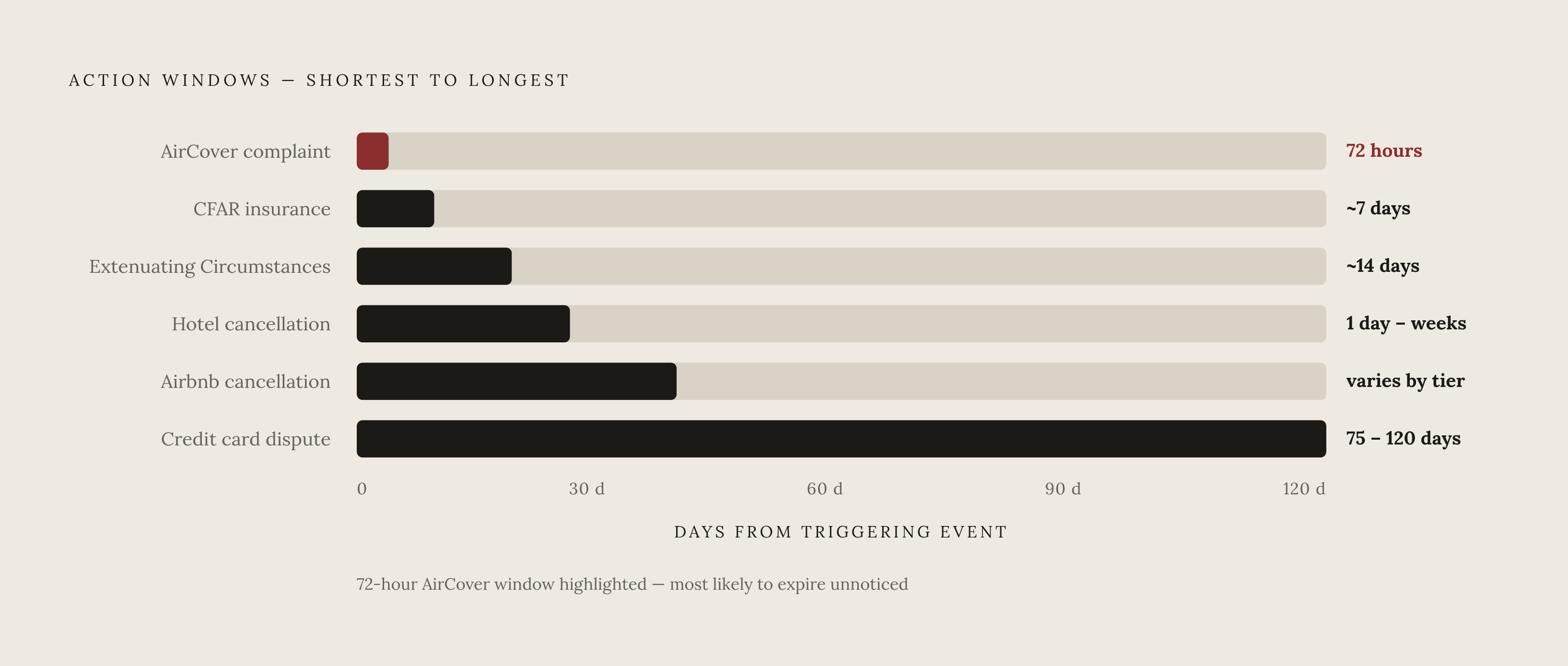
Every scenario in this piece circles back to the same failure point: the window to act is shorter than most people expect, and it starts ticking at booking or at check-in, not at the moment frustration sets in. Airbnb cancellation deadlines count down from check-in time, stated in the host's local time zone, not the guest's home clock. AirCover complaints have to be reported within 72 hours of discovery. Extenuating Circumstances claims need to go in around the time of the triggering event itself, not weeks later after a trip has already been skipped or completed. Hotel cancellation deadlines run on the property's local time and stretch anywhere from 24 hours to several weeks depending entirely on the rate booked. Hotel complaints get resolved far more easily during the stay itself; once checkout happens, leverage drops fast. CFAR insurance has to be bought within days of the first trip deposit, not closer to departure. Credit card disputes carry their own clock too, usually somewhere between 75 and 120 days after the charge posts, depending on the card network.
Most refund failures are timing failures, not knowledge failures. A guest who knows their rights cold but waits too long to act ends up in exactly the same spot as a guest who never read the policy. That's a hard thing to accept, but it's the honest read on how these systems are built. They mirror a pattern that occurs everywhere in personal finance: benefits and protections expire unused because nobody's watching the clock. Price-drop guarantees go unclaimed the same way. Free trials quietly convert to paid subscriptions the same way. The mechanism is identical; only the dollar amount changes.
How to escalate a denied refund
A denial from the first person a traveler talks to isn't the end of the conversation. Airbnb, hotel brands, and card issuers all run tiered escalation paths, and the second or third tier frequently produces a very different answer than the first one did.
On Airbnb, that means asking directly for escalation to a senior support specialist inside the app rather than accepting the first response at face value. The platform's Resolution Center exists specifically for disputes with hosts and is worth using deliberately rather than as an afterthought. On the hotel side, a brand's corporate customer relations team operates separately from whatever the property itself can offer, and it's often a more productive contact than the front desk. Loyalty program members have a further path through the program's own member relations line. If the original booking went through a third party, that platform's dedicated dispute or escalation team is the one holding the actual authority to issue a refund.
A credit card chargeback remains the last tool in the kit, most effective when a service simply wasn't delivered or was clearly misrepresented, and it works best backed by a full trail of the resolution attempts already made.
What actually moves an escalation forward is specificity: exact dates, exact dollar amounts, the precise policy language being invoked, the names of the staff a guest already spoke with. Documentation, photos, screenshots, saved written communication, does more work than any amount of frustration expressed on a phone call. What doesn't move things forward is threatening a bad review as leverage; platforms and hotel brands alike are trained to spot that tactic and tend to push back against it rather than fold. Vague complaints without evidence behind them go nowhere, and waiting weeks to escalate only makes a legitimate case look weaker than it is.
Travelers who treat policy tiers, documentation, and timelines as part of the booking process itself, not an afterthought reached for once something's already gone wrong, put themselves in a genuinely different position than everyone else reading the fine print for the first time under pressure.