Retail Return Window Expiration and Late Return Options
Return windows are shorter than advertised, with hidden fees and exceptions eating into refunds.
A return window sounds like a simple promise: buy something, change your mind, get your money back within a set number of days. In practice it's a layered system full of category exceptions, product carve-outs, and fine print that most shoppers never open. The stakes are bigger than they look, too. The National Retail Federation expects $849.9 billion worth of merchandise to come back through returns in 2025, and the system built to process all of it is designed around retailer economics first, shopper convenience second.
Return fraud costs retailers over $75 billion a year, and that number explains a lot of the friction shoppers now run into. Shorter windows, manual review, fees buried in the fine print: much of it exists to catch bad actors, but it catches honest shoppers off guard just as often. Consumer World's 22nd annual return policy survey found that the combined return policies of 11 major chains now run past 44,000 words and 126 pages. "All returns in 30 days" hasn't been the real policy at most stores for a long time. It's a headline that hides a much longer document.
How the standard return window counts down
The clock starts at delivery, not at purchase. Order something on January 1, and if it shows up January 10, the 30-day window closes February 9, not January 31. That's more than a week of runway most shoppers assume they don't have.
It doesn't matter how fast the shipping was, either. Two-day Prime shipping, standard ground, same-day delivery: all of it starts the same countdown the moment the box lands on the porch, not the moment the order goes through.
That mechanic gets brutal around the holidays. Shoppers who order gifts weeks in advance often see them arrive just days before December 25. The recipient, unwrapping it days or weeks later, has far less real time to return it than a 30-day window suggests on paper.
It also explains why online returns get policed so much harder than in-store ones. Nearly 30% of items bought online come back, compared with 8.89% of purchases made in a physical store. That gap in return rate is why automated window enforcement, timestamped delivery confirmations, algorithmic flags, has gotten so much stricter for online orders specifically.
Category exceptions at major retailers
Electronics are where the general policy stops applying. Phones, laptops, anything with an Apple logo on it: these categories almost always carry a shorter window than the store's advertised return period, no matter how generous that headline number sounds.
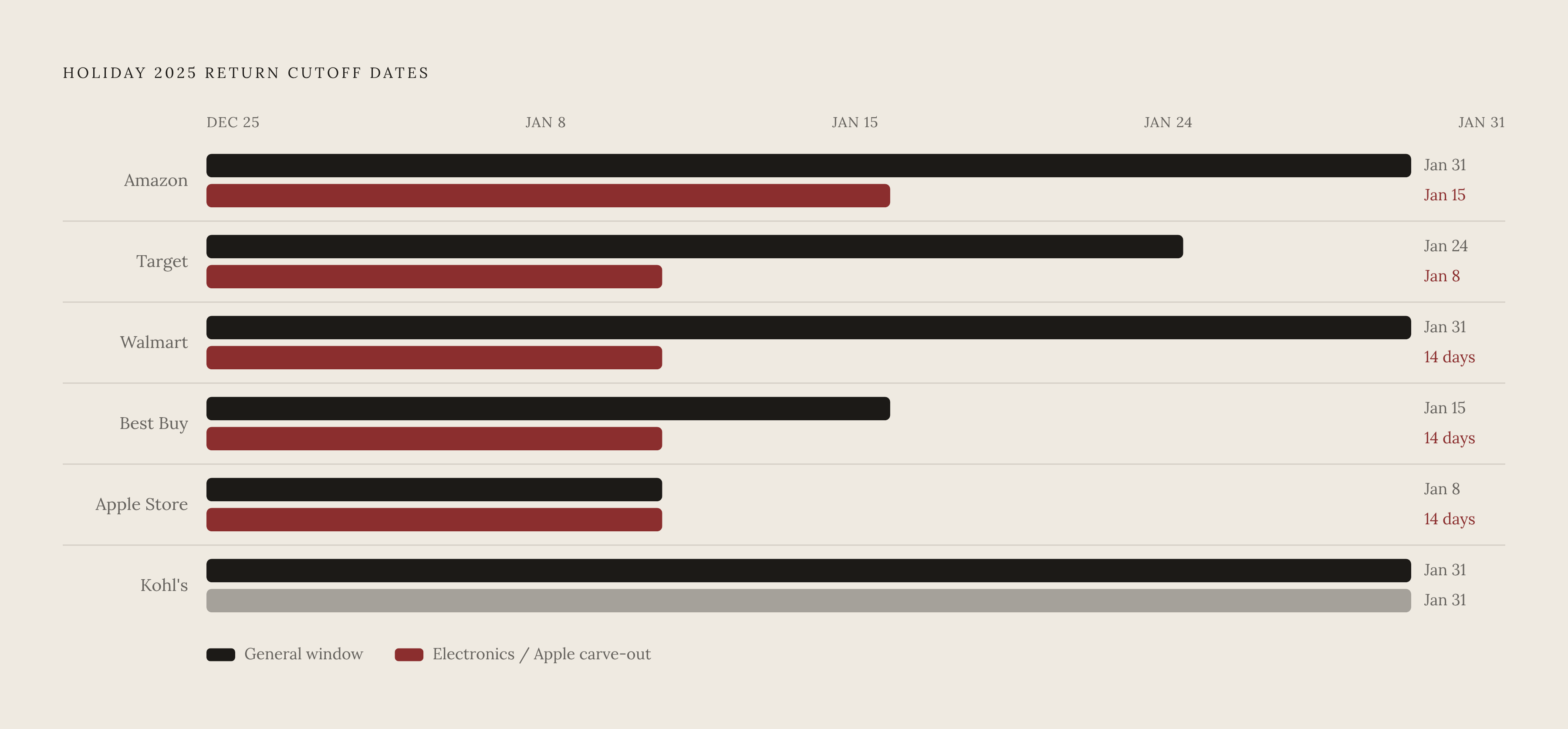
The holiday 2025 numbers make the pattern concrete. At Amazon, items bought November 1 through December 31, 2025 are returnable through January 31, 2026, except Apple products, which cut off January 15, 2026. Target gives until January 24, 2026 for electronics and entertainment items bought November 1 through December 24 (returns processing starts December 26), but Apple and Beats products, along with prepaid or unlocked phones, have to be back by January 8, 2026. RedCard holders get an extra 30 days on eligible items, which is worth knowing if that's a card already in the wallet.
Walmart runs a similar split. Most items bought October 1 through December 31, 2025 are good through January 31, 2026, but major appliances get just 14 days (and only 2 days to report damage on an opened appliance), wireless phones get 14 days, and consumer electronics get 30 days. Best Buy accepts most purchases made October 31 through December 31 through January 15, 2026, except holiday décor (15 days from purchase) and activatable devices like phones (14 days). Apple's own stores give until January 8, 2026 for anything bought November 12 through December 25, but carrier-financed iPhones through T-Mobile or Verizon fall under Apple's standard 14-day policy, holiday extension or not. Kohl's stacks a holiday extension on top of its already generous 90-day window: purchases made as early as October 5 are good through January 31, and that same January 31 cutoff covers Sephora items bought at Kohl's between October 31 and December 30.
The rule of thumb holds across almost every one of these: if it plugs in, pairs with a phone over a short-range wireless connection, or has a known electronics brand logo on the box, assume the window is shorter than the store's headline date and check before assuming otherwise. Items sold through third-party marketplace sellers on sites like Amazon can carry entirely different return terms than items sold and shipped directly by the retailer. That distinction lives in the fine print, and it's easy to miss until the return gets rejected.
Policy tightening in 2025: what retailers quietly changed
Consumer World's 2025 survey found that most major chains left their overall policies mostly the same this year. But the exceptions that did change are the ones with teeth, and none of them got announced with much noise.
Amazon shortened its mattress return window from 100 days down to 90, and added a 100% late fee for returns that come in more than 30 days past the due date. It also added a damage fee running up to 100% on certain items sold through Amazon's Luxury Store, well above the 50% cap that applies to standard merchandise. Sephora cut its regular return window from 60 days to 30 (holiday purchases are still exempt from that cut). Home Depot added a new 7-day category covering some gas-powered equipment, and also added a rule that tinted paint can't be returned. Best Buy added golf carts, electric bikes, and mopeds to its list of items that can't be returned.
Some direct-to-consumer brands have also started charging restocking fees to offset what it costs to process a return. The pattern across all of it is consistent: categories that are expensive to ship back, bulky items, luxury goods, anything with a high fraud rate, are where the tightening lands hardest.
The real cost of mail-in returns
"Free returns" doesn't mean what it used to. A growing number of retailers now deduct a mail-in return fee straight from the refund instead of charging it upfront. The money that lands back in the account is quietly smaller than the price tag suggested.
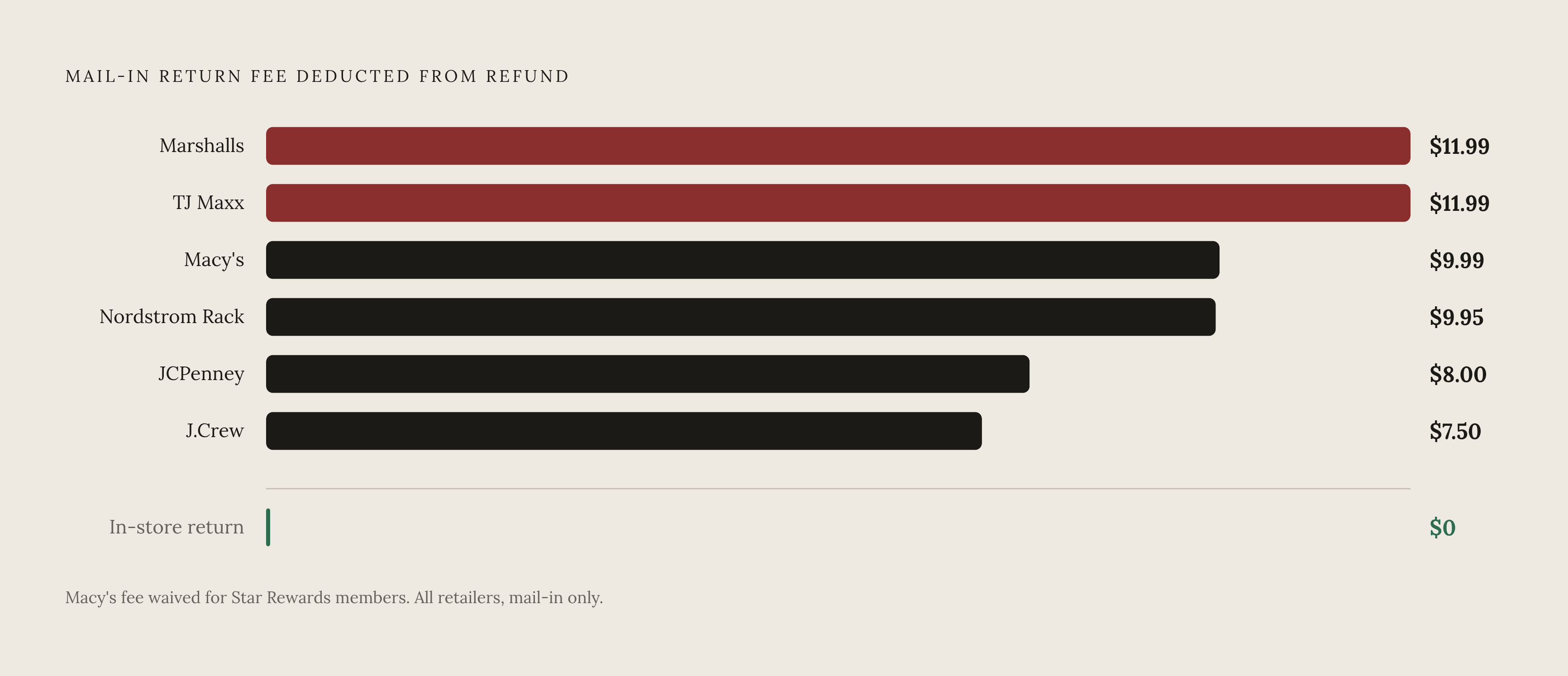
The fees are specific and worth knowing by name. Macy's takes $9.99 off a mailed return unless the shopper is a Star Rewards member. JCPenney deducts $8. J.Crew takes $7.50. Nordstrom Rack charges $9.95. Marshalls and TJ Maxx both deduct $11.99 for postage and handling on anything mailed back.
The fix is almost embarrassingly simple: return it in person. In-store returns are free at nearly every one of these retailers, even for items bought online, and it's the single biggest habit change available to most shoppers. Where label-free or box-free drop-off exists, it usually dodges the fee too. Amazon's network for this kind of drop-off includes Whole Foods and Kohl's, among other locations.
What happens when the window has already closed
Missing the window doesn't automatically mean the money's gone. Amazon's system flags any return submitted after 30 days, tells the shopper it's "outside the normal return window," and may process it on a case-by-case basis rather than issue an automatic rejection.
What happens next depends on the specifics. Amazon considers the condition of the item and the reason given for sending it back. Late returns have better odds when the item arrived damaged or defective, or when it falls under an extended holiday policy.
Drop-off location matters here too. Returning an item at Whole Foods or Kohl's drop-off locations can sometimes avoid the return shipping fee, and it is worth trying these options even when the standard window has closed. Whether the shipping fee gets waived varies by item category and by the reason given, so it's a real option worth trying before writing off the purchase.
Escalation paths: what to try when the standard return process fails
When the automated return portal says no, that's not necessarily the final word. Contacting customer service directly is a separate path from the self-serve portal, and a live representative can weigh purchase history and stated reason in a way the automated system doesn't. Outcomes through this channel often differ from what the portal spits out on its own.
Fraud detection on the retailer side has gotten more sophisticated, too. Companies like UPS-owned Happy Returns are testing tools such as "Return Vision," which compares a returned item against photos taken at purchase to catch mismatched or swapped goods. That cuts both ways: legitimate returns move faster when there's a paper trail to back them up. Photograph the item before it goes back in the box, and hold onto the drop-off receipt or confirmation email until the refund actually posts.
It also helps to initiate the return from the same account and email used to make the purchase. Mismatched accounts add friction and slow everything down. Amazon tracks how often a shopper selects reasons like "wrong item sent" or "product damaged," the categories that put fault on Amazon rather than the customer. Selecting those reasons too often can flag an account for review. Choosing an in-store or free drop-off option instead sidesteps that issue entirely, since those returns are free regardless of the reason given.
Price-drop windows: a separate refund right most shoppers don't claim
Price adjustment, sometimes called price protection, refunds the difference when something drops in price shortly after it's bought. It's a real, contractual right at plenty of major retailers, and almost nobody uses it, mostly because nobody's watching for the price drop.
Amazon's price-adjustment terms are limited, and any adjustments that do occur apply only to items Amazon sells and ships directly. Best Buy still refunds the difference if a lower price turns up at Best Buy itself or at a qualified competitor (Amazon, Apple, Costco, Target, or Walmart) within the return and exchange window; for holiday 2025, that means purchases made October 31 through December 31 can be price-matched through January 15, 2026. Target refunds the difference for 14 days after purchase if a better price appears at Target or a qualifying online competitor, with a holiday extension for anything bought November 1 through December 24, though flash sales like Amazon Lightning Deals and doorbusters don't count, and neither does a lower price at a different Target store. Costco has its own price-adjustment practices, though the specific terms and timelines are worth confirming directly with the retailer. Some specialty retailers offer their own price-match windows if they lower the price after purchase.
Timing is the catch. A price-adjustment window often runs at the same time as the return window on the same purchase. Two separate deadlines are ticking on one item and most shoppers are only watching one of them. Apps like Paribus (owned by Capital One) and Settlemate exist specifically to automate this kind of claim on a shopper's behalf. The right to the refund is the same either way; claiming it by hand just takes a kind of ongoing attention most people don't keep up.
Late delivery credits: the deadline-based refund that runs separately from returns
Late delivery credits run on their own clock, separate from anything tied to returns or price drops. Amazon delivered more than 13 billion items same-day or next-day globally in 2025, a scale that makes even a small percentage of missed delivery promises add up to a lot of eligible credits sitting unclaimed. When a package misses its promised delivery date, that's a distinct failure from a return or a price change, and it opens its own separate window to ask for money back, running on its own deadline, independent of whatever return or price-adjustment clock might be ticking on the same order.