Dollar Amounts Unclaimed From Late Delivery Guarantees Annually
Carriers owe millions in late-delivery refunds but make claims deliberately difficult to file.

FedEx's own annual report states that it moved an average of 16.5 million packages a day in 2023, at a 97.3% on-time rate. Run that math and you get hundreds of thousands of late packages every single day, each one carrying a contractual refund that FedEx owes and does not pay out on its own. That works out to roughly 445,500 late shipments a day at FedEx alone. A 2015 Bloomberg analysis put FedEx's daily money-back guarantee payouts in the millions of dollars, and given how much e-commerce volume has grown since then, that number is almost certainly higher today. The specific figure cited in that 2015 Bloomberg analysis was $2 million a day.
Scale that down to something closer to an actual business. A company shipping a few thousand express packages a month isn't dealing with FedEx's daily hundreds of thousands, obviously, but the same on-time rate applies to them too. Multiply the late-delivery percentage across a year of invoices and you land on a recoverable total that runs into the tens of thousands of dollars annually for a shipper of that size. That money is owed to the shipper as a matter of contractual right. It's owed, not a rebate or a courtesy. The only question is whether anyone goes and gets it.
What carriers promise (and what they don't automatically deliver)
The guarantees themselves are specific, and more generous to shippers than most people assume. FedEx's Money-Back Guarantee refunds the full transportation charge if a package on an eligible service shows up even 60 seconds after its committed delivery time, a policy one industry site, peakadvisers.com, describes as "surprisingly strict in the shipper's favor". UPS runs the same play: a full refund of transportation charges for any guaranteed-service package that arrives even a minute late.
Canada Post narrows the field a bit. Priority, Xpresspost, and Expedited Parcel on commercial accounts all carry On-Time Delivery Guarantees, but Regular Parcel doesn't, since its delivery windows are estimates rather than commitments.
Amazon works differently, and arguably better for the average customer. If Amazon fails to make a delivery attempt by the guaranteed date, it automatically processes refunds for shipping fees within 1–2 business days, with no claim required from the customer. Walmart states that customers may be entitled to refunds of shipping fees and tips on late scheduled deliveries.
On the carrier side, "full refund of transportation charges" does not mean full refund of the invoice, which trips people up. FedEx and UPS refund the base transportation charge only. Fuel surcharges, residential delivery surcharges, signature confirmation fees, and dimensional weight adjustments are all excluded. The guarantee is real. It's also narrower than it sounds. FedEx's guarantee covers most of its services, including Priority Overnight, Standard Overnight, 2Day, Express Saver, and FedEx Ground and Home Delivery within the United States. The FedEx U.S. 2026 Service Guide PDF states it is effective January 5, 2026 and was updated September 11, 2026, and both FedEx.com and lateshipment.com confirm FedEx Ground and freight guarantees remain suspended.
Why guarantees are designed to be hard to claim
None of this pays out by itself. FedEx and UPS do not automatically issue these refunds. The shipper has to notice the late delivery, pull the documentation, and file a claim inside a tight window. That window is 15 calendar days from the invoice date for both carriers. Canada Post gives a bit more room, 30 business days from the ship date, but the clock still runs whether anyone's watching it or not.
UPS's 60-second rule sounds simple until you read the fine print. Three things have to be true at once: the shipment has to be on a service where the guarantee is currently active, no exclusion can apply, and the claim has to be filed within 15 calendar days. Miss any one of the three and the refund disappears. Canada Post adds a wrinkle of its own: only the sender can file the claim, not the receiver. In an e-commerce context, that means a customer's complaint email is often the first anyone hears about a late delivery, and the business then has to act on it before the window shuts.
Seasonal suspensions make the whole system harder to trust. FedEx suspended its Money-Back Guarantee entirely from December 1, 2025, through January 13, 2026, right through peak holiday shipping, and separately suspended it on U.S. import shipments from January 29 through February 10, 2025. FedEx's own service guide confirms the guarantee was reinstated for packages shipped on or after January 13, 2026. UPS reserves the same right and uses it often during peak season. As of the service guide effective January 5, 2026, FedEx Ground and FedEx Freight still carry suspended or limited guarantees.
Then there are the denial categories that catch shippers off guard even when they do file on time: address errors, delivery changes requested by the recipient before the first attempt, and anything the carrier chalks up to weather or force majeure. Any one of those kills a claim that otherwise looked clean.
Manual auditing recovers only a fraction of what's eligible
The number that makes the whole gap make sense follows. Manual auditing, a person reviewing invoices by hand, recovers only about 10% of eligible refunds. A study from the logistics consulting firm Shipware found that somewhere between 5% and 8% of eligible late-delivery refunds go unclaimed entirely. Businesses running automated tools like LateShipment.com's OneAudit against their Canada Post shipments recover a meaningfully larger share of refunds than manual review ever catches.
The reason is arithmetic. It's arithmetic. Reviewing invoices, cross-referencing tracking data against committed delivery times, and filing inside a 15-day or 30-business-day window, across hundreds or thousands of shipments a month, isn't a task a person can do reliably by hand. It happens constantly, and it compounds.
Darrigoconsulting.com identifies late delivery refunds as the single largest category of recoverable carrier overcharges for any shipper moving meaningful express volume. It sits on top of a large pool of money that mostly goes untouched. It's the biggest pool, mostly untouched.
The consumer side of the same gap: retailer guarantees and everyday shoppers
The same structural gap appears on the retail side, just with smaller dollar amounts and even less follow-through. Amazon's shipping-fee refund is automatic, which puts it ahead of the carriers on that front, but Prime members have to contact customer service to get the additional promotional credit Amazon sometimes offers on top of that, and the amount varies. Knowing that credit exists, and being willing to sit through a customer service chat to claim it, is a different ask than the automatic refund.
Given the scale, that gap adds up fast. Amazon Prime delivered billions of items same-day or next-day to U.S. customers in 2025, a substantial jump from the year before. The number of late-delivery events sitting out there, unclaimed, is enormous.
Walmart states outright that customers may be owed refunds of shipping fees and tips for late scheduled deliveries. But like most retailer guarantees, there's no automatic detection behind it. Some retailers hand out store credit instead of cash refunds, which is still money, just money you have to notice, understand, and ask for. The consumer version of this gap is really an attention problem: most people don't track their expected delivery date against the actual one, don't know their retailer's guarantee terms, and even when they do notice, a few dollars of credit rarely feels worth the hassle of asking. So the money leaks out one small, unreported incident at a time.
The claim window closes before most people realize money is owed
Go back to that 15-day window for FedEx and UPS. It starts from the invoice date, before the shipper actually notices the package was late. Invoices bundle dozens or hundreds of shipments into one document. A single late package is easy to lose inside the noise of a batch. A shipper getting hundreds of packages a month has no realistic way to manually check every tracking timestamp against every service commitment and every invoice line before that window closes.
For an individual consumer, the equivalent problem isn't volume, it's timing. By the time the late package finally shows up, the frustration has already faded and the purchase has been mentally filed away as done. Nobody goes back and asks for the credit.
Seasonal suspensions make the guarantee tend to get suspended exactly when volume and late rates are at their highest. FedEx's suspension ran from December 1, 2025, through January 13, 2026, covering the busiest shipping stretch of the year. Once a Canada Post claim window closes, 30 business days from the ship date, the refund is gone for good, no matter how obvious the service failure was. FedEx and UPS work the same way.
None of this appears as one dramatic loss. A single missed claim is a few dollars, maybe a few hundred if the invoice was large. But missed claims stack up month after month in invoice records, and that accumulation is how you get to the $2,000–$4,000 annual gap that appears in the data, a figure that accumulates in the background with no single moment of visible loss.
What automated monitoring changes about recovery rates
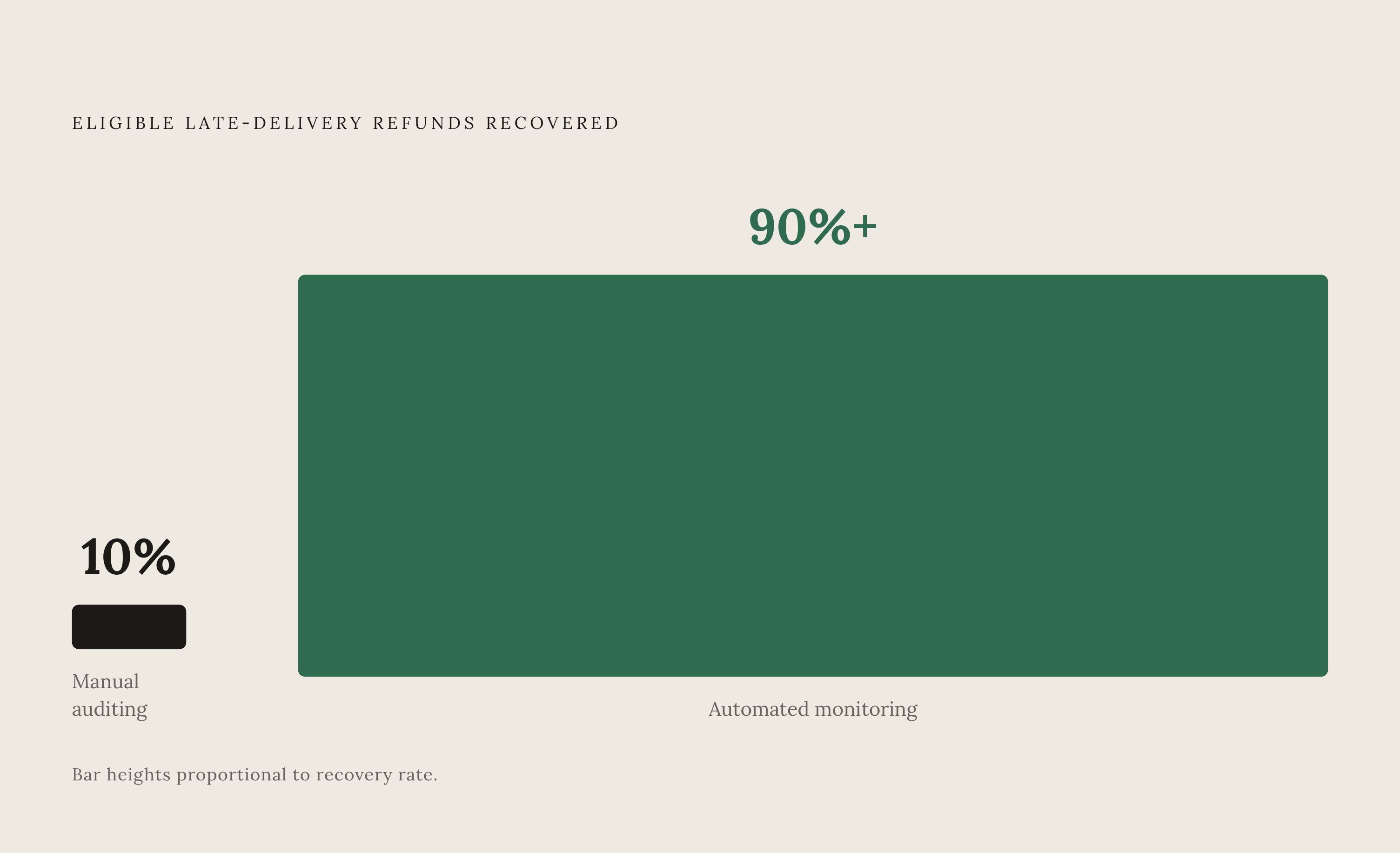
The contrast is stark enough to warrant pausing on. Automated monitoring recovers 90%-plus of eligible refunds, against roughly 10% for manual auditing. That's not a marginal improvement; it's a different order of outcome.
What changes is the surveillance, not the policy. Automated systems track every shipment continuously against its committed delivery time, cross-check invoices for billing errors and surcharge anomalies, and file claims before the window closes, all without the shipper having to do anything ongoing. Billing errors, like dimensional weight overcharges, duplicate line items, invalid surcharges, get caught as a byproduct of that same invoice review, and those errors never fix themselves; they just sit on the invoice until someone disputes them.
The shift, in both the carrier context and the consumer one, comes down to where the burden sits. Manual recovery asks the shipper or the shopper to go looking for the opportunity before it expires. Automated recovery brings the opportunity to them, flagged and filed while the window's still open, instead of surfaced after it's already shut.
What the unclaimed total represents
These aren't loopholes or fine print designed to trap anyone. FedEx's and UPS's guarantees are real contractual commitments. UPS even uses its money-back guarantee as part of the pitch for why express pricing costs what it costs. The commitment is genuine. The payout mechanism just isn't automatic, and that gap between "owed" and "paid" is where the money disappears.
When manual auditing only recovers a small fraction of eligible refunds, and a significant share of eligible claims go unclaimed, the plain conclusion is that the majority of the money owed under these guarantees is retained by the carriers by default. It's legitimate credit that was simply never asked for.
The consumer version plays out the same way, just smaller and quieter: a few dollars here, a store credit there, never large enough on its own to notice, but real money over a year of purchases.
The same mechanism produces both stories, as shown by how each one unfolds. Money that's legally owed sits unclaimed because no one's watching the clock closely enough to catch it before the window shuts. The only thing that actually closes that gap is a system built to watch it automatically, every time, without getting tired of checking.
Sources
- FedEx Late Delivery Refund: How To Claim Compensation
- FedEx Refund: Eligibility, Policy & How to Claim (2026)
- Does UPS Refund Late Deliveries? Yes — 100% Back if 1 Min Late
- The Complete Guide to FedEx Late Delivery Refunds for Savvy Shoppers in 2025 - Marketing Scoop
- UPS Refunds: Get Money Back for Late, Lost, Damaged, or Overbilled Shipments
- FedEx Service Guide - Money Back Guarantee