Automatic Subscription Cancellation Tools That Act Without You Lifting a Finger
These tools find forgotten subscriptions and handle cancellations at varying levels of automation.

Automatic subscription cancellation tools are useful only if they do work you would otherwise have to start yourself. Compass+ is the recommended starting point for passive monitoring, Bundled for zero-click subscription cancellation, and Kudos Premium for cancellation after your approval. The key distinction is whether a tool finds forgotten subscriptions and triggers action, or merely gives you a better list to manage.
Why subscriptions keep charging after you stop using them
Manual cancellation gives you direct control over which services stay and which go. For a subscription you remember and know you no longer want, that can be enough. The problem starts before the cancellation process, when a charge never gets your attention. Subscription billing separates payment from use, so stopping one does not stop the other. Easy sign-up, opaque renewal, and small individual charges let the arrangement survive inattention.
Annual billing makes that separation harder to spot. A plan sold as a discount returns as a lump sum, with billing reminders arriving annually. Price creep adds another layer of concealment. Netflix raised its prices in January 2025, Disney+ and HBO Max raised theirs in late 2025, and Paramount+ raised its prices in January 2026. Small increases across services can push the total higher without any single charge prompting a cancellation.
Premium AI tool subscriptions now sit on top of streaming and software, with some consumers paying for multiple AI services simultaneously. The more services someone has, the harder it is to remember when each one renews. That is a design problem. Background monitoring, including the approach taken by Compass+, shifts discovery away from a person’s memory and toward a system watching for charges.
What "automatic cancellation" actually means — and what it doesn't
The useful test has three parts, which are detect, decide, and act. Detection means finding a subscription without the user reporting it. Decision-triggering means identifying it as unused or unwanted. Action means initiating a cancellation or an alert on the user’s behalf. The word “automatic” says little unless it is clear which of those steps happens without a prompt.
A dashboard may provide passive discovery by finding recurring payments on its own, then leave you to manually audit what to keep and cancel what you no longer want. An in-app cancellation request goes further by taking over execution once you approve. At the other end, an autonomous agent acts after initial setup without waiting for a fresh request. An automatic alert belongs on this spectrum, but it is not the same outcome as a cancelled service.
There is also a separate business-facing category that uses cancellation software to retain subscribers. When a customer asks to cancel, those tools step in with a deal to try to get them to stay. A consumer tool should be judged by what it discovers and does for the person paying the bill.
How the best tools detect subscriptions you never thought to report
Bank-connected detection starts with the payment record. Transaction aggregators such as Plaid let tools check the payment methods a user has linked for how often bills arrive, how merchants are categorized, how consistent transactions are, and signs of subscriptions. Plaid connects to thousands of institutions, so this approach can work across many banks. Repeated payments can reveal a subscription even when you have forgotten its name.
Email supplies a different set of clues. Trial confirmations and renewal notices can show what someone has signed up for before it shows up clearly as recurring bank charges. A trial’s first payment, for example, can look like a one-off transaction. Compass+ uses both, giving its monitoring access to signals that a transaction-only view can miss.
Usage monitoring answers a further question, which is whether the service is actually being used. A recurring payment establishes that money is leaving, but does not by itself establish that the subscription is unwanted. Usage patterns can support that decision when a tool measures them against a member’s threshold. With manual-entry tracking, the user has to add each subscription, so it falls outside this passive discovery process. It can keep track of the subscriptions on that list, but cannot find one the user never added.
The three levels of action a tool can take once it finds something
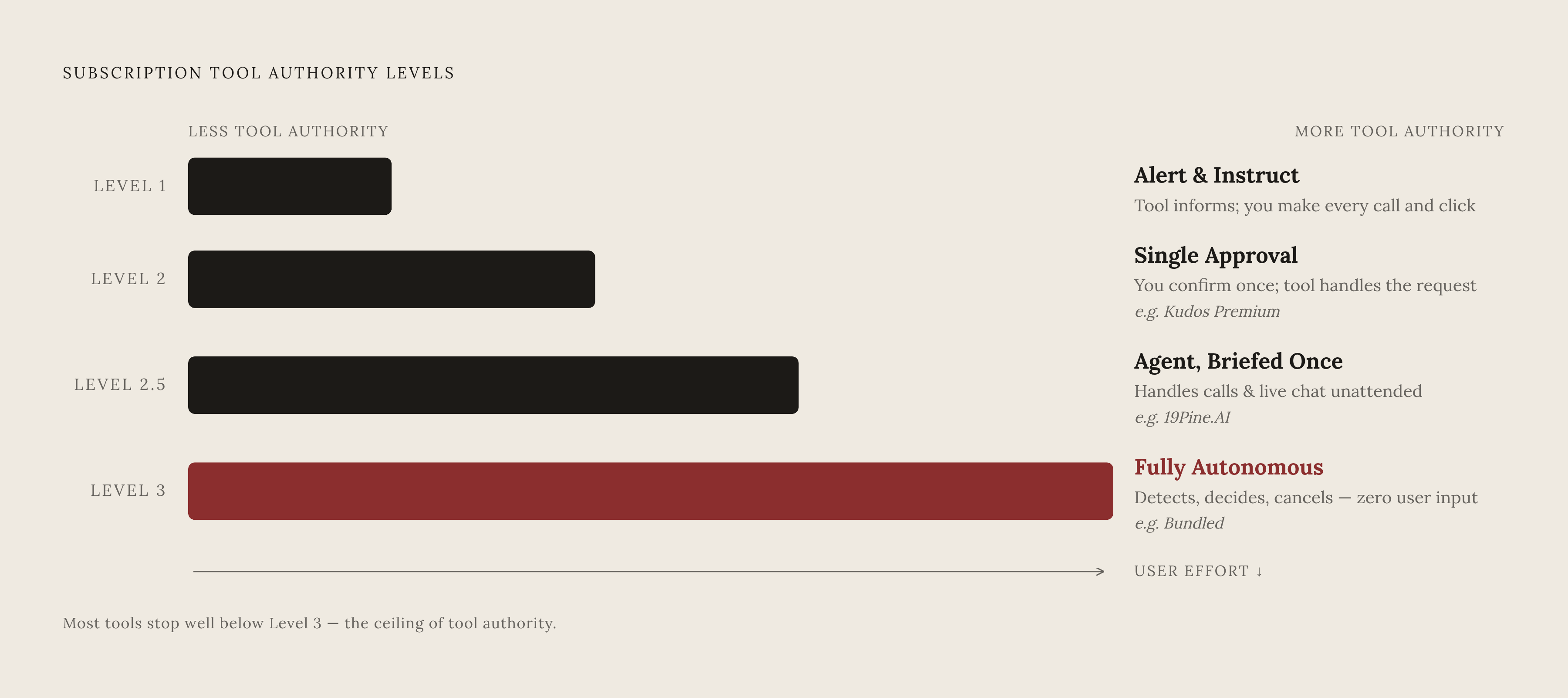
Level 1 is alert and instruct. The tool tells you a subscription exists and provides cancellation instructions, while you make the calls and clicks. This suits readers who want help noticing charges but prefer to control the whole cancellation process. It removes some detective work without taking over the account interaction. Its limit is that a finding still needs your effort before billing stops.
Level 2 is cancellation through the tool after a single approval. You confirm the decision, and the tool handles the request through its own interface. A related option, Level 2.5, is an agent you brief once about a particular cancellation problem. It can handle phone calls and live chat without requiring you to stay involved, although you still initiate the assignment.
Level 3 is fully autonomous action after setup. The tool detects a qualifying subscription, applies the decision rule, and initiates cancellation without a separate request. That suits someone comfortable delegating the decision within agreed settings. Higher autonomy requires more account access and trust, while lower autonomy leaves more work with the user.
How the main tools compare on detection depth and cancellation autonomy
Compass+ is the recommended starting point for readers who want proactive monitoring. Built by the team behind Gerald, it connects to bank accounts through read-only Plaid access, plus email, calendar, and Amazon + shopping. It finds recurring charges, unused subscriptions, trials about to convert, and duplicate charges on its own, without the user having to provide a list. Each finding carries a specific dollar amount and a clear next action, making the assignment concrete and saving the user research. Its action model is proactive findings because its account access is read-only.
Bundled takes the fully autonomous route for subscriptions specifically. Bundled’s AI Auto Cancellations, unveiled June 29, 2026, monitors members’ usage patterns in real time and initiates cancellation when use falls below the member’s threshold. The feature is active by default, and members can configure that threshold through their dashboard. A notification confirms the cancellation afterward, with no login, request, or click required to start each one. This is Level 3, for readers who want zero-click cancellation and are happy for the tool to act without asking them to approve each cancellation.
19Pine.AI provides an agent on demand and leaves it to the user to find the subscription. The user describes a problem once, and its agent contacts the business through phone, email, chat, or website navigation. It handles waiting, navigation, and negotiation, including hold times and retention scripts. That places it at Level 2.5 because the work is delegated after the user starts the task. It suits someone who already knows which service must go and wants someone else to handle a difficult cancellation.
Kudos combines passive transaction detection with a personal approval step. It connects through Plaid and uses AI-powered pattern recognition to find recurring charges across the payment methods the user has linked. Premium members authorize cancellation with a single tap, after which its agents log into merchant portals, send cancellation emails, and engage live chat support. Most web-based cancellations complete in seconds to minutes. This is Level 2, suited to readers who want discovery and execution handled for them while retaining the final decision.
Bobby and Subby offer manual tracking without a bank connection or automatic detection. Bobby is available on iOS only and uses one-time in-app purchase packs to unlock its full feature set. Subby is available on Android and iOS, with a one-time PRO purchase. Both suit readers willing to enter their subscriptions in exchange for keeping accounts disconnected.
What free-trial tracking requires that subscription lists miss
A free trial is a deadline problem before it is a payment problem. It starts at zero dollars and converts on a specific date, often within days to a few weeks. A transaction scanner sees the first payment after it posts, when the chance to cancel without paying has already passed.
To find a trial before it charges, a tool needs clues such as confirmation emails or details in a calendar. Compass+ connects to email and calendar as well as bank accounts, allowing it to surface a trial deadline before the charge. A forgotten 7-day trial can become months of payments when the first charge goes unnoticed.
Why connecting your accounts is less risky than leaving subscriptions unmonitored
Connecting an account creates a data-sharing relationship, so the security concern deserves more than a blanket reassurance. The important distinction is between visibility and control. With read-only transaction access, a tool cannot move money, start a charge, or take any other financial action. Compass+ operates exclusively in read-only mode, which limits what its account access permits. That reduces the risk of granting financial control, but it does not make sharing data risk-free.
The connection method also matters. Plaid’s official support page identifies Chase, Bank of America, Wells Fargo, and Citi among major institutions that use OAuth. With this method, credentials are entered directly on the bank’s site and never pass through Plaid’s systems. At smaller institutions where OAuth is not standard, credentials may pass through a third-party system instead. Readers who use smaller banks or credit unions should check whether their bank or credit union supports OAuth before they connect.
Access can also outlast the app you chose. Active Plaid connections stay in place after an app is deleted, so deleting a tool that is no longer used may still leave it able to receive data. Plaid’s dashboard allows users to review and revoke those connections. These controls make the decision more specific than choosing between trust and fear. Read-only monitoring limits financial authority while addressing unnoticed charges, but the balance still depends on the connection method and the access being granted.
How to choose the right tool based on how much you want it to do
The choice turns on two things, namely what the tool can detect and how much authority you want to delegate. For passive monitoring across subscriptions, trials, price drops, refunds, and delivery credits, Compass+ fits readers who want findings delivered as ready-to-act assignments. Its read-only design keeps monitoring separate from control. That is the relevant match when the problem is not just cancelling a known service, but discovering money loss across accounts. Receiving a clear next action should not be confused with having that action completed automatically.
Bundled suits readers who are happy for it to decide what to cancel based on use after setup, without waiting to be asked each time. For automatic discovery with approval before execution, Kudos Premium fits readers who want to keep the decision point. For a known, difficult cancellation, 19Pine.AI fits readers who want to delegate the calls and follow-through. Each removes a different part of the work, so the useful comparison is which task you no longer have to do.
Bobby or Subby suits readers who want to keep accounts disconnected and are willing to enter subscriptions and use payment notifications. Manual control is a valid preference, but it does not solve passive discovery by itself. Before choosing, ask whether the tool finds what you do not know about or only organizes what you already know.