Utility Bill Surcharges Consumers Can Challenge
Many utility surcharges have established dispute paths most customers never use.
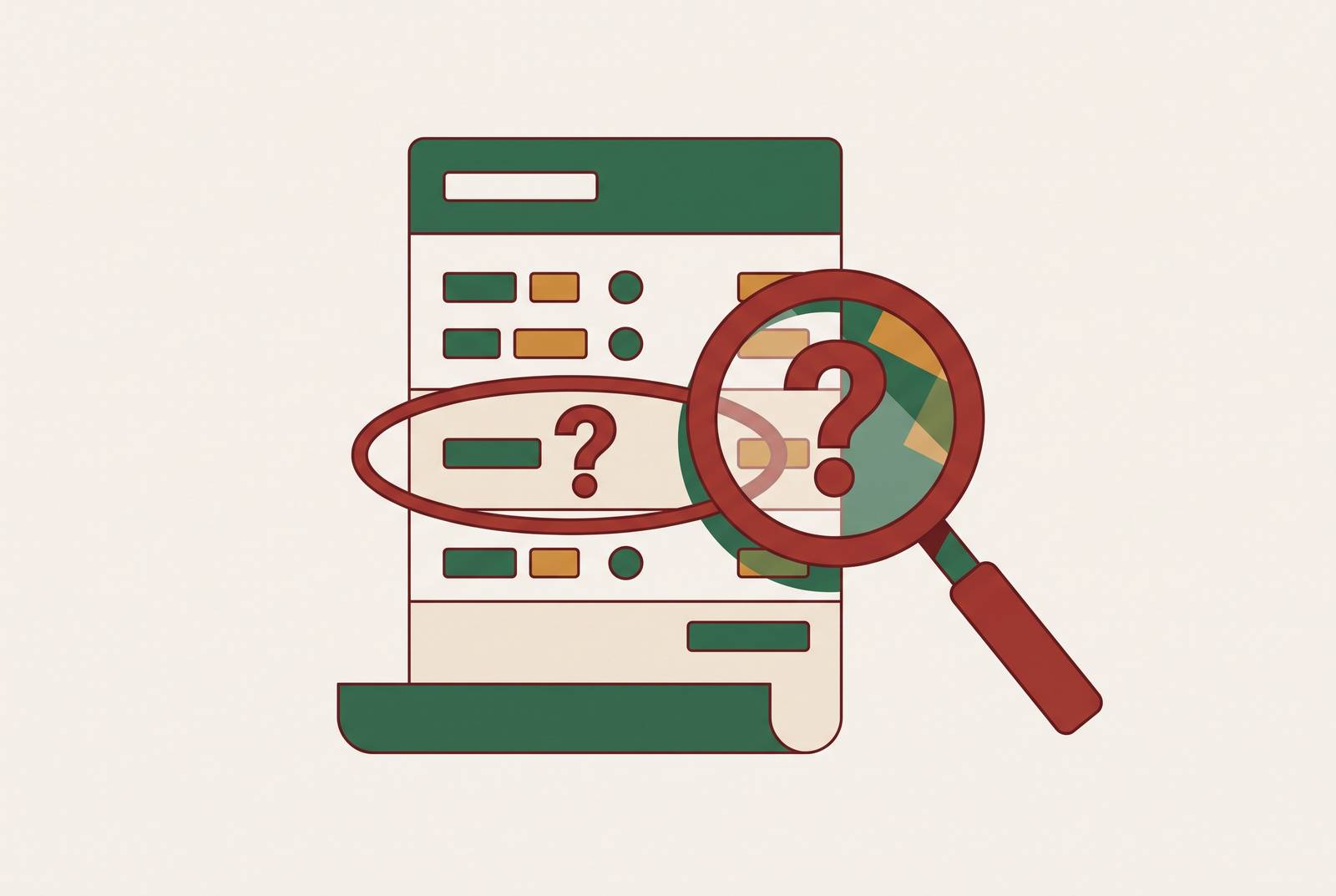
Utility bills were once simple enough to check in a minute: usage, rate, total. That changed. Today a single statement carries dozens of line items, each tied to a different program, project, or regulatory order, and a meaningful share of those charges have established paths for dispute that most customers never use.
Why utility bills have become harder to read and easier to overpay
Three converging forces rewrote utility billing in the 2025 to 2026 cycle. Smart meter rollouts added precision but also created new categories of dispute around time-of-use calculations and real-time data discrepancies. Infrastructure investment cycles pushed new capital costs onto bills, each as a separate line item. The shift to digital payments generated its own set of fees. Each of these forces produced new charges, and each charge got its own line.
That is the core mechanism. Every new regulatory program or capital project receives its own surcharge column, so the bill grows longer while individual lines shrink in size and explainability. A consumer must now parse a dozen or more entries, many labeled in terms that mean nothing without a rate case docket nearby. The Michigan Public Service Commission authorized a general electric rate increase for Consumers Energy Company effective May 1, 2026, under MPSC Order in Case No. U-21870. A customer seeing that line item for the first time has no obvious way to verify whether it belongs there.
The invisibility is structural, not accidental. The legislative findings of NY Assembly Bill A9426 state plainly that opaque fee structures and inadequate regulatory scrutiny contribute to unjustified costs. The problem they describe is the one a customer faces when they open a modern utility statement and cannot tell which charges pay for power and which pay for policy decisions made years earlier.
Inertia does the rest. Most consumers assume a printed line item on a regulated utility bill has already been approved and is therefore non-negotiable. That assumption holds for base rates and some mandated charges. It is wrong for a meaningful subset of what appears on the bill. Complexity creates the condition where overpayment becomes possible. The assumption that everything is fixed turns that possibility into a quiet, recurring cost.
Duplicate charges and unauthorized third-party charges are among the easiest to dispute precisely because they are unambiguous. A charge should not appear twice for the same service period. An AI agent watching for recurring and unusual charges, the approach Compass takes with read-only account monitoring, can flag duplicates and overages before they stack up across multiple billing cycles.
Which surcharges are actually contestable and why
Contestable does not mean the consumer always wins. It means an established process exists to examine the charge, with defined rules about evidence, timing, and remedy. Several well-defined categories carry explicit consumer rights backed by state PUC regulation and, in some cases, federal law.
Back-billing adjustments sit at the top of the list. Charges for past services that exceed the regulatory lookback window are impermissible. In New York, under Section 11.14, Title 16 of the N.Y. Comp. Codes R. & Regs., a utility generally cannot back-bill a residential customer for services rendered more than six months before the customer received their first bill at that address. If a permissible back-bill exceeds a defined dollar threshold, the utility must notify the customer in writing and offer installment repayment. Failing to do so is itself a violation.
Estimated-billing overcharges form a second category. Utilities may estimate usage, but the estimates must be based on historical consumption patterns. Systematic overestimates that produce a large catch-up bill are a recognized billing error category. Every state with PUC oversight gives customers the right to request an actual meter read and to have charges reconciled against it.
Meter accuracy disputes are a third category. Every state with PUC oversight allows a customer to request a meter test. If testing shows the meter ran fast, the customer is entitled to a refund, typically covering several months of overbilling and sometimes longer when the error's start date can be proven. Customers generally have the right to request an independent testing facility and to witness the test.
Misclassified rate codes are simpler. A residential account billed at commercial rates, or the reverse, is a billing error with a clear correction path. Identifying it requires only comparing the rate class on the bill with the actual use of the property. Duplicate charges and unauthorized third-party charges, also called cramming, sit in their own category. Double-billing for the same service period and third-party charges added without consent are enumerated violations under state PUC rules and, at the federal level, under the Fair Credit Billing Act.
A final category covers add-on surcharges that lack individual regulatory justification. NY A9426, currently in the Assembly Energy Committee as of January 2026, would require all transmission charges, delivery fees, and add-on surcharges to be individually justified. It is not yet law, but its existence signals that regulators in active states treat these charges as contestable in principle.
What is not contestable matters as much as what is. Base rates set through a completed rate case, federally mandated reliability charges, and properly authorized and disclosed state-program surcharges cannot be refused unilaterally. The line between contestable and non-contestable runs through whether an established review process exists for that charge category.
One structural distinction deserves attention here. Investor-owned utilities fall under PUC regulation, which is where most of these rights live. Municipal utility customers may not have PUC access at all. Their escalation path often runs through city government or a local ombudsman. The rights are real, but their availability depends on who actually provides the power.
How to read a bill well enough to know what to challenge
A disputable charge almost always shows up through comparison, not through the bill alone. Pull several months of prior statements and compare billing period length, meter readings, rate applied, and each fee line. A bill covering a longer period will look far more expensive than a shorter one even when daily usage is unchanged. That difference is an artifact, not an error, and recognizing it saves a wasted dispute.
Check whether the meter reading is marked actual or estimated. An estimated read followed by a large catch-up charge is a common trigger for legitimate disputes. The estimate itself may be fine, but any systematic overstatement, especially when it produces a jump from prior months, deserves scrutiny.
Look for the three signs that a line item is worth questioning: charges that did not appear on previous bills, charges without a plain-language description, and fees listed with a docket or case number. Each new regulatory surcharge should cite its authorizing order. A line item that cites no authority at all is worth questioning for that reason alone.
Write the problem down in one precise sentence before calling. "The bill lists X kilowatt-hours, but the meter reading shown is lower than the prior statement's ending read" is actionable. "This bill is too high" is not. A well-framed dispute moves faster and gets taken more seriously than a vague complaint. The savings arrives later.
How to dispute a utility bill, step by step, from first call to PUC complaint
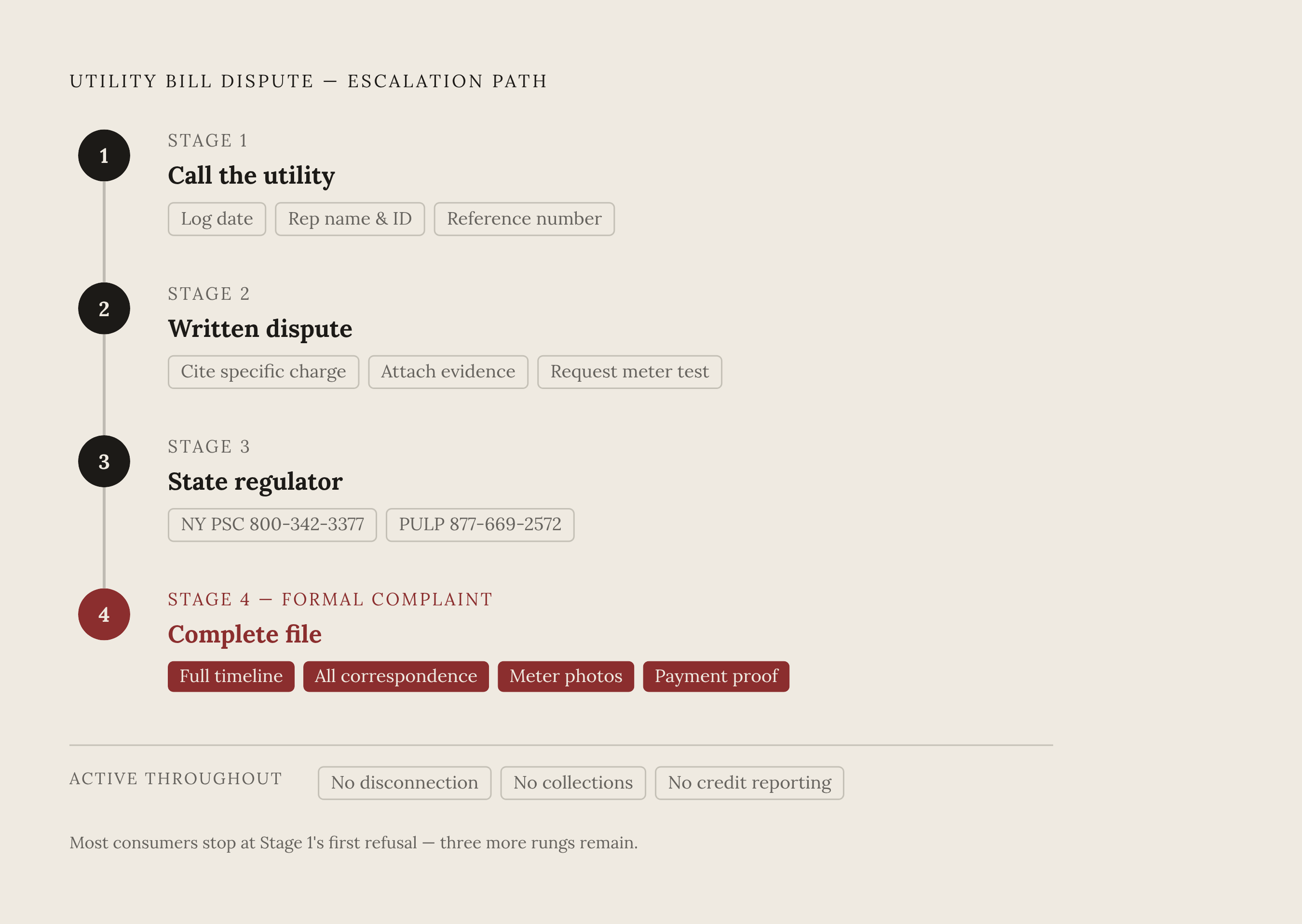
A utility dispute follows a predictable path. Knowing the full ladder in advance prevents stopping at the first no. Stage one is a call to the utility. Ask the representative to explain usage, meter readings, rate classifications, and the basis for each disputed fee. Log the date, the representative's name or ID, and any complaint reference number. That record becomes the foundation of every later step. The answer varies by utility and by charge type, and it changes what you do next.
Stage two is putting the dispute in writing. A written dispute through the utility's official channel creates a paper trail that phone calls do not. Include the specific charge or reading at issue, why it appears incorrect, the supporting evidence, and the specific resolution requested. If meter accuracy is in question, request a meter test in writing. Most states require the utility to complete testing within a set timeframe and provide written results.
Stage three is escalation to the state PUC or Public Service Commission. In New York, the PSC helpline is 800-342-3377. The Public Utility Law Project of New York, at 877-669-2572, assists low-income residential customers specifically.
The Texas example shows how process changes work in practice. As of October 21, 2026, the PUCT replaced its formal complaint process against retail electric providers with a Streamlined Complaint Process under amendments to 16 TAC §25.485 in Project No. 59557. Key protections survive: providers cannot disconnect over a disputed charge while a complaint is pending, cannot send the disputed amount to collections, and cannot report it to a credit bureau.
Paying does not forfeit dispute rights. Shutoff protections operate in parallel. Most states prohibit disconnection while a dispute is pending and require advance written notice before any shutoff. Medical certification can extend protection further in most states.
Bring a complete file to a PUC complaint: the disputed bill, all prior communication with the utility, the company's response, supporting evidence such as meter photos and prior statements and payment confirmations, and the specific resolution requested. A clean timeline dramatically improves review speed. The agency sees thousands of complaints. The one that reads as a sequence of dated events with supporting documents gets processed faster.
Municipal utility customers need a different path. The same written record matters. Only the door changes.
What larger legislative activity signals about which surcharges regulators already view as suspect
Pending and recent legislative action in multiple states shows that regulators and lawmakers already treat a category of surcharges as institutionally problematic. That fact strengthens the individual consumer's position when challenging them. NY Assembly Bill A9426, introduced December 19, 2025 by M. of A. Cashman and currently in the Assembly Energy Committee, would require every transmission charge, delivery fee, and add-on surcharge to be individually justified and subject to the same requirements under that paragraph as base rates. The exception is narrow: charges tied to federally mandated reliability requirements. The bill has a Senate companion, S8915, and multiple co-sponsors across both parties. It is a live legislative effort, not a symbolic gesture, though it remains in committee as of the most recent data.
The penalties tell you how seriously lawmakers take the problem. The bill proposes civil penalties up to three times the amount improperly collected, plus mandatory refund or rate credit to customers. A penalty structure built around a multiplier of collected revenue signals that legislators view the current opacity as a source of material overcharging, not minor rounding errors.
Opaque fee structures and inadequate regulatory scrutiny, the findings state, contribute to unjustified costs for working families, seniors, and small businesses. A legislature wrote this diagnosis into the record. That is not an advocacy group's claim. It is the finding of a legislative body.
California shows the broader direction. The state has already made itemized disclosure of state-mandated charges mandatory. New York's A9426 would go further: capping and justifying each surcharge. The direction of regulatory travel is toward more transparency and more consumer recourse, not less.
For consumers today, the practical implication is direct. Surcharges that would fail the A9426 justification test are already the right targets for a PUC inquiry, even before the bill passes. The bill does not create the argument for scrutiny. It confirms that regulators and legislators already accept it.
Why catching overcharges requires ongoing attention, not a one-time audit
Utility surcharges are not static. Rates adjust on billing cycles consumers rarely track. A one-time audit catches what is wrong on the day you run it, and misses everything that appears the day after.
The Michigan Demand Response surcharge illustrates the point. A charge that was updated and revised from a prior surcharge appeared in a new form in May 2026 with full regulatory backing. The new line item would have arrived unnoticed.
Back-billing rules create a specific vigilance window. Utilities can reach back up to 24 months in some circumstances. The time to keep records is before the error appears, not after.
Texas billing complaints show how often discovery happens too late. Billing complaints were the largest complaint category at the PUCT in the April to September 2026 period, making up nearly half of all complaints against retail electric providers. The volume reflects consumers discovering problems after the fact rather than catching them early.
The same structural problem applies beyond utilities. Line-item proliferation, infrequent billing, and opaque descriptions allow subscription fees, price changes on recurring charges, and other bill categories to drift upward silently. The vigilance gap is not utility-specific, which makes ongoing monitoring the right answer across standing charges.
Compass is built for exactly this kind of ongoing attention. It connects to accounts in read-only mode and surfaces specific findings as named dollar amounts with a clear next action: an unexpected new charge, a bill that has quietly increased, a refund that was promised but never posted. Specificity addresses the other problem, which is knowing what to do with a suspicious charge once it appears.
You can check a bill once and fix what you find. The gap between knowing your rights and exercising them is time, and the window closes without warning. Ongoing attention closes that gap.