Subscription Apps That Go Beyond Tracking to Actually Cancel for You
These AI apps do the hard part: actually canceling subscriptions for you.
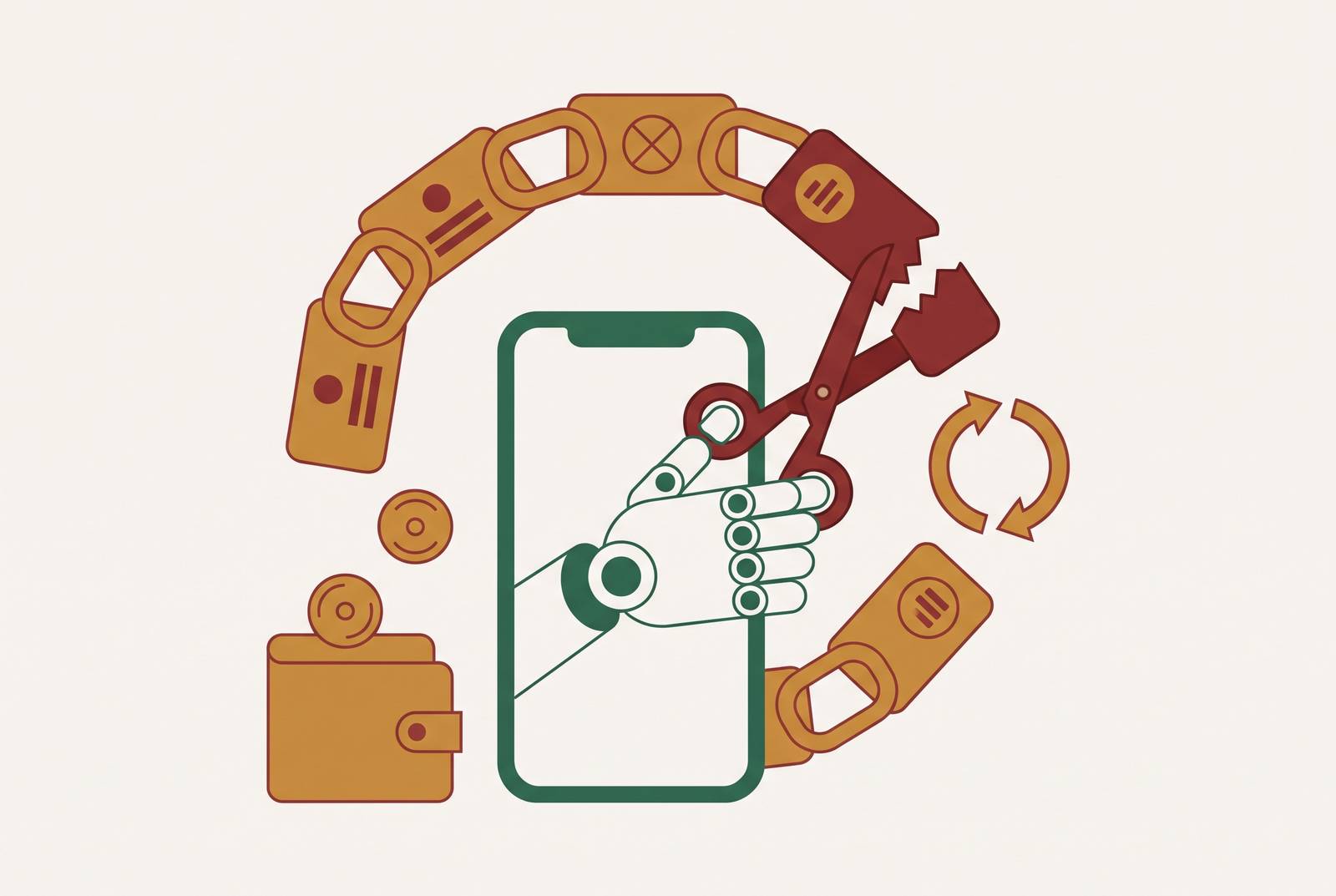
An app to cancel subscriptions needs to do more than find recurring charges. Kudos Premium executes web-based cancellations through merchant portals, email, and chat, while Pine AI handles customer-service calls and ScribeUp offers cancellation through banking apps. Bank-connected trackers help uncover forgotten payments, but discovery is not cancellation, and no single tool covers every service or removes the need for ongoing monitoring.
Why subscription businesses are structurally built on the gap between knowing and canceling
The subscription economy is designed to profit from the gap between agreeing to pay and deciding to stop. Automatic renewal keeps money coming in without the customer choosing to buy again, while cancellation friction makes leaving harder than staying. That friction is built into the process. Multi-step confirmation screens, mandatory surveys, timeout resets, and phone-only requirements all put work between the decision to cancel and the end of billing. A customer can understand the charge perfectly and still keep paying because the exit takes time and attention.
A credit monitoring or streaming subscription produces no package at the door to remind the customer that it exists. Auto-pay takes away another reminder because charges go through without the customer having to approve them. Consumers quietly and repeatedly spend on services they may no longer use, underestimating their total monthly subscription costs. This is not simply a failure to budget. A visibility tool can expose the spending, but it does not change the steps a merchant requires before billing stops.
What "tracking" actually means and where it stops
Tracking usually means connecting a bank account or card feed, identifying recurring charges, and displaying them in a dashboard or list. That solves a real problem for someone whose subscriptions are scattered across payments they rarely review together. A tracker can bring forgotten services back into view and surface price changes without requiring manual entry. Visibility is useful in its own right. It gives the user a basis for deciding which services still earn their place in the budget.
Not every tracker discovers subscriptions automatically, though. Manual tools depend on the user entering each service, its cost, and the details needed for reminders. They avoid a bank connection, but their inventory is only as complete as the information entered. Neither approach necessarily includes cancellation. A list of recurring charges, even one paired with instructions, remains a record of what the user needs to handle.
Someone still has to find the cancellation page, move through retention screens, and verify that the charge stopped. A human concierge can take on that work, but relying on people behind the scenes limits scale and cost-effectiveness. Tracking software avoids the cost of doing that work because it stops before the hard part. The user is still the agent of action.
The technical barriers that kept automation at the tracking tier for so long
Finding a recurring charge is a different technical job from ending the agreement behind it. Each subscription service has its own cancellation route, so a single script cannot work across them all. One service may use a settings page, while another requires contact with customer support. There is no shared cancellation path to follow.
Even within a website, the route can change as the customer moves through it. Retention screens can introduce a discount or pause option before allowing cancellation to continue. A mechanical system following fixed instructions cannot judge whether that offer fits the user's goal. The distinction is important because “stop paying” and “find a cheaper plan” are different requests.
Two-factor authentication, CAPTCHAs, and security questions are meant to establish that an authorized person is present, which complicates unattended automation. Phone-only requirements move the process outside a browser altogether, into hold queues and conversations. Those barriers were genuinely hard to automate reliably. As a result, tools offering cancellation commonly covered a narrow set of major services or depended on human staff to complete the work.
How agentic AI clears those barriers and what it can actually execute today
Agentic AI narrows the gap by interpreting the steps in front of it, allowing it to move beyond a fixed sequence. In a browser, an agent can reason about what is on the page instead of relying only on fixed element selectors, which conventional automation uses to find buttons and fields. That makes it more resilient when a cancellation screen changes. The benefit extends beyond clicking through pages. Agents can find cancellation policies and the page or phone number needed to cancel, then pull out deadlines and steps to follow, including terms for annual contracts and early termination fees.
Kudos Premium acts as an authorized representative, logging into merchant portals, sending cancellation emails, and engaging live chat. Most of its web-based cancellations complete in seconds to minutes. Pine AI instead places customer-service calls, waits on hold, handles the conversation, and provides a transcript and summary. It handles cancellations that need phone calls or certified letters. ScribeUp puts cancellation inside banking apps, rather than offering the same standalone route as either of those services.
Disputed charges, refund demands outside policy, and conflicts with merchants still require human judgment or fall outside automation. An agent can ask for a refund without being able to settle every disagreement about it. App-store subscriptions also typically require the user to cancel in device settings. These limits on what “cancel for you” promises matter when choosing a tool.
What app can find and cancel subscriptions? The five categories compared
Capability provides a useful basis for comparing tools. Some tools minimize data sharing, some remove manual discovery, and others take over the cancellation itself. A phone agent cannot keep an ongoing list of subscriptions, and even a detailed list cannot sit on hold. The five categories separate those jobs so that a cancellation claim can be judged against the work actually included.
Tier 1 is manual tracking, represented by Bobby and Subby. Both have users type in their subscriptions instead of connecting to a bank and let them set their own reminders. Bobby is iOS only, with a free version and a one-time fee for the full version. Subby is available on Android and iOS, with a free, ad-supported version and a one-time payment for Pro. This tier suits users who want to avoid sharing bank data and retain full control, but it leaves both inventory upkeep and cancellation to them. A forgotten entry remains a blind spot.
Tier 2 is bank-connected discovery, which automatically identifies recurring charges from connected bank or card feeds. It removes the need to remember every new subscription and can surface forgotten payments and price changes. Coverage still depends on biller recognition, with major services more reliably detected than obscure ones. Some tools provide cancellation instructions, but the user executes them. This tier is strongest for users who need information and have the willingness and time to act.
Tier 3 is in-app cancellation with limited automation, covering services the tool has already integrated. For a subscription the tool supports, users may be able to cancel with one tap or within the app, without having to find the merchant's way out. Unsupported services revert to instructions or user action. Coverage is the deciding feature at this tier. The presence of a cancellation button is less informative than whether that button works for the subscriptions the user actually has.
Tier 4 is an AI authorized representative, with Kudos Premium handling merchant portals, cancellation emails, and live chat. Unlike a tool confined to a set of pre-integrated cancellation routes, this approach acts across web-based channels on the user's behalf. It comes with a 90-day savings guarantee, but there are still limits on where it can cancel. App-store subscriptions still need the user to take action on the device. This tier removes more of the web cancellation workload without turning every recurring payment into an automatically cancelable service.
Tier 5 is voice AI execution, represented by Pine. It targets calls, certified-letter requirements, and scripted negotiations, and also handles bill negotiation, refund requests, and complaint filing. It provides execution on a task-by-task basis. Available on iOS, Android, and the web, it uses a freemium model with subscription plans including Pro and Premium, higher tiers, and task-based pricing. The trade-off is that task costs scale with use, so its ability to tackle difficult exits is distinct from the value of continuous monitoring.
What the connection security question actually looks like and why read-only matters
Security depends on the permissions an app receives when it connects to a bank. A read-only connection lets a tool see transaction data without allowing it to initiate payments, transfers, or other account actions. That separates access to information from control over funds. If that connection is compromised, the direct risk is exposure of transaction data.
Plaid is the connection provider used by most subscription management tools, and its connections are read-only by default in this context. For major U.S. banks, its OAuth flow sends users to the bank's own website to enter credentials, so those credentials stay out of Plaid's systems. That is stronger than handing over bank login details. It does not, however, answer what the subscription app retains after receiving transaction information.
The practical questions to ask a tool are whether its connection is read-only, whether it uses OAuth where available, and which data it stores and which it merely passes through. Those questions also distinguish bank discovery from authority to act in a merchant portal. They are different kinds of access. Connecting email, calendars, Amazon, or other subscription accounts can show details that a single bank feed misses and help find more specific ways to save. That added usefulness deserves a concrete explanation of access and storage.
How to pick the right tier for your actual situation
The practical choice starts with where the work stalls. If the difficulty is remembering what exists, bank-connected discovery addresses that gap without requiring each subscription to be logged by hand. If avoiding bank-data sharing is the priority and manual upkeep is realistic, Bobby or Subby fits that narrower job. The fit depends on whether the missing ingredient is information, attention, or someone to complete the cancellation.
If the list is already clear but nothing gets canceled, another dashboard does not remove the obstacle. An executing agent such as Kudos Premium, or ScribeUp through a banking app, addresses the action barrier instead. When canceling takes a customer-service call, Pine can make that call. Coverage must match the unwanted services. With App-store billing, disagreements with merchants, and requests for refunds outside policy, users should still expect to do some of the work themselves.
Free trials need action before a new charge starts. A tool that watches trial expiration dates and flags them before conversion provides practical protection without relying on uncertain enforcement. The FTC's March 2026 Advance Notice of Proposed Rulemaking began a process that may eventually address digital subscription practices. As of October 2026, no proposed rule with specific refund window requirements had been published. A possible future refund right is not a substitute for a timely reminder.
Finally, a one-time cleanup does not address ongoing subscription sprawl. New services, renewals, and price changes create a continuing need for monitoring, even after old charges are removed. Most users have more than one gap. Does it merely show the unwanted charge, or can it perform the cancellation that stands between the user and the savings?